
Pulp Fiction, 1922 · page 121 of 187
Argosy All-Story Weekly — page 121: what you’re looking at
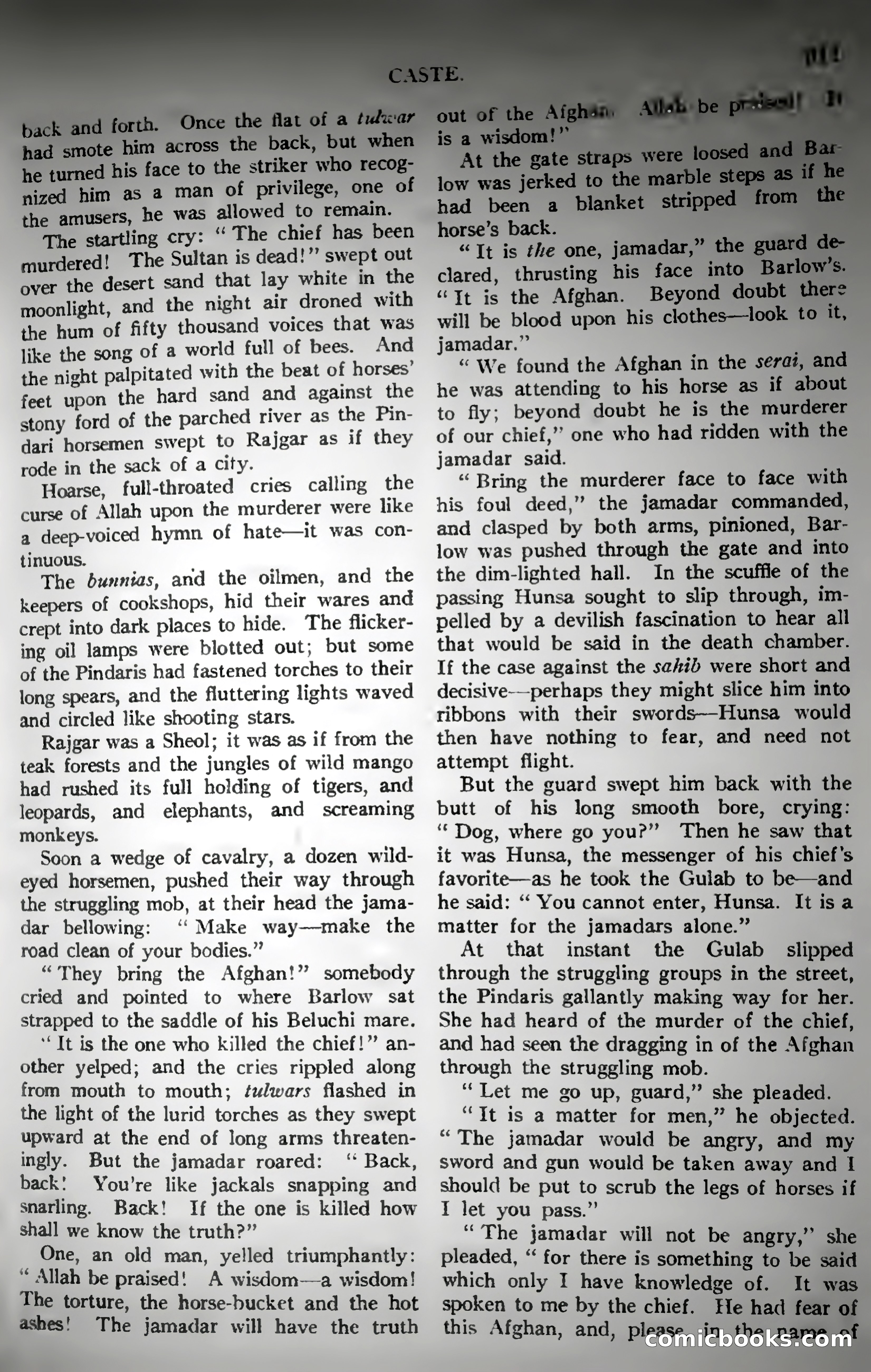
A restored page from Pulp Fiction, 1922. Page through the whole issue in the reader above.
📄 Transcribed text from this page (OCR, searchable)
Machine-transcribed from the original scan — historical spelling and the odd misread are preserved.
he turned his face to the striker who recog- nized him as a man of privilege, one of the amusers, he was allowed to remain. The startling cry: ‘‘ The chief has been murdered! The Sultan is dead! ’” swept out over the desert sand that lay white in the moonlight, and the night air droned with the hum of fifty thousand voices that was like the song of a world full of bees. And the night palpitated with the beat of horses’ feet upon the hard sand and against the stony ford of the parched river as the Pin- dari horsemen swept to Rajgar as if they rode in the sack of a city. Hoarse, full-throated cries calling the curse of Allah upon the murderer were like a deep-voiced hymn of hate—it was con- tinuous. The bunnias, and the oilmen, and the keepers of cookshops, hid their wares and crept into dark places to hide. The flicker- ing oil lamps were blotted out; but some of the Pindaris had fastened torches to their long spears, and the fluttering lights waved and circled like shooting stars. Rajgar was a Sheol; it was as if from the teak forests and the jungles of wild mango had rushed its full holding of tigers, and leopards, and elephants, and screaming monkeys. Soon a wedge of cavalry, a dozen wild- eyed horsemen, pushed their way through the struggling mob, at their head the jama- dar bellowing: ‘‘ Make way——make the road clean of your bodies.” “They bring the Afghan!” somebody cried and pointed to where Barlow sat strapped to the saddle of his Beluchi mare. ‘It is the one who killed the chief!” an- other yelped; and the cries rippled along from mouth to mouth; ¢tulwars flashed in the light of the lurid torches as they swept upward at the end of long arms threaten- ingly. But the jamadar roared: ‘ Back, back! You're like jackals snapping and snarling. Back! If the one is killed how shall we know the truth?” One, an old man, yelled triumphantly: ‘ Allah be praised! A wisdom—a wisdom! The torture, the horse-bucket and the hot ashes! The jamadar will have the truth low was jerked t had been a blanket s horse’s back. ee. “Tt is the one, jamadar, the § clared, thrusting his face into I “Jt is the Afghan. Beyond doubt will be blood upon his clothes—look to © jamadar.” a ‘“ We found the Afghan in the seraz, and — he was attending to his horse as if about to fly; beyond doubt he is the murderer of our chief,” one who had ridden with the jamadar said. “Bring the murderer face to face with his foul deed,” the jamadar commanded, and clasped by both arms, pinioned, Bar- low was pushed through the gate and into the dim-lighted hall. In the scuffle of the passing Hunsa sought to slip through, im- pelled by a devilish fascination to hear all that would be said in the death chamber. If the case against the sahib were short and decisive-—perhaps they might slice him into ribbons with their swords—Hunsa would then have nothing to fear, and need not attempt flight. But the guard swept him back with the butt of his long smooth bore, crying: ‘‘ Dog, where go your” ‘Then he saw that it was Hunsa, the messenger of his chief's favorite—as he took the Gulab to be—and he said: ‘‘ You cannot enter, Hunsa. It is a matter for the jamadars alone.” At that instant the Gulab slipped through the struggling groups in the street, the Pindaris gallantly making way for her. She had heard of the murder of the chief, and had seen the dragging in of the Afghan through the struggling mob. ‘“Let me go up, guard,” she pleaded. ‘Tt is a matter for men,” he objected. “The jamadar would be angry, and my sword and gun would be taken away and I should be put to scrub the legs of horses if I let you pass.”’ “The jamadar will not be angry,’ she pleaded, “‘ for there is something to be said which only I have knowledge of. It was spoken to me by the chief. He had fear this Afghan, and, eomicbooks,