
Pulp Fiction, 1922 · page 117 of 187
Argosy All-Story Weekly — page 117: what you’re looking at
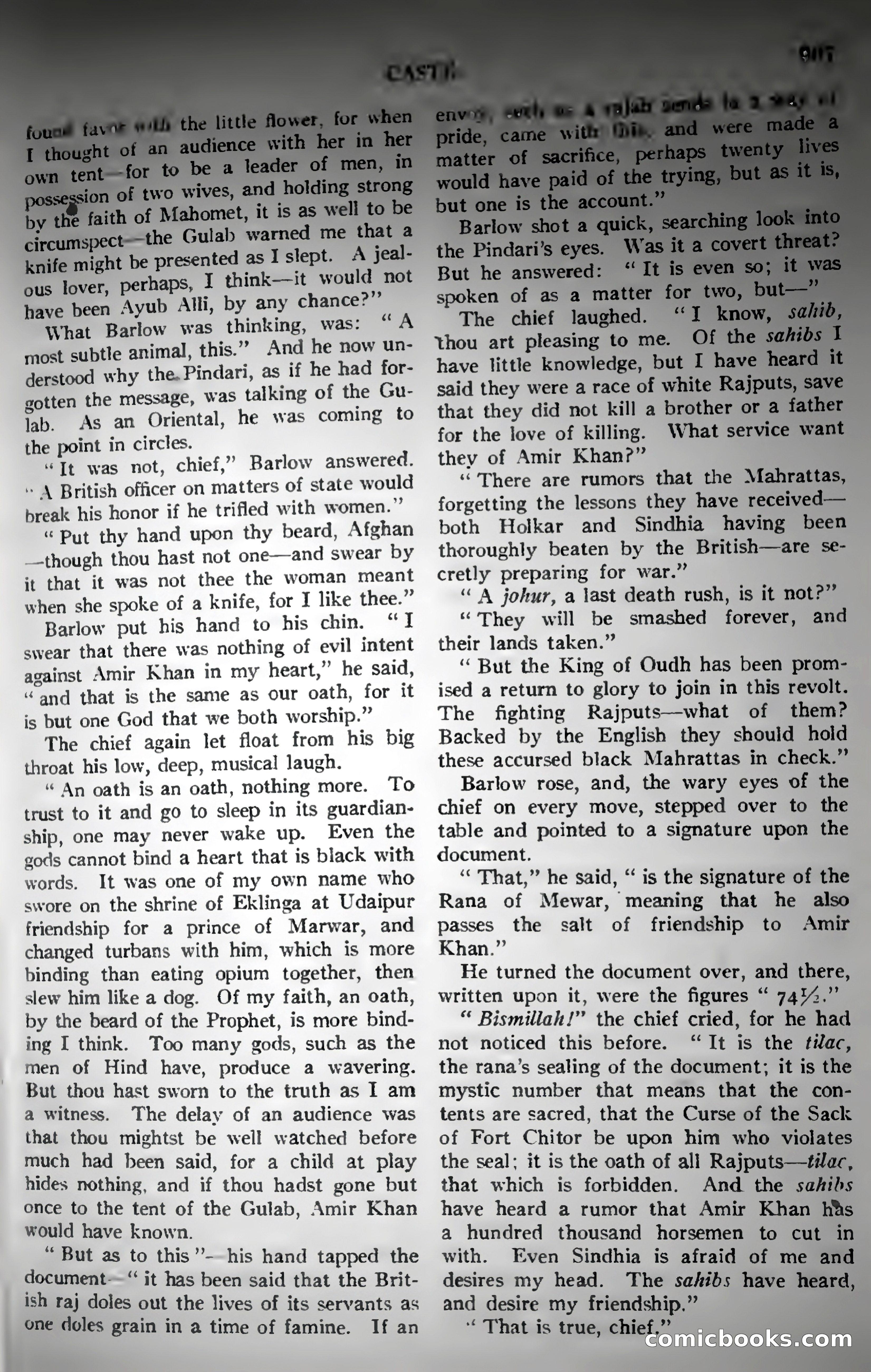
A restored page from Pulp Fiction, 1922. Page through the whole issue in the reader above.
📄 Transcribed text from this page (OCR, searchable)
Machine-transcribed from the original scan — historical spelling and the odd misread are preserved.
. yt ‘two wives, and holding strong hy the faith of Mahomet, it is as circumspect-—the Gulab warned me that a knife might be presented as I slept. A jeal- ous lover, perhaps, I think—it would not have been Ayub Alli, by any chance?” What Barlow was thinking, was: “A most subtle animal, this.” And he now un- derstood why the. Pindari, as if he had for- gotten the message, was talking of the Gu- lab. As an Oriental, he was coming to the point in circles. “It was not, chief,” Barlow answered. \ British officer on matters of state would break his honor if he trifled with women.” “ Put thy hand upon thy beard, Afghan —though thou hast not one—and swear by it that it was not thee the woman meant when she spoke of a knife, for I like thee.” Barlow put his hand to his ciin. “2 swear that there was nothing of evil intent against Amir Khan in my heart,” he said, “and that is the same as our oath, for it is but one God that we both worship.” The chief again let float from his big throat his low, deep, musical laugh. “ An oath is an oath, nothing more. To trust to it and go to sleep in its guardian- ship, one may never wake up. Even the gods cannot bind a heart that is black with words, It was one of my own name who swore on the shrine of Eklinga at Udaipur friendship for a prince of Marwar, and changed turbans with him, which is more binding than eating opium together, then slew him like a dog. Of my faith, an oath, by the beard of the Prophet, is more bind- ing I think. Too many gods, such as the men of Hind have, produce a wavering. But thou hast sworn to the truth as I am a witness. The delay of an audience was that thou mightst be well watched before much had been said, for a child at play hides nothing, and if thou hadst gone but once to the tent of the Gulab, Amir Khan would have known. “ But as to this’’--his hand tapped the document. “it has been said that the Brit- ish raj doles out the lives of its servants as one doles grain in a time of famine. If an ‘ell to be bt the Pindari’s eyes. But he answered: “I spoken of as a matter for The chief laughed. “I thou art pleasing to me. Of the s have little knowledge, but I have hea said they were a race of white Rajputs, sav that they did not kill a brother or a father for the love of killing. What service want — they of Amir Khane” “There are rumors that the Mahrattas, forgetting the lessons they have received— both Holkar and Sindhia having been thoroughly beaten by the British—are se- cretly preparing for war.” ‘A johur, a last death rush, is it not?” “They will be smashed forever, and their lands taken.” “ But the King of Oudh has been prom- ised a return to glory to join in this revolt. The fighting Rajputs—what of them? Backed by the English they should hold these accursed black Mahrattas in check.” Barlow rose, and, the wary eyes of the chief on every move, stepped over to the table and pointed to a signature upon the document. ‘““ That,” he said, “‘ is the signature of the Rana of Mewar, meaning that he also passes the salt of friendship to Amir Khan.” He turned the document over, and there, written upon it, were the figures “ 741%.” * Bismillah!” the chief cried, for he had not noticed this before. ‘“ It is the tdac, the rana’s sealing of the document; it is the mystic number that means that the con- tents are sacred, that the Curse of the Sack of Fort Chitor be upon him who violates the seal; it is the oath of all Rajputs—tiac, that which is forbidden. And the sahths have heard a rumor that Amir Khan his a hundred thousand horsemen to cut in with. Even Sindhia is afraid of me and desires my head. The sakibs have heard mings Berit and desire my friendship.” “ That is true, chief,” aH ; b DO : CS. C'