
Pulp Fiction, 1922 · page 111 of 187
Argosy All-Story Weekly — page 111: what you’re looking at
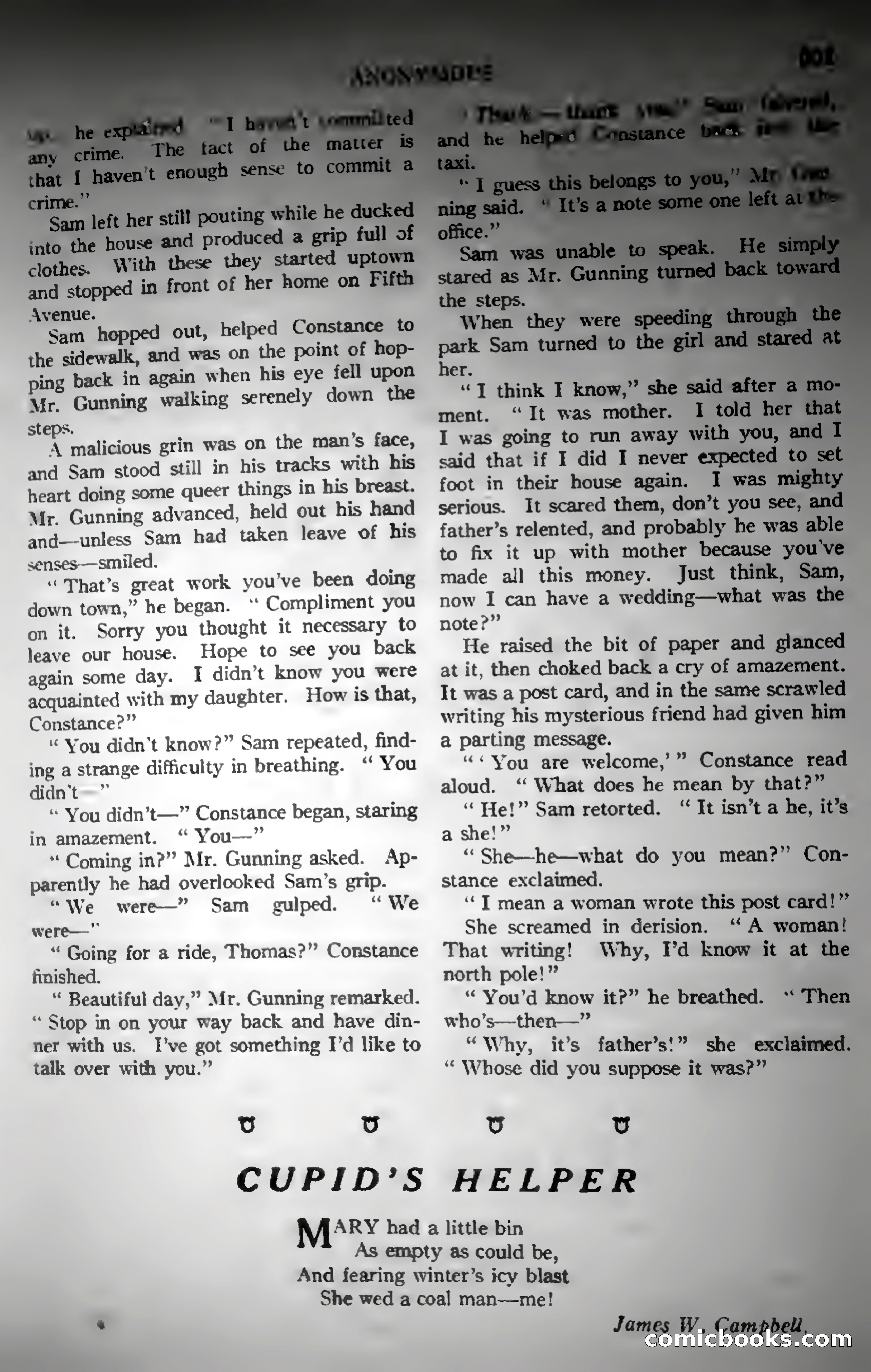
A restored page from Pulp Fiction, 1922. Page through the whole issue in the reader above.
📄 Transcribed text from this page (OCR, searchable)
Machine-transcribed from the original scan — historical spelling and the odd misread are preserved.
te yi Sam left her still pouting while h into the house and produced a grip full . clothes. With these they started uptown and stopped in front of her home on Fifth Avenue. Sam hopped out, helped Constance to the sidewalk, and was on the point of hop- ping back in again when his eye fell upon Mr. Gunning walking serenely down the steps. A malicious grin was on the man’s face, and Sam stood still in his tracks with his heart doing some queer things in his breast. Mr. Gunning advanced, held out his hand and—unless Sam had taken leave of his senses—smiled. “ That’s great work you've been doing down town,” he began. “ Compliment you on it. Sorry you thought it necessary to leave our house. Hope to see you back again some day. I didn’t know you were acquainted with my daughter. How is that, Constance?” “ You didn’t know?” Sam repeated, find- ing a strange difficulty in breathing. ‘‘ You didn't ~”’ “ You didn’t—” Constance began, staring in amazement. ‘ You—”’ “ Coming in?” Mr. Gunning asked. Ap- parently he had overlooked Sam’s grip. “We were—” Sam gulped. “ We were—" “ Going for a ride, Thomas?” Constance finished. “ Beautiful day,” Mr. Gunning remarked. “ Stop in on your way back and have din- ner with us. I’ve got something I'd like to talk over with you.” Le} U CUPID’S HELPER ARY had a little bin As empty as could be, And fearing winter’s icy blast She wed a coal man—me! is. When they were spec her. ® il “J think I know,” she said afte ment. “It was mother. I told her I was going to run away with you, ¢ caid that if I did I never expected to s foot in their house again. JI was mig serious. It scared them, don’t you see, and father’s relented, and probably he was able to fix it up with mother because you've — made all this money. Just think, Sam, — now I can have a wedding—what was the note?” He raised the bit of paper and glanced at it, then choked back a cry of amazement. It was a post card, and in the same scrawled writing his mysterious friend had given him a parting message. “You are welcome,’” Constance read aloud. ‘‘ What does he mean by that?” “He!” Sam retorted. ‘It isn’t a he, it’s a she!” ‘‘ She—he—what do you mean?” Con- stance exclaimed. ‘‘T mean a woman wrote this post card!” She screamed in derision. ‘ A woman! That writing! Why, I’'d know it at the north pole!” “ You’d know it?” he breathed. who’s—then—” , “Why, it’s father’s!” she exclaimed. ‘“ Whose did you suppose it was?” “Then U U James >