
Pulp Fiction, 1922 · page 76 of 185
Argosy All-Story Weekly, October 7, 1922 — page 76: what you’re looking at
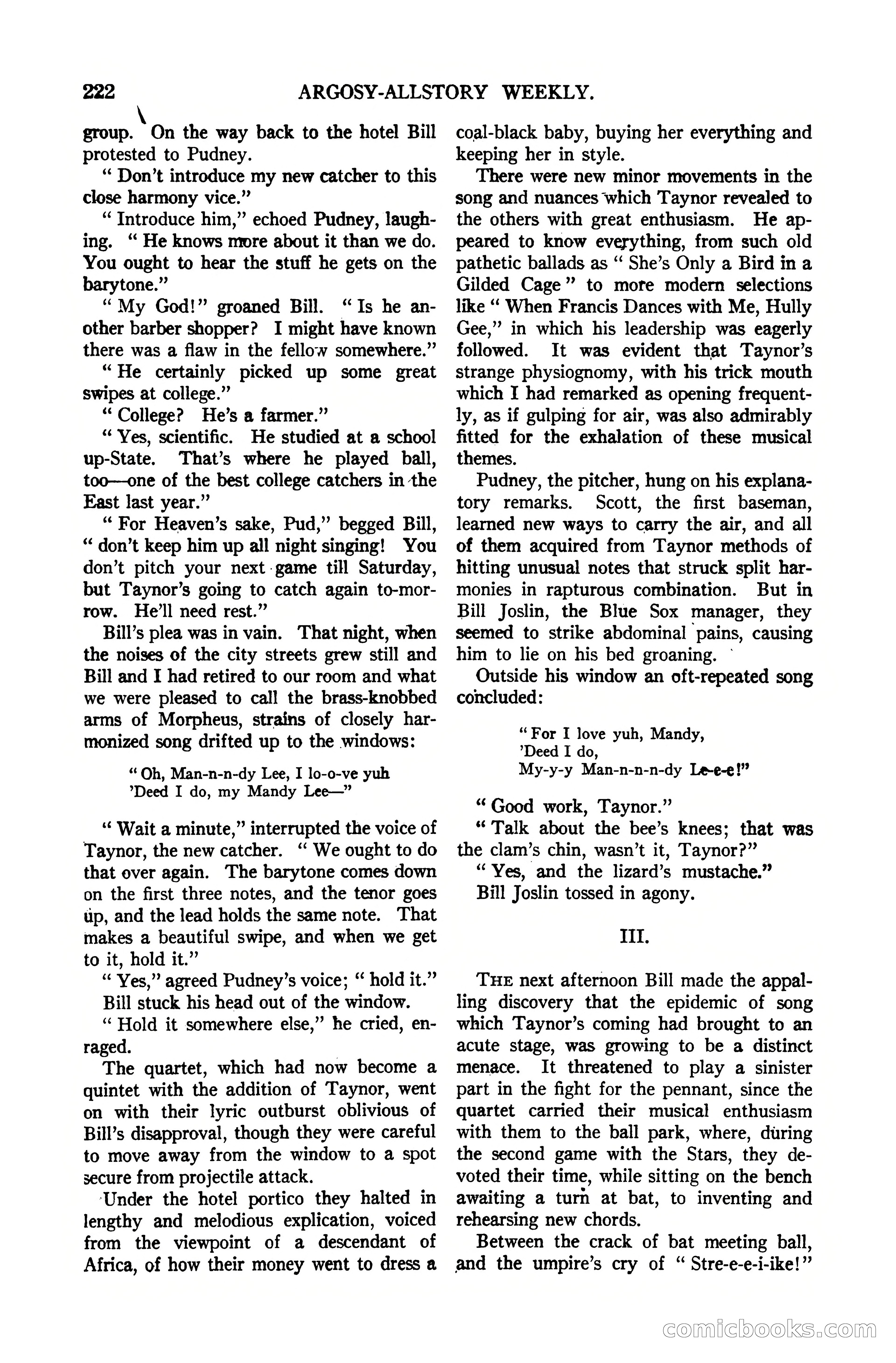
A restored page from Pulp Fiction, 1922. Page through the whole issue in the reader above.
📄 Transcribed text from this page (OCR, searchable)
Machine-transcribed from the original scan — historical spelling and the odd misread are preserved.
222 group. \ On the way back to the hotel Bill protested to Pudney. ‘“‘ Don’t introduce my new catcher to this close harmony vice.” “Introduce him,” echoed Pudney, lJaugh- ing. ‘‘ He knows more about it than we do. You ought to hear the stuff he gets on the barytone.” ‘““My God!” groaned Bill. “Is he an- other barber shopper? I might have known there was a flaw in the fellow somewhere.” “He certainly picked up some great swipes at college.” ‘““ College? He’s a farmer.” ““ Yes, scientific. He studied at a school up-State. That’s where he played ball, too—one of the best college catchers in the Fast last year.”’ “For Heaven’s sake, Pud,” begged Bill, *‘ don’t keep him up all night singing! You don’t pitch your next game till Saturday, but Taynor’s going to catch again to-mor- row. He'll need rest.” Bill’s plea was in vain. That night, when the noises of the city streets grew still and Bill and I had retired to our room and what we were pleased to call the brass-knobbed arms of Morpheus, strains of closely har- monized song drifted up to the windows: “Qh, Man-n-n-dy Lee, I lo-o-ve yuh *"Deed I do, my Mandy Lee—” ‘“‘ Wait a minute,” interrupted the voice of Taynor, the new catcher. ‘‘ We ought to do that over again. The barytone comes down on the first three notes, and the tenor goes up, and the lead holds the same note. That makes a beautiful swipe, and when we get to it, hold it.” “Yes,” agreed Pudney’s voice; “ hold it.” Bill stuck his head out of the window. “Hold it somewhere else,” he cried, en- raged. The quartet, which had now become a quintet with the addition of Taynor, went on with their lyric outburst oblivious of Bill’s disapproval, though they were careful to move away from the window to a spot secure from projectile attack. ‘Under the hotel portico they halted in lengthy and melodious explication, voiced from the viewpoint of a descendant of Africa, of how their money went to dress a ARGOSY-ALLSTORY WEEKLY. coal-black baby, buying her everything and keeping her in style. There were new minor movements in the song and nuances which Taynor revealed to the others with great enthusiasm. He ap- peared to know everything, from such old pathetic ballads as “‘ She’s Only a Bird ina Gilded Cage” to more modern selections like ‘“‘ When Francis Dances with Me, Hully Gee,”’ in which his leadership was eagerly followed. It was evident that Taynor’s strange physiognomy, with his trick mouth which I had remarked as opening frequent- ly, as if gulping for air, was also admirably fitted for the exhalation of these musical themes. Pudney, the pitcher, hung on his explana- tory remarks. Scott, the first baseman, learned new ways to carry the air, and all of them acquired from Taynor methods of hitting unusual notes that struck split har- monies in rapturous combination. But in Bill Joslin, the Blue Sox manager, they seemed to strike abdominal pains, causing him to lie on his bed groaning. ~ Outside his window an oft-repeated song concluded: “For I love yuh, Mandy, ’Deed I do, My-y-y Man-n-n-n-dy Lee-e!” “Good work, Taynor.” ‘Talk about the bee’s knees; that was the clam’s chin, wasn’t it, Taynor?” “Yes, and the lizard’s mustache.” Bill Joslin tossed in agony. IIT. THE next afternoon Bill made the appal- ling discovery that the epidemic of song which Taynor’s coming had brought to an acute stage, was growing to be a distinct menace. It threatened to play a sinister part in the fight for the pennant, since the quartet carried their musical enthusiasm with them to the ball park, where, during the second game with the Stars, they de- voted their time, while sitting on the bench awaiting a turn at bat, to inventing and rehearsing new chords. Between the crack of bat meeting ball, and the umpire’s cry of “ Stre-e-e-i-ike!” comicboooks C©