
Pulp Fiction, 1922 · page 67 of 185
Argosy All-Story Weekly, October 7, 1922 — page 67: what you’re looking at
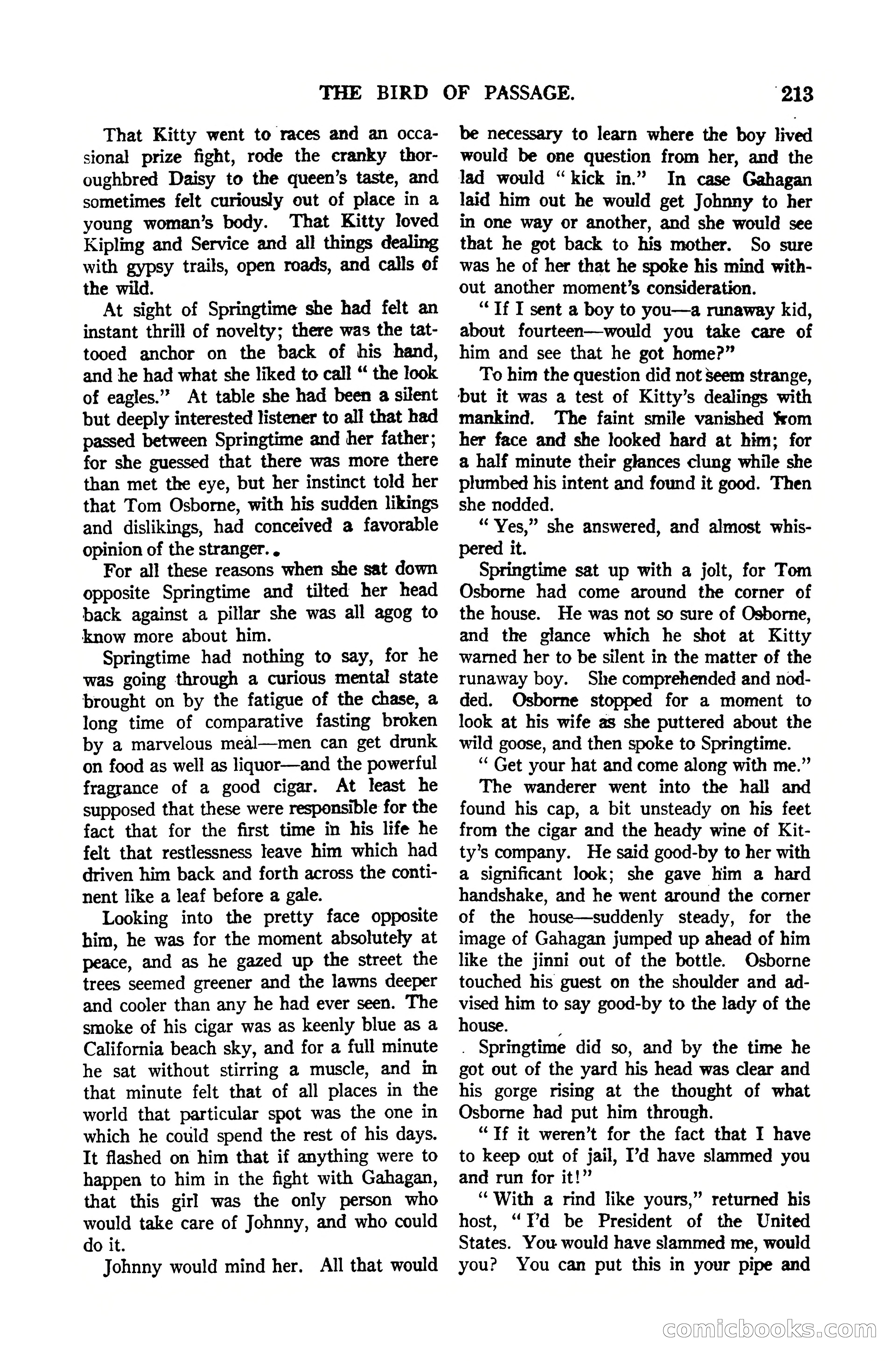
A restored page from Pulp Fiction, 1922. Page through the whole issue in the reader above.
📄 Transcribed text from this page (OCR, searchable)
Machine-transcribed from the original scan — historical spelling and the odd misread are preserved.
THE BIRD OF PASSAGE. That Kitty went to races and an occa- sional prize fight, rode the cranky thor- oughbred Daisy to the queen’s taste, and sometimes felt curiously out of place in a young woman’s body. That Kitty loved Kipling and Service and all things dealing with gypsy trails, open roads, and calls of the wild. At sight of Springtime she had felt an instant thrill of novelty; there was the tat- tooed anchor on the back of his hand, and he had what she liked to call “ the look of eagles.” At table she had been a silent but deeply interested listener to all that had passed between Springtime and her father; for she guessed that there was more there than met the eye, but her instinct told her that Tom Osborne, with his sudden likings and dislikings, had conceived a favorable opinion of the stranger. . For all these reasons when she sat down opposite Springtime and tilted her head back against a pillar she was all agog to know more about him. Springtime had nothing to say, for he was going through a curious mental state brought on by the fatigue of the chase, a long time of comparative fasting broken by a marvelous meal—men can get drunk on food as well as liquor—and the powerful fragrance of a good cigar. At least he supposed that these were responsible for the fact that for the first time in his life he felt that restlessness leave him which had driven him back and forth across the conti- nent like a leaf before a gale. Looking into the pretty face opposite him, he was for the moment absolutely at peace, and as he gazed up the street the trees seemed greener and the lawns deeper and cooler than any he had ever seen. The smoke of his cigar was as keenly blue as a California beach sky, and for a full minute he sat without stirring a muscle, and m that minute felt that of all places in the world that particular spot was the one in which he could spend the rest of his days. It flashed on him that if anything were to happen to him in the fight with Gahagan, that this girl was the only person who would take care of Johnny, and who could do it. Johnny would mind her. All that would 213 be necessary to learn where the boy lived would be one question from her, and the lad would “kick in.” In case Gahagan laid him out he would get Johnny to her in one way or another, and she would see that he got back to his mother. So sure was he of her that he spoke his mind with- out another moment’s consideration. ‘Tf I sent a boy to you—a runaway kid, about fourteen—would you take care of him and see that he got home?” To him the question did not seem strange, but it was a test of Kitty’s dealings with mankind. The faint smile vanished from her face and she looked hard at him; for a half minute their glances clung while she plumbed his intent and found it good. Then she nodded. “Yes,” she answered, and almost whis- pered it. Springtime sat up with a jolt, for Tom Osborne had come around the corner of the house. He was not so sure of Osborne, and the glance which he shot at Kitty warned her to be silent in the matter of the runaway boy. She comprehended and nod- ded. Osborne stopped for a moment to look at his wife as she puttered about the wild goose, and then spoke to Springtime. ‘“‘ Get your hat and come along with me.” The wanderer went into the hall and found his cap, a bit unsteady on his feet from the cigar and the heady wine of Kit- ty’s company. He said good-by to her with a significant look; she gave him a hard handshake, and he went around the corner of the house—suddenly steady, for the image of Gahagan jumped up ahead of him like the jinni out of the bottle. Osborne touched his guest on the shoulder and ad- vised him to say good-by to the lady of the house. ; . Springtime did so, and by the time he got out of the yard his head was clear and his gorge rising at the thought of what Osborne had put him through. “If it weren’t for the fact that I have to keep out of jail, ’d have slammed you and run for it!” “With a rind like yours,” returned his host, “Yd be President of the United States. You would have slammed me, would you? You can put this in your pipe and comicboooks C©