
Pulp Fiction, 1922 · page 65 of 185
Argosy All-Story Weekly, October 7, 1922 — page 65: what you’re looking at
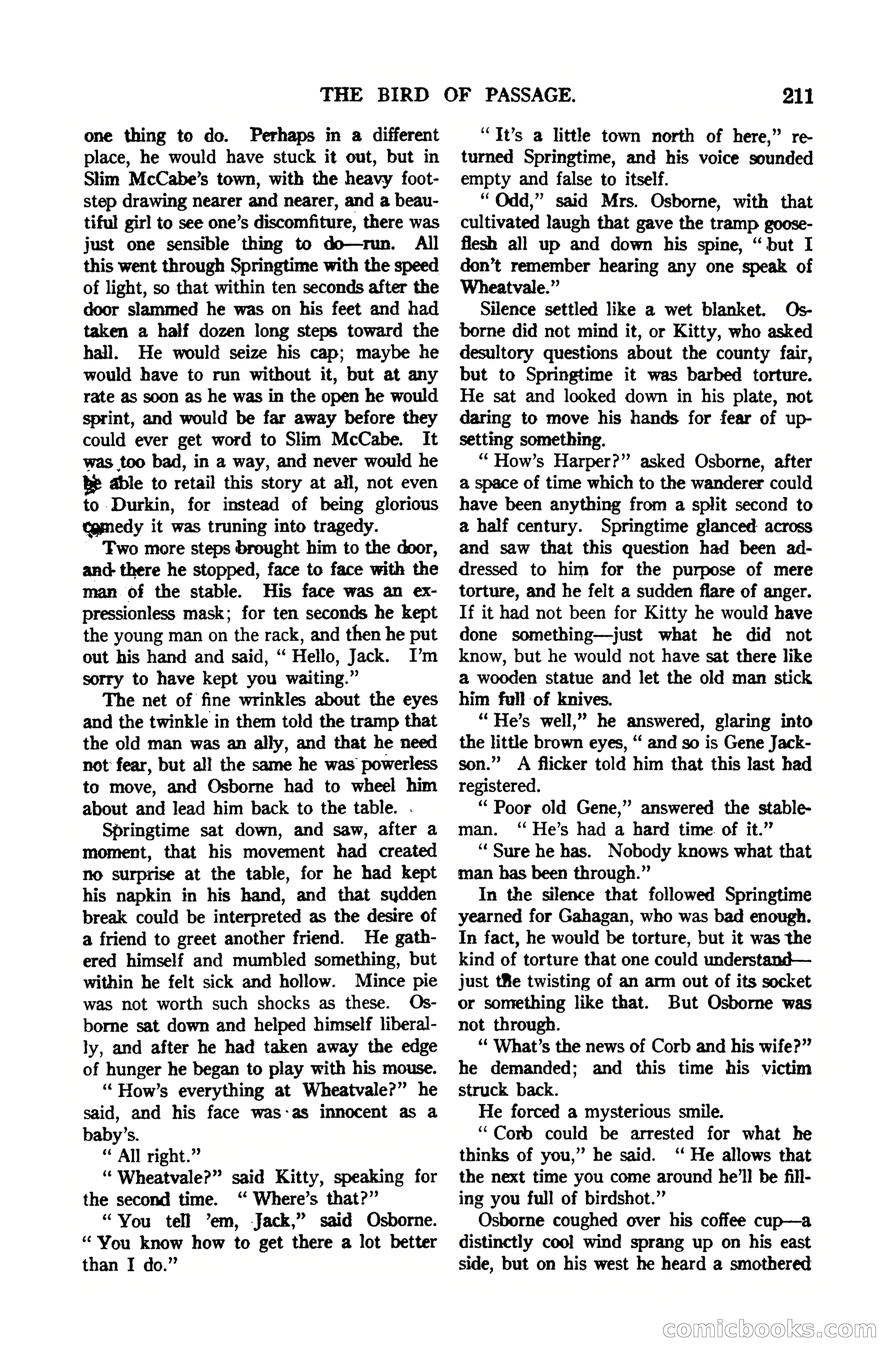
A restored page from Pulp Fiction, 1922. Page through the whole issue in the reader above.
📄 Transcribed text from this page (OCR, searchable)
Machine-transcribed from the original scan — historical spelling and the odd misread are preserved.
THE BIRD OF PASSAGE. one thing to do. Perhaps in a different place, he would have stuck it out, but in Slim McCabe’s town, with the heavy foot- step drawing nearer and nearer, and a beau- tiful girl to see one’s discomfiture, there was just one sensible thing to do—run. All this went through Springtime with the speed of light, so that within ten seconds after the door slammed he was on his feet and had taken a half dozen long steps toward the hall. He would seize his cap; maybe he would have to run without it, but at any rate as soon as he was in the open he would sprint, and would be far away before they could ever get word to Slim McCabe. It was too bad, in a way, and never would he be able to retail this story at all, not even to Durkin, for instead of being glorious Comedy it was truning into tragedy. Two more steps brought him to the door, and there he stopped, face to face with the man of the stable. His face was an ex- pressionless mask; for ten seconds he kept the young man on the rack, and then he put out his hand and said, “ Hello, Jack. I’m sorry to have kept you waiting.” The net of fine wrinkles about the eyes and the twinkle in them told the tramp that the old man was an ally, and that he need not fear, but all the same he was powerless to move, and Osborne had to wheel him about and Jead him back to the table. . Springtime sat down, and saw, after a moment, that his movement had created no surprise at the table, for he had kept his napkin in his hand, and that sydden break could be interpreted as the desire of a friend to greet another friend. He gath- ered himself and mumbled something, but within he felt sick and hollow. Mince pie was not worth such shocks as these. Os- borne sat down and helped himself liberal- ly, and after he had taken away the edge of hunger he began to play with his mouse. “ How’s everything at Wheatvale?” he said, and his face was-as innocent as a baby’s. “ All right.” “ Wheatvale?” said Kitty, speaking for the second time. ‘“ Where’s that?” “You tell ’em, Jack,” said Osborne. “You know how to get there a lot better than I do.” 211 “It’s a little town north of here,” re- turned Springtime, and his voice sounded empty and false to itself. ““Odd,” said Mrs. Osborne, with that cultivated laugh that gave the tramp goose- flesh all up and down his spine, “but I don’t remember hearing any one speak of Wheatvale.” Silence settled like a wet blanket. Os- borne did not mind it, or Kitty, who asked desultory questions about the county fair, but to Springtime it was barbed torture. He sat and looked down in his plate, not daring to move his hands for fear of up- setting something. “* How’s Harper?” asked Osborne, after a space of time which to the wanderer could have been anything from a split second to a half century. Springtime glanced. across and saw that this question had been ad- dressed to him for the purpose of mere torture, and he felt a sudden flare of anger. If it had not been for Kitty he would have done something—just what he did not know, but he would not have sat there like a wooden statue and let the old man stick him full of knives. “‘'He’s well,” he answered, glaring into the little brown eyes, ‘“‘ and so is Gene Jack- son.” A flicker told him that this last had registered. “Poor old Gene,” answered the stable- man. ‘ He’s had a hard time of it.” “‘ Sure he has. Nobody knows what that man has been through.” In the silence that followed Springtime yearned for Gahagan, who was bad enough. In fact, he would be torture, but it was the kind of torture that one could understand— just tHe twisting of an arm out of its socket or something like that. But Osborne was not through. “ What’s the news of Corb and his wife?” he demanded; and this time his victim struck back. He forced a mysterious smile. “Corb could be arrested for what he thinks of you,” he said. ‘‘ He allows that the next time you come around he'll be fill- ing you full of birdshot.” Osborne coughed over his coffee cup—a distinctly cool wind sprang up on his east side, but on his west he heard a smothered comicboooks C©