
Pulp Fiction, 1922 · page 63 of 185
Argosy All-Story Weekly, October 7, 1922 — page 63: what you’re looking at
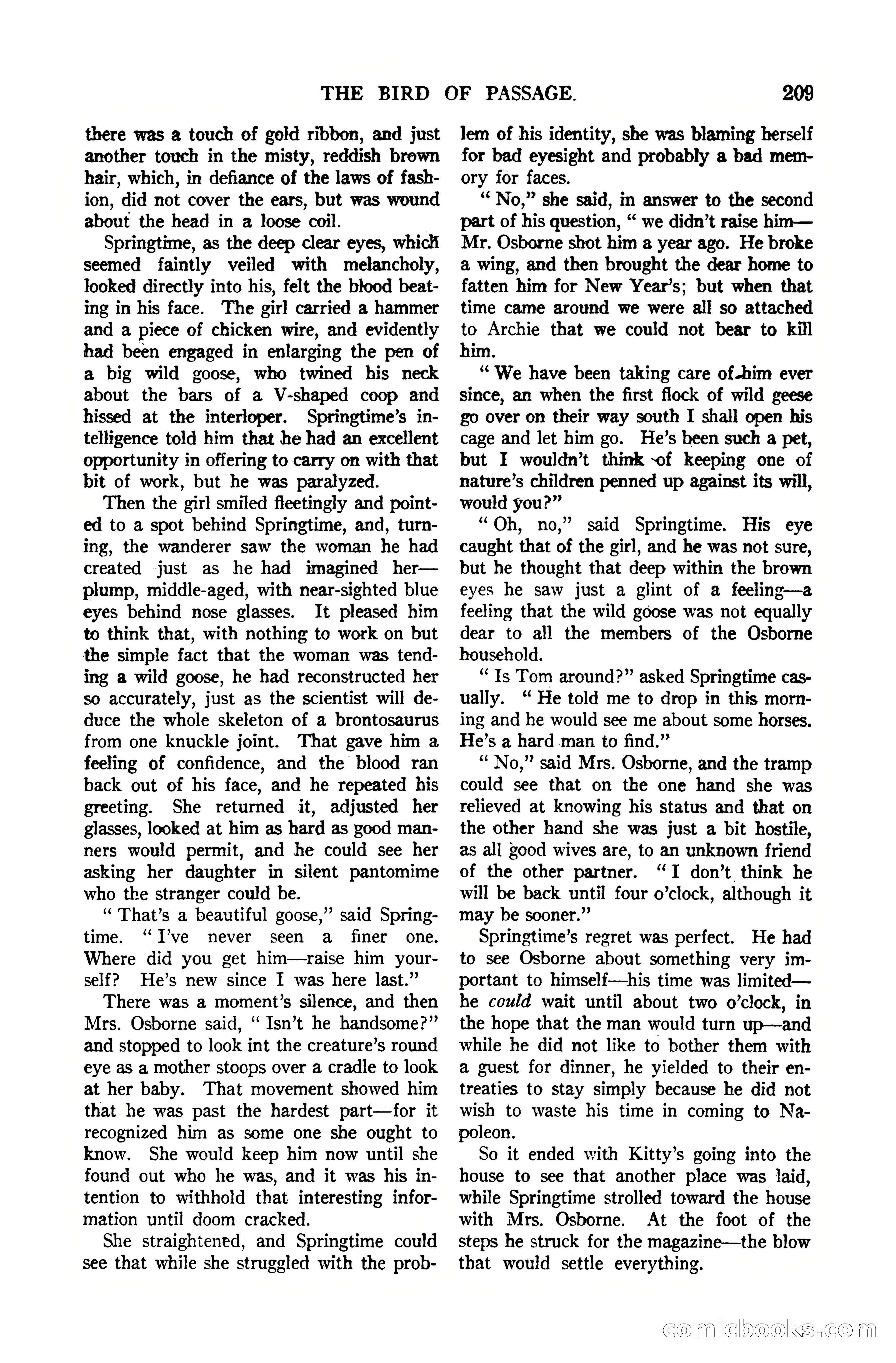
A restored page from Pulp Fiction, 1922. Page through the whole issue in the reader above.
📄 Transcribed text from this page (OCR, searchable)
Machine-transcribed from the original scan — historical spelling and the odd misread are preserved.
THE BIRD OF PASSAGE. there was 2 touch of geld ribbon, and just another touch in the misty, reddish brewn hair, which, in defiance of the laws of fash- ion, did not cover the ears, but was wound about the head in a loose coil. | Springtime, as the deep clear eyes, whicli seemed faintly veiled with melancholy, looked directly into his, felt the blood beat- ing in his face. The girl carried a hammer and a piece of chicken wire, and evidently had been engaged in enlarging the pen of a big wild goose, who twined his neck about the bars of a V-shaped coop and hissed at the interloper. Springtime’s in- telligence told him that he had an excellent opportunity in offering to carry on with that bit of work, but he was paralyzed. Then the girl smiled fleetingly and point- ed to a spot behind Springtime, and, turn- Ing, the wanderer saw the woman he had created just as he had imagined her— plump, middle-aged, with near-sighted blue eyes behind nose glasses. It pleased him to think that, with nothing to work on but the simple fact that the woman was tend- ing a wild goose, he had reconstructed her so accurately, just as the scientist will de- duce the whole skeleton of a brontosaurus from one knuckle joint. That gave him a feeling of confidence, and the blood ran back out of his face, and he repeated his greeting. She returned it, adjusted her glasses, looked at him as hard as good man- ners would permit, and he could see her asking her daughter in silent pantomime who the stranger could be. ‘“ That’s a beautiful goose,” said Spring- time. “I’ve never seen a finer one. Where did you get him—raise him your- self? He’s new since I was here last.” There was a moment’s silence, and then Mrs. Osborne said, “‘ Isn’t he handsome?” and stopped to look int the creature’s round eye as a mother stoops over a cradle to look at her baby. That movement showed him that he was past the hardest part—for it recognized him as some one she ought to know. She would keep him now until she found out who he was, and it was his in- tention to withhold that interesting infor- mation until doom cracked. She straightened, and Springtime could see that while she struggled with the prob- 209 lem of his identity, she was blaming herself for bad eyesight and probably a bad mem- ory for faces. ‘‘ No,” she said, in answer to the second part of his question, ‘“‘ we didn’t raise him— Mr. Osborne shot him a year ago. He broke a wing, and then brought the dear home to fatten him for New Year’s; but when that time came around we were all so attached to Archie that we could not bear to kill him. “We have been taking care of-him ever since, an when the first flock of wild geese go over on their way south I shall open his cage and let him go. He’s been such a pet, but I wouldn’t think of keeping one of nature’s children penned up against its will, would you?” “Oh, no,” said Springtime. His eye caught that of the girl, and he was not sure, but he thought that deep within the brown eyes he saw just a glint of a feeling—a feeling that the wild goose was not equally dear to all the members of the Osborne household. “Is Tom around?” asked Springtime cas- ually. “ He told me to drop in this morn- ing and he would see me about some horses. He’s a hard man to find.” “No,”’ said Mrs. Osborne, and the tramp could see that on the one hand she was relieved at knowing his status and that on the other hand she was just a bit hostile, as all good wives are, to an unknown friend of the other partner. “I don’t think he will be back until four o’clock, although it may be sooner.”’ Springtime’s regret was perfect. He had to see Osborne about something very im- portant to himself—his time was limited— he could wait until about two o’clock, in the hope that the man would turn up—and while he did not like to bother them with a guest for dinner, he yielded to their en- treaties to stay simply because he did not wish to waste his time in coming to Na- poleon. So it ended with Kitty’s going into the house to see that another place was laid, while Springtime strolled toward the house with Mrs. Osborne. At the foot of the steps he struck for the magazine—the blow that would settle everything. comiclbooolx C©