
Pulp Fiction, 1922 · page 60 of 185
Argosy All-Story Weekly, October 7, 1922 — page 60: what you’re looking at
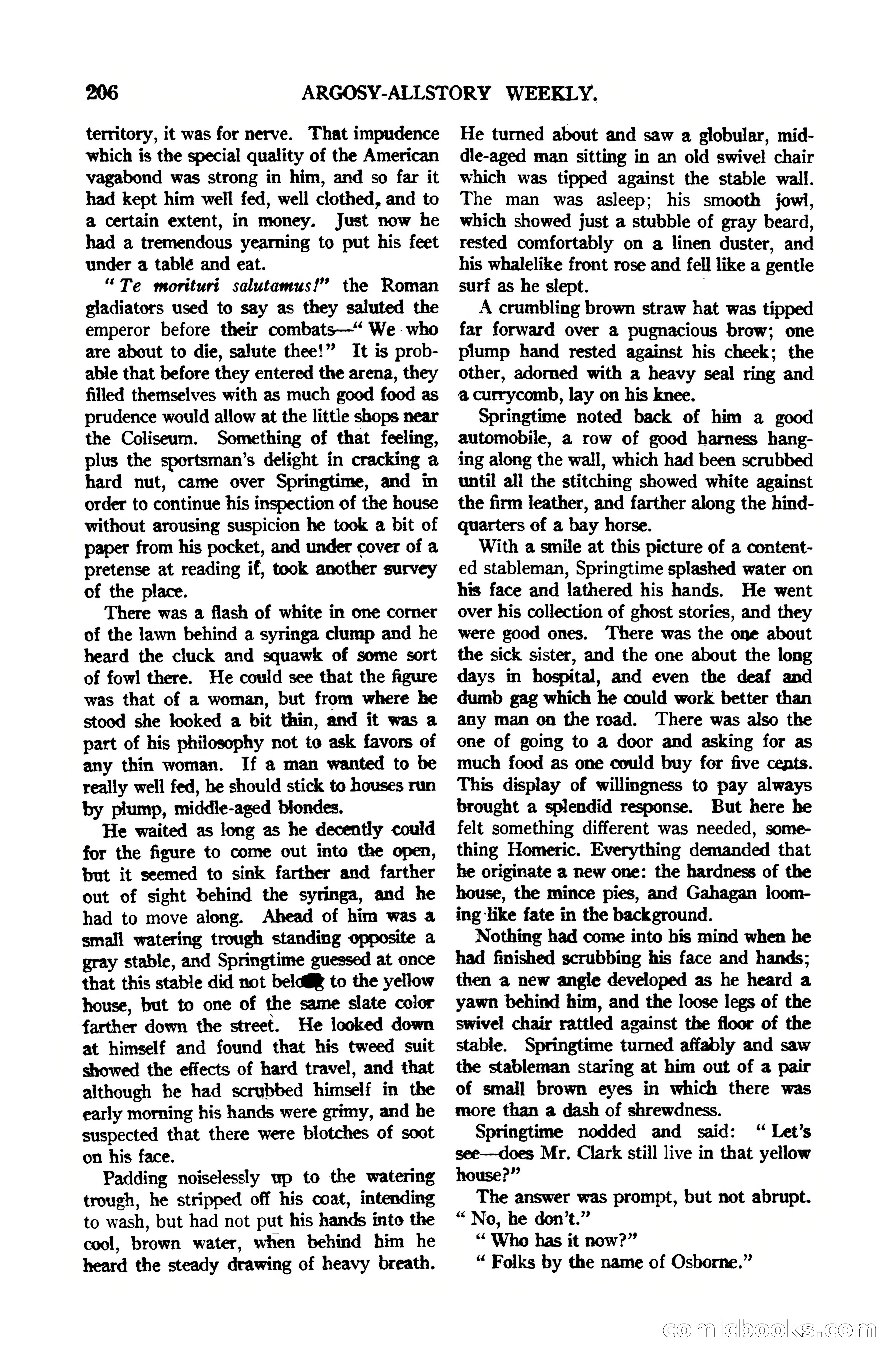
A restored page from Pulp Fiction, 1922. Page through the whole issue in the reader above.
📄 Transcribed text from this page (OCR, searchable)
Machine-transcribed from the original scan — historical spelling and the odd misread are preserved.
206 territory, it was for nerve. That impudence which is the special quality of the American vagabond was strong in him, and so far it had kept him well fed, well clothed, and to a certain extent, in money. Just now he had a tremendous yearning to put his feet under a table and eat. “Te moriturit salutamus!’”’ the Roman gladiators used to say as they saluted the emperor before their combats—‘ We . who are about to die, salute thee!” It is prob- able that before they entered the arena, they filled themselves with as much good food as prudence would allow at the little shops near the Coliseum. Something of that feeling, plus the sportsman’s delight in cracking a hard nut, came over Springtime, and in order to continue his inspection of the house without arousing suspicion he took a bit of paper from his pocket, and under cover of a pretense at reading if, took another survey of the place. There was a flash of white in one corner of the lawn behind a syringa clump and he heard the cluck and squawk of some sort of fowl there. He could see that the figure was that of a woman, but from where he stood she looked a bit thin, and it was a part of his philosophy not to ask favors of any thin woman. If a man wanted to be really well fed, he should stick to houses run by plump, middle-aged blondes. He waited as long as he decently could for the figure to come out into the open, but it seemed to sink farther and farther out of sight behind the syringa, and he had to move along. Ahead of him was a small watering trough standing opposite a gray stable, and Springtime guessed at once that this stable did not beld@® to the yellow house, but to one of the same slate color farther down the street. He looked down at himself and found that his tweed suit showed the effects of hard travel, and that although he had scrubbed himself in the early morning his hands were grimy, and he suspected that there were blotches of soot on his face. Padding noiselessly wp to the watering trough, he stripped off his coat, intending to wash, but had not put his hands into the cool, brown water, when behind him he heard the steady drawing of heavy breath. ARGOSY-ALLSTORY WEEKLY. He turned about and saw a globular, mid- dle-aged man sitting in an old swivel chair which was tipped against the stable wall. The man was asleep; his smooth jowl, which showed just a stubble of gray beard, rested comfortably on a linen duster, and his whalelike front rose and fell like a gentle surf as he slept. | A crumbling brown straw hat was tipped far forward over a pugnacious brow; one plump hand rested against his cheek; the other, adorned with a heavy seal ring and a currycomb, lay on his knee. Springtime noted back of him a good automobile, a row of good harness hang- ing along the wall, which had been scrubbed until all the stitching showed white against the firm leather, and farther along the hind- quarters of a bay horse. With a smile at this picture of a content- ed stableman, Springtime splashed water on his face and lathered his hands. He went over his collection of ghost stories, and they were good ones. There was the one about the sick sister, and the one about the long days in hospital, and even the deaf and dumb gag which he could work better than any man on the road. There was also the one of going to a door and asking for as much food as one could buy for five cents. This display of willingness to pay always brought a splendid response. But here he felt something different was needed, some- thing Homeric. Everything demanded that he originate a new one: the hardness of the house, the mince pies, and Gahagan loom- ing like fate in the background. Nothing had come into his mind when he had finished scrubbing his face and hands; then a new angle developed as he heard a yawn behind him, and the loose legs of the swivel chair rattled against the floor of the stable. Springtime turned affably and saw the stableman staring at him out of a pair of small brown eyes in which there was more than a dash of shrewdness. Springtime nodded and said: “ Let’s see—does Mr. Clark still live in that yellow house?” The answer was prompt, but not abrupt. “No, he don’t.” “Who has it now?” “ Folks by the name of Osborne.” comiclbooolx 1e@