
Pulp Fiction, 1922 · page 49 of 185
Argosy All-Story Weekly, October 7, 1922 — page 49: what you’re looking at
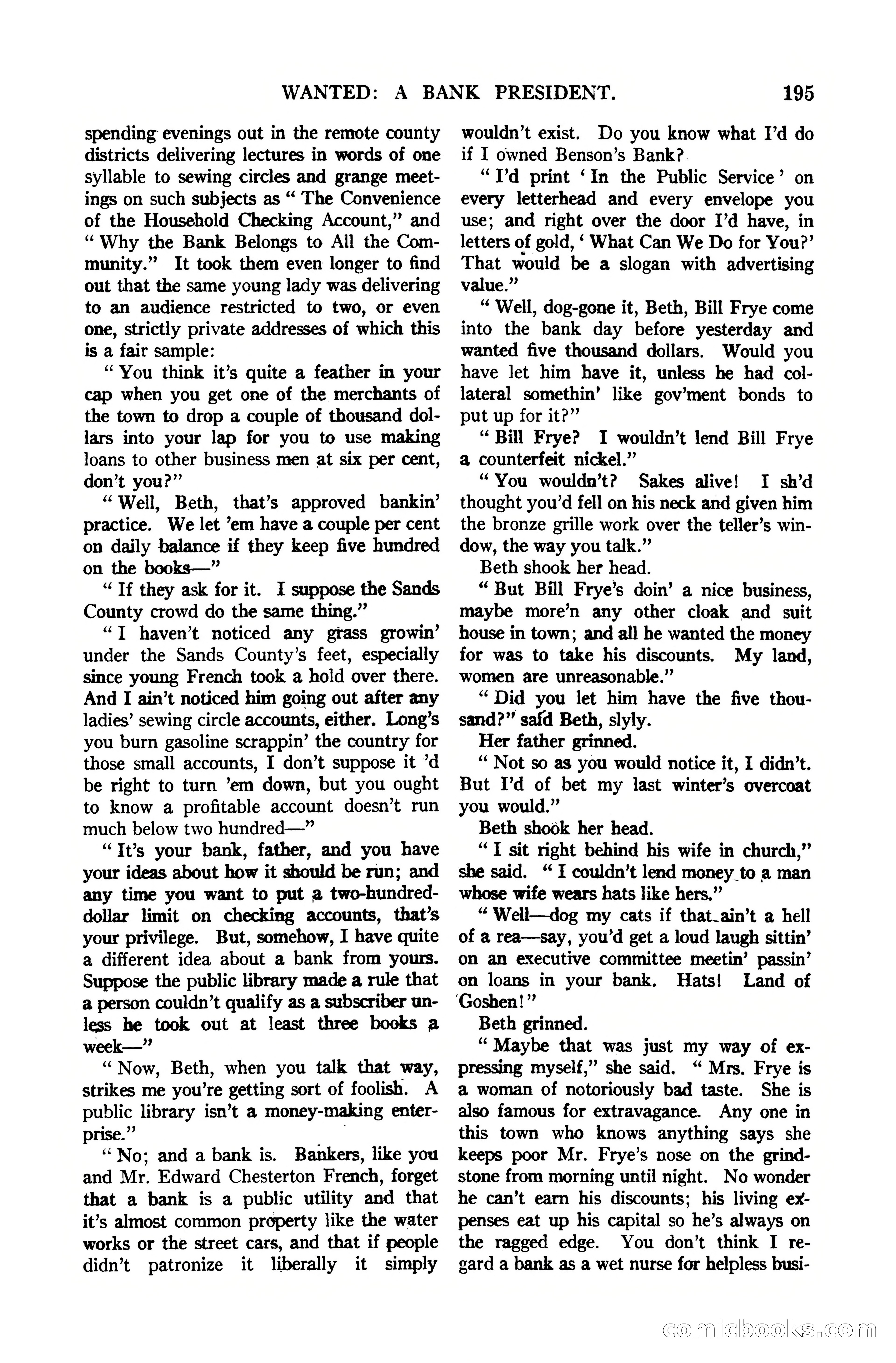
A restored page from Pulp Fiction, 1922. Page through the whole issue in the reader above.
📄 Transcribed text from this page (OCR, searchable)
Machine-transcribed from the original scan — historical spelling and the odd misread are preserved.
WANTED: A BANK PRESIDENT. spending evenings out in the remote county districts delivering lectures in words of one syllable to sewing circles and grange meet- ings on such subjects as “ The Convenience of the Household Checking Account,” and “Why the Bank Belongs to All the Com- munity.” It took them even longer to find out that the same young lady was delivering to an audience restricted to two, or even one, strictly private addresses of which this is a fair sample: “You think it’s quite a feather in your cap when you get one of the merchants of the town to drop a couple of thousand dol- lars into your lap for you to use making loans to other business men at six per cent, don’t you?”’ “Well, Beth, that’s approved bankin’ practice. We let ’em have a couple per cent on daily balance if they keep five hundred on the books—” “ Tf they ask for it. I suppose the Sands County crowd do the same thing.” “T haven’t noticed any grass growin’ under the Sands County’s feet, especially since young French took a hold over there. And I ain’t noticed him going out after any ladies’ sewing circle accounts, either. Long’s you burn gasoline scrappin’ the country for those small accounts, I don’t suppose it ’d be right to turn ’em down, but you ought to know a profitable account doesn’t run much below two hundred—” “It’s your bank, father, and you have your ideas about how it should be run; and any time you want to put a two-hundred- dollar limit on checking accounts, that’s your privilege. But, somehow, I have quite a different idea about a bank from yours. Suppose the public library made a rule that a person couldn’t qualify as a subscriber un- less he took out at least three books a week—” “Now, Beth, when you talk that way, strikes me you’re getting sort of foolish. A public library isn’t a money-making enter- prise.” . ‘No; and a bank is. Bankers, like you and Mr. Edward Chesterton French, forget that a bank is a public utility and that it’s almost common property like the water works or the street cars, and that if people didn’t patronize it liberally it simply 195 wouldn’t exist. Do you know what I’d do if I owned Benson’s Bank?. “Td print ‘In the Public Service’ on every letterhead and every envelope you use; and right over the door I’d have, in letters of gold, ‘ What Can We Do for You?’ That would be a slogan with advertising value.” “ Well, dog-gone it, Beth, Bill Frye come into the bank day before yesterday and wanted five thousand dollars. Would you have let him have it, unless he had col- lateral somethin’ like gov’ment bonds to put up for it?” “ Bill Frye? I wouldn’t lend Bill Frye a counterfeit nickel.’ “You wouldn’t? Sakes alive! I sh’d thought you’d fell on his neck and given him the bronze grille work over the teller’s win- dow, the way you talk.” Beth shook her head. “ But Bill Frye’s doin’ a nice business, maybe more’n any other cloak and suit house in town; and all he wanted the money for was to take his discounts. My land, women are unreasonable.” “ Did you let him have the five thou- sand?” safd Beth, slyly. Her father grinned. “* Not so as you would notice it, I didn’t. But I’d of bet my last winter’s overcoat you would.” Beth shook her head. “T sit right behind his wife in church,” she said. “I couldn’t lend money _to a man whose wife wears hats like hers,” “ Well—dog my cats if that_ain’t a hell of a rea—say, you’d get a loud laugh sittin’ on an executive committee meetin’ passin’ on loans in your bank. Hats! Land of ‘Goshen! ”’ Beth grinned. “Maybe that was just my way of ex- pressing myself,” she said. “ Mrs. Frye is a woman of notoriously bad taste. She is also famous for extravagance. Any one in this town who knows anything says she keeps poor Mr. Frye’s nose on the grind- stone from morning until night. No wonder he can’t earn his discounts; his living ex- penses eat up his capital so he’s always on the ragged edge. You don’t think I re- gard a bank as a wet nurse for helpless busi- comicboooks C©