
Pulp Fiction, 1922 · page 45 of 185
Argosy All-Story Weekly, October 7, 1922 — page 45: what you’re looking at
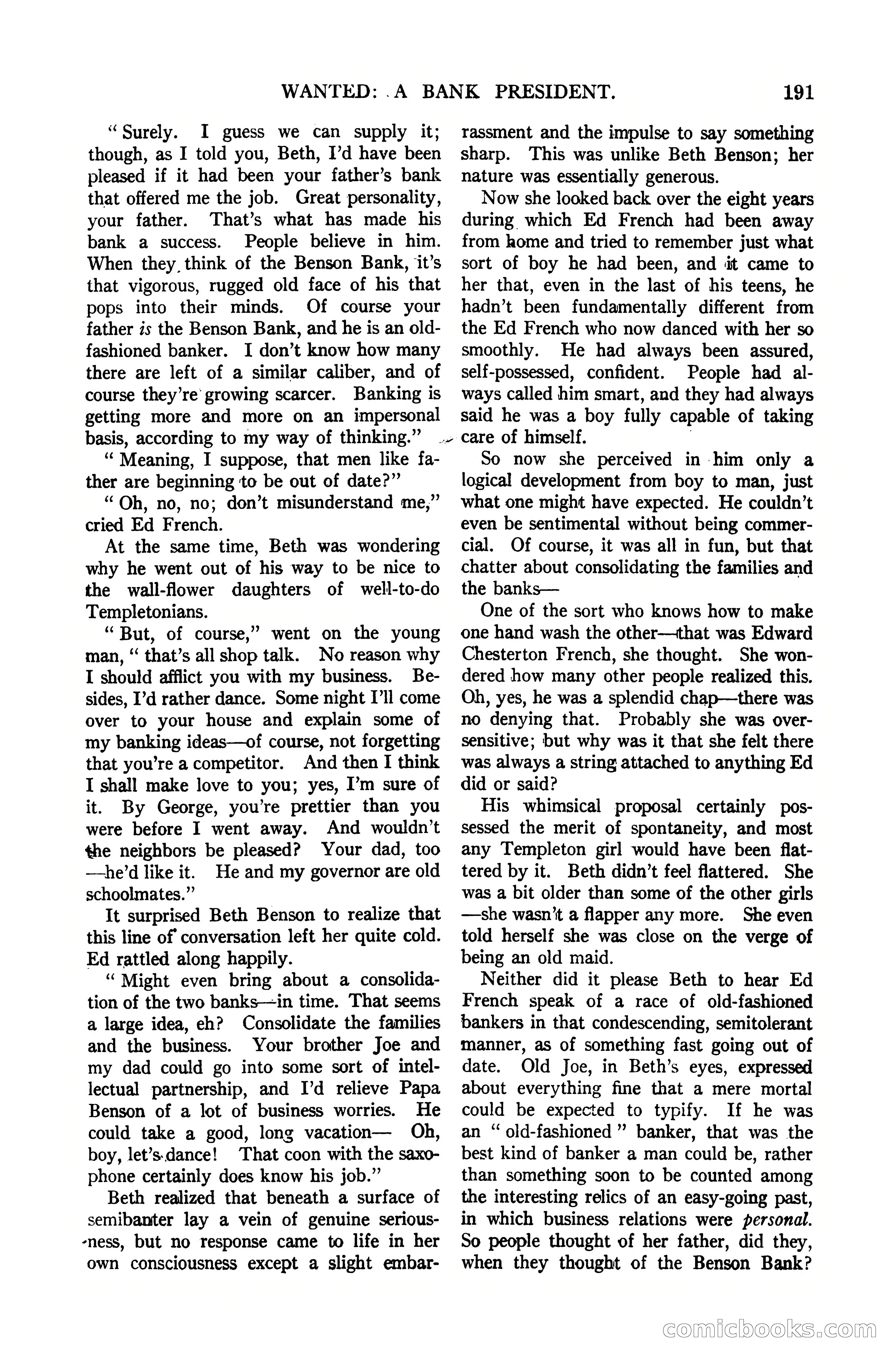
A restored page from Pulp Fiction, 1922. Page through the whole issue in the reader above.
📄 Transcribed text from this page (OCR, searchable)
Machine-transcribed from the original scan — historical spelling and the odd misread are preserved.
WANTED: .A BANK PRESIDENT. “Surely. I guess we can supply it; though, as I told you, Beth, I’d have been pleased if it had been your father’s bank that offered me the job. Great personality, your father. That’s what has made his bank a success. People believe in him. When they. think of the Benson Bank, ‘it’s that vigorous, rugged old face of his that pops into their minds. Of course your father is the Benson Bank, and he is an old- fashioned banker. I don’t know how many there are left of a similar caliber, and of course they’re growing scarcer. Banking is getting more and more on an impersonal basis, according to my way of thinking.” “Meaning, I suppose, that men like fa- ther are beginning to be out of date?” “Qh, no, no; don’t misunderstand me,” cried Ed French. At the same time, Beth was wondering why he went out of his way to be nice to the wall-flower daughters of well-to-do Templetonians. “But, of course,” went on the young man, ‘‘ that’s all shop talk. No reason why I should afflict you with my business. Be- sides, I’d rather dance. Some night I’ll come over to your house and explain some of my banking ideas—of course, not forgetting that you’re a competitor. And then I think I shall make love to you; yes, I’m sure of it. By George, you’re prettier than you were before I went away. And wouldn’t the neighbors be pleased? Your dad, too —he’d like it. He and my governor are old schoolmates.”’ It surprised Beth Benson to realize that this line of conversation left her quite cold. Ed rattled along happily. “Might even bring about a consolida- tion of the two banks—in time. That seems a large idea, eh? Consolidate the families and the business. Your brother Joe and my dad could go into some sort of intel- lectual partnership, and I’d relieve Papa Benson of a lot of business worries. He could take a good, long vacation— Oh, boy, let’s.dance! That coon with the saxo- phone certainly does know his job.” Beth realized that beneath a surface of semibanter lay a vein of genuine serious- ‘ness, but no response came to life in her own consciousness except a slight embar- 191 rassment and the impulse to say something sharp. This was unlike Beth Benson; her nature was essentially generous. Now she looked back over the eight years during which Ed French had been away from home and tried to remember just what sort of boy he had been, and it came to her that, even in the last of his teens, he hadn’t been fundamentally different from the Ed French who now danced with her so smoothly. He had always been assured, self-possessed, confident. People had al- ways called him smart, and they had always said he was a boy fully capable of taking ~ Care of himself. So now she perceived in him only a logical development from boy to man, just what one might have expected. He couldn’t even be sentimental without being commer- cial. Of course, it was all in fun, but that chatter about consolidating the families and the banks— One of the sort who knows how to make one hand wash the other—that was Edward Chesterton French, she thought. She won- dered how many other people realized this. Oh, yes, he was a splendid chap—there was no denying that. Probably she was over- sensitive; but why was it that she felt there was always a string attached to anything Ed did or said? His whimsical proposal certainly pos- sessed the merit of spontaneity, and most any Templeton girl would have been flat- tered by it. Beth didn’t feel flattered. She was a bit older than some of the other girls —she wasn’t a flapper any more. She even told herself she was close on the verge of being an old maid. Neither did it please Beth to hear Ed French speak of a race of old-fashioned bankers in that condescending, semitolerant manner, as of something fast going out of date. Old Joe, in Beth’s eyes, expressed about everything fine that a mere mortal could be expected to typify. If he was an “ old-fashioned ” banker, that was the best kind of banker a man could be, rather than something soon to be counted among the interesting relics of an easy-going past, in which business relations were personal. So people thought of her father, did they, when they thought of the Benson Bank? comicboooks C©