
Pulp Fiction, 1922 · page 43 of 185
Argosy All-Story Weekly, October 7, 1922 — page 43: what you’re looking at
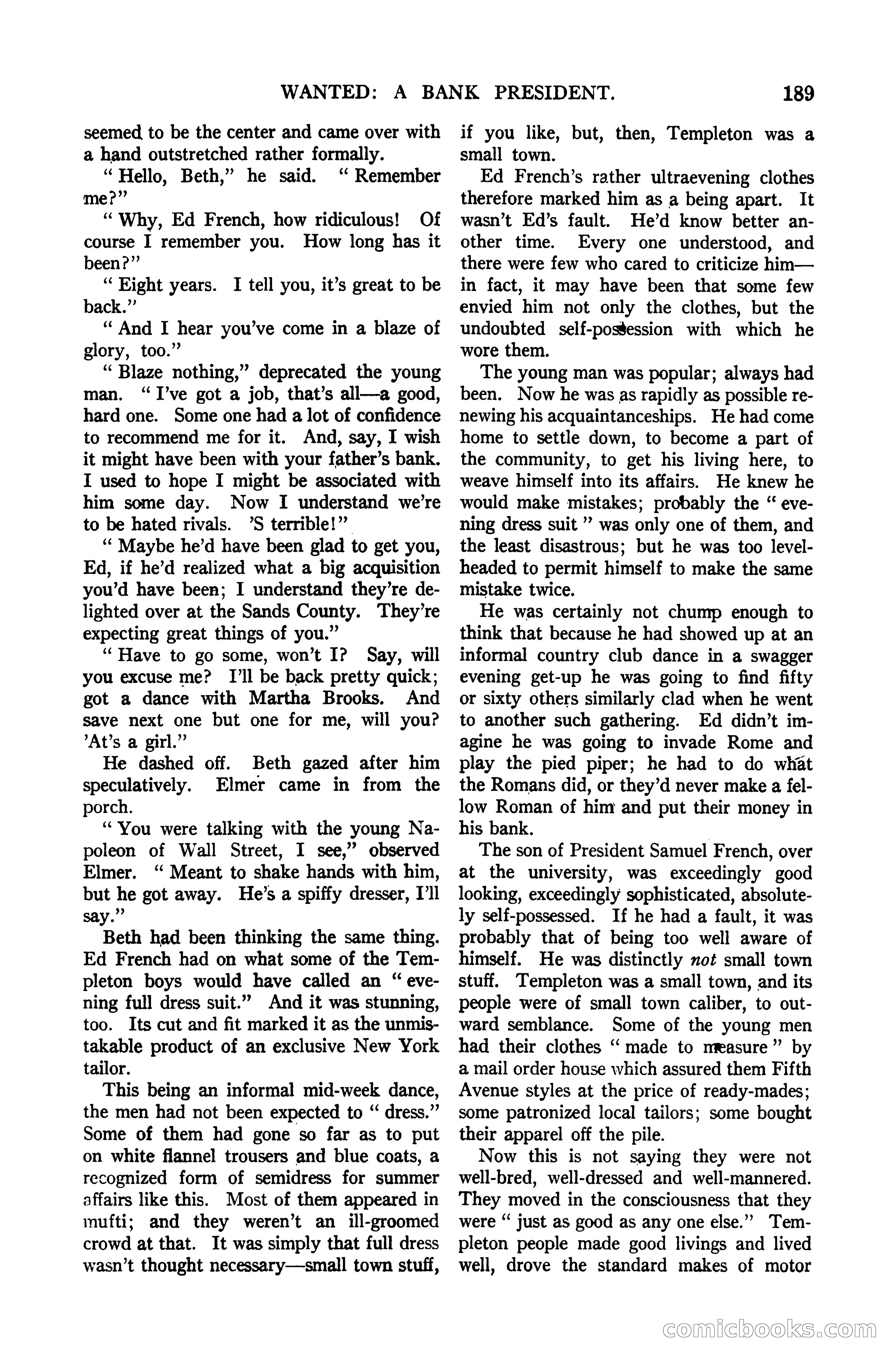
A restored page from Pulp Fiction, 1922. Page through the whole issue in the reader above.
📄 Transcribed text from this page (OCR, searchable)
Machine-transcribed from the original scan — historical spelling and the odd misread are preserved.
WANTED: A BANK PRESIDENT. seemed to be the center and came over with a hand outstretched rather formally. “ Hello, Beth,” he said. ‘ Remember me?” ‘Why, Ed French, how ridiculous! Of course I remember you. How long has it been?”’ “ Eight years. I tell you, it’s great to be back.”’ ‘And I hear you’ve come in a blaze of glory, too.” ‘“‘ Blaze nothing,” deprecated the young man. “I’ve got a job, that’s all—a good, hard one. Some one had a lot of confidence to recommend me for it. And, say, I wish it might have been with your father’s bank. I used to hope I might be associated with him some day. Now I understand we're to be hated rivals. ’S terrible!” ‘‘ Maybe he’d have been glad to get you, Ed, if he’d realized what a big acquisition you’d have been; I understand they’re de- lighted over at the Sands County. They’re expecting great things of you.” “Have to go some, won’t I? Say, will you excuse me? I'll be back pretty quick; got a dance with Martha Brooks. And save next one but one for me, will you? ’At’s a girl.” He dashed off. Beth gazed after him speculatively. Elmer came in from the porch. “You were talking with the young Na- poleon of Wall Street, I see,” observed Elmer. ‘ Meant to shake hands with him, but he got away. He’s a spiffy dresser, Ill say.” Beth had been thinking the same thing. Ed French had on what some of the Tem- pleton boys would have called an “ eve- ning full dress suit.” And it was stunning, too. Its cut and fit marked it as the unmis- takable product of an exclusive New York tailor. This being an informal mid-week dance, the men had not been expected to “ dress.” Some of them had gone so far as to put on white flannel trousers and blue coats, a recognized form of semidress for summer affairs like this. Most of them appeared in mufti; and they weren’t an ill-groomed crowd at that. It was simply that full dress wasn’t thought necessary—small town stuff, 189 if you like, but, then, Templeton was a small town. Ed French’s rather ultraevening clothes therefore marked him as a being apart. It wasn’t Ed’s fault. He’d know better an- other time. Every one understood, and there were few who cared to criticize him— in fact, it may have been that some few envied him not only the clothes, but the undoubted self-posgession with which he wore them. The young man was popular; always had been. Now he was as rapidly as possible re- newing his acquaintanceships. He had come home to settle down, to become a part of the community, to get his living here, to weave himself into its affairs. He knew he would make mistakes; probably the “ eve- ning dress suit ’’ was only one of them, and the least disastrous; but he was too level- headed to permit himself to make the same mistake twice. He was certainly not chump enough to think that because he had showed up at an informal country club dance in a swagger evening get-up he was going to find fifty or sixty others similarly clad when he went to another such gathering. Ed didn’t im- agine he was going to invade Rome and play the pied piper; he had to do what the Romans did, or they’d never make a fel- low Roman of him and put their money in his bank. | The son of President Samuel French, over at the university, was exceedingly good looking, exceedingly sophisticated, absolute- ly self-possessed. If he had a fault, it was probably that of being too well aware of himself. He was distinctly mot small town stuff. Templeton was a small town, and its people were of small town caliber, to out- ward semblance. Some of the young men had their clothes “‘ made to measure” by a mail order house which assured them Fifth Avenue styles at the price of ready-mades; some patronized local tailors; some bought their apparel off the pile. Now this is not saying they were not well-bred, well-dressed and well-mannered. They moved in the consciousness that they were “ just as good as any one else.” Tem- pleton people made good livings and lived well, drove the standard makes of motor comicboooks C©