
Pulp Fiction, 1922 · page 33 of 185
Argosy All-Story Weekly, October 7, 1922 — page 33: what you’re looking at
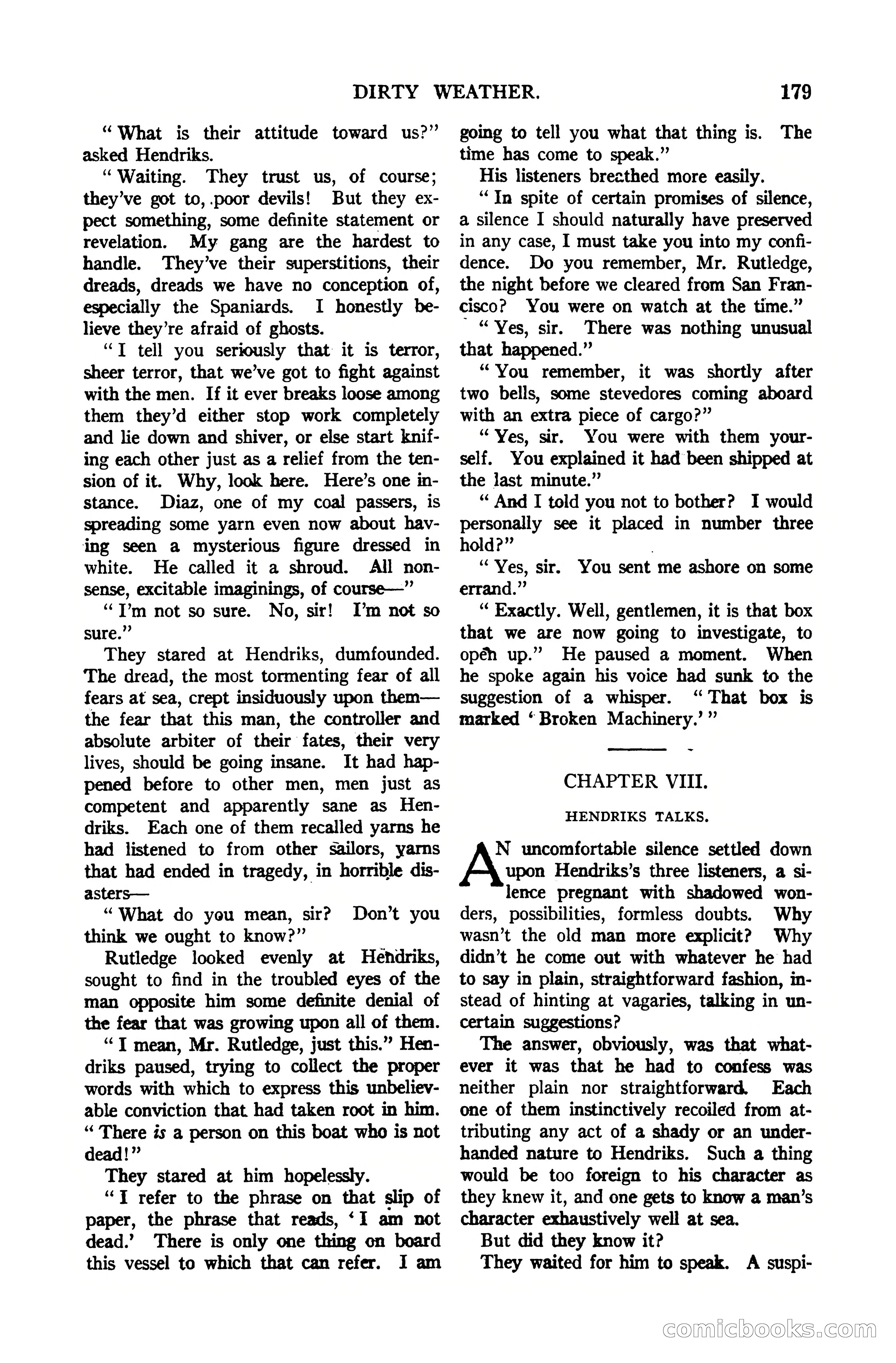
A restored page from Pulp Fiction, 1922. Page through the whole issue in the reader above.
📄 Transcribed text from this page (OCR, searchable)
Machine-transcribed from the original scan — historical spelling and the odd misread are preserved.
DIRTY WEATHER. “ What is their attitude toward us?” asked Hendriks. “Waiting. They trust us, of course; they’ve got to, poor devils! But they ex- pect something, some definite statement or revelation. My gang are the hardest to handle. They’ve their superstitions, their dreads, dreads we have no conception of, especially the Spaniards. I honestly be- lieve they’re afraid of ghosts. “T tell you seriously that it is terror, sheer terror, that we’ve got to fight against with the men. If it ever breaks loose among them they’d either stop work completely and lie down and shiver, or else start knif- ing each other just as a relief from the ten- sion of it. Why, look here. Here’s one in- stance. Diaz, one of my coal passers, is spreading some yarn even now about hav- ing seen a mysterious figure dressed in white. He called it a shroud. All non- sense, excitable imaginings, of course—” ‘“‘I’m not so sure. No, sir! I’m not so sure.” They stared at Hendriks, dumfounded. The dread, the most tormenting fear of all fears at sea, crept insiduously upon them— the fear that this man, the controller and absolute arbiter of their fates, their very lives, should be going insane. It had hap- pened before to other men, men just as competent and apparently sane as Hen- driks. Each one of them recalled yarns he had listened to from other sailors, yarns that had ended in tragedy, in horrible dis- asters— “What do you mean, sir? Don’t you think we ought to know?” Rutledge looked evenly at Hendriks, sought to find in the troubled eyes of the man opposite him some definite denial of the fear that was growing upon all of them. “T mean, Mr. Rutledge, just this.” Hen- driks paused, trying to collect the proper words with which to express this unbeliev- able conviction that had taken root in him. ‘“‘ There is a person on this boat who is not dead!” They stared at him hopelessly. “T refer to the phrase on that slip of paper, the phrase that reads, ‘I am not dead.’ There is only one thing on board this vessel to which that can refer. I am 179 going to tell you what that thing is. The time has come to speak.” His listeners breathed more easily. “In spite of certain promises of silence, a silence I should naturally have preserved in any case, I must take you into my confi- dence. Do you remember, Mr. Rutledge, the night before we cleared from San Fran- cisco? You were on watch at the time.” “Yes, sir. There was nothing unusual that happened.” “You remember, it was shortly after two bells, some stevedores coming aboard with an extra piece of cargo?” “Yes, sir. You were with them your- self. You explained it had been shipped at the jast minute.” “ And I told you not to bother? I would personally see it placed in number three hold?” | ‘Yes, sir. You sent me ashore on some errand.”’ “‘ Exactly. Well, gentlemen, it is that box that we are now going to investigate, to opéh up.” He paused a moment. When he spoke again his voice had sunk to the suggestion of a whisper. ‘That box is marked ‘ Broken Machinery.’ ” = CHAPTER VIII. HENDRIKS TALKS, N uncomfortable silence settled down upon Hendriks’s three listeners, a si- lence pregnant with shadowed won- ders, possibilities, formless doubts. Why wasn’t the old man more explicit? Why didn’t he come out with whatever he had to say in plain, straightforward fashion, in- stead of hinting at vagaries, talking in un- certain suggestions? The answer, obviously, was that what- ever it was that he had to confess was neither plain nor straightforward. Each one of them instinctively recoiled from at- tributing any act of a shady or an under- handed nature to Hendriks. Such a thing would be too foreign to his character as they knew it, and one gets to know a man’s character exhaustively well at sea. But did they know it? They waited for him to speak. A suspi- COMmiclboo SS C©