
Pulp Fiction, 1922 · page 143 of 185
Argosy All-Story Weekly, October 7, 1922 — page 143: what you’re looking at
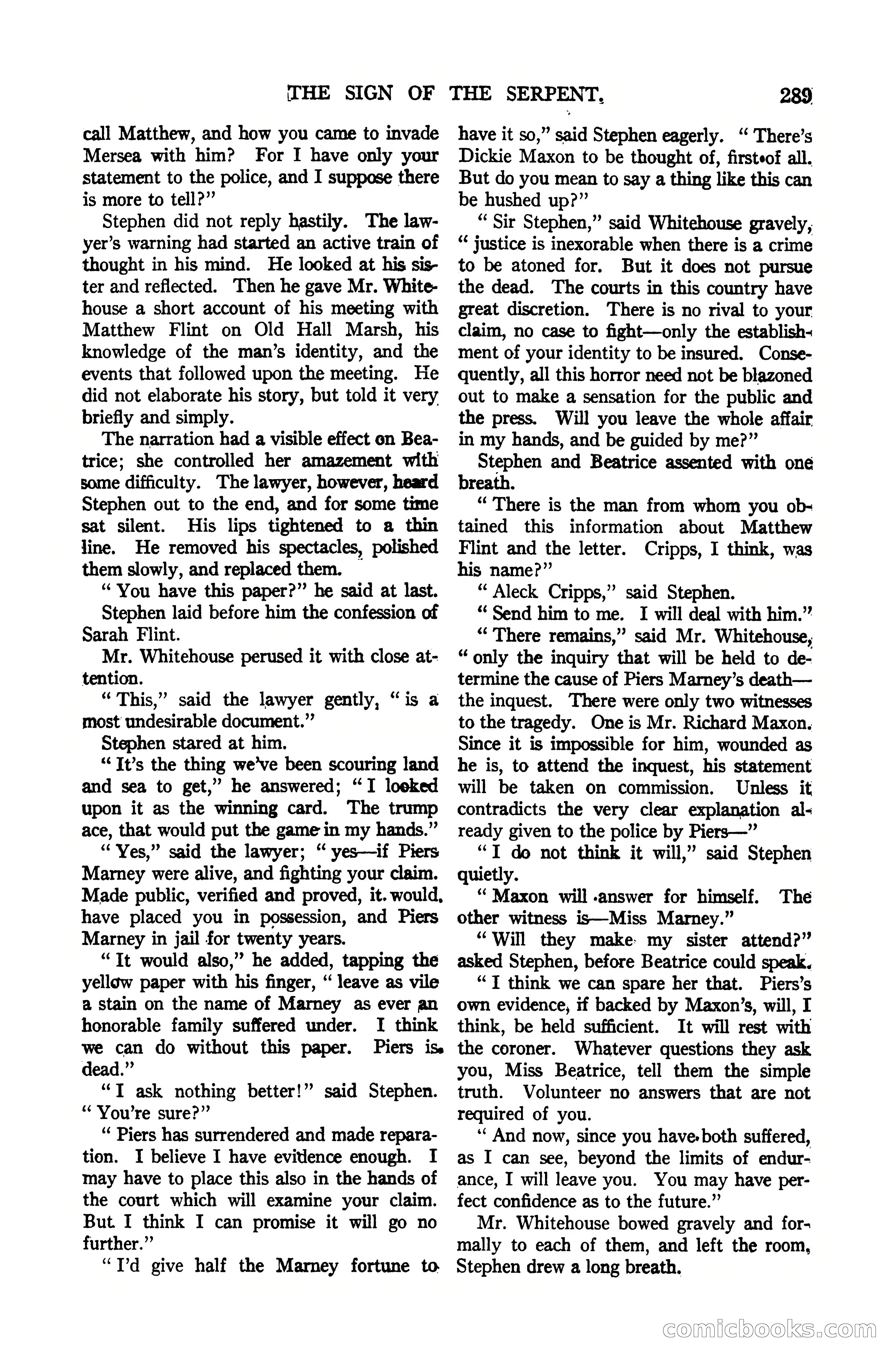
A restored page from Pulp Fiction, 1922. Page through the whole issue in the reader above.
📄 Transcribed text from this page (OCR, searchable)
Machine-transcribed from the original scan — historical spelling and the odd misread are preserved.
(HE SIGN OF THE SERPENT. call Matthew, and how you came to invade Mersea with him? For I have only your statement to the police, and I suppose there is more to tell?” Stephen did not reply hastily. The law- yer’s warning had started an active train of thought in his mind. He looked at his sis- ter and reflected. Then he gave Mr. White- house a short account of his meeting with Matthew Flint on Old Hall Marsh, his knowledge of the man’s identity, and the events that followed upon the meeting. He did not elaborate his story, but told it very briefly and simply. The narration had a visible effect on Bea- trice; she controlled her amazement with some difficulty. The lawyer, however, heard Stephen out to the end, and for some time sat silent. His lips tightened to a thin line. He removed his spectacles, polished them slowly, and replaced them. “You have this paper?’’ he said at last. Stephen laid before him the confession of Sarah Flint. Mr. Whitehouse perused it with close at- tention. “ This,” said the lawyer gently, “is a most undesirable document.” Stephen stared at him. ‘It’s the thing we’ve been scouring land and sea to get,” he answered; “TI looked upon it as the winning card. The trump ace, that would put the game in my hands.” “Yes,” said the lawyer; “ yes—if Piers Marney were alive, and fighting your claim. Made public, verified and proved, it. would, have placed you in possession, and Piers Marney in jail for twenty years. “Tt would also,” he added, tapping the yellow paper with his finger, “ leave as vile a stain on the name of Marney as ever an honorable family suffered under. I think we can do without this paper. Piers is dead.” “IT ask nothing better!” said Stephen. “* You’re sure?” ‘“‘ Piers has surrendered and made repara- tion. I believe I have evidence enough. I may have to place this also in the hands of the court which will examine your claim. But I think I can promise it will go no further.” ‘“T’d give half the Marney fortune to 289 have it so,” said Stephen eagerly. ‘ There’s Dickie Maxon to be thought of, firsteof all. But do you mean to say a thing like this can be hushed up?” “ Sir Stephen,” said Whitehouse gravely, “¢ justice is inexorable when there is a crime to be atoned for. But it does not pursue the dead. The courts in this country have great discretion. There is no rival to your claim, no case to fight—only the establish- ment of your identity to be insured. Conse- quently, all this horror need not be blazoned out to make a sensation for the public and the press. Will you leave the whole affair in my hands, and be guided by me?” Stephen and Beatrice assented with oné breath. “There is the man from whom you ob- tained this information about Matthew Flint and the letter. Cripps, I think, was his name?” ‘“ Aleck Cripps,” said Stephen. ** Send him to me. I will deal with him.” “There remains,” said Mr. Whitehouse, “ only the inquiry that will be held to de- termine the cause of Piers Marney’s death— the inquest. There were only two witnesses to the tragedy. One is Mr. Richard Maxon. Since it is impossible for him, wounded as he is, to attend the inquest, his statement will be taken on commission. Unless it contradicts the very clear explanation al- ready given to the police by Piers—” “T do not think it will,” said Stephen quietly. “Maxon will -answer for himself. other witness is—Miss Marney.” “Will they make: my sister attend?” asked Stephen, before Beatrice could speak. “I think we can spare her that. Piers’s own evidence, if backed by Maxon’s, will, I think, be held sufficient. It will rest with the coroner. Whatever questions they ask you, Miss Beatrice, tell them the simple truth. Volunteer no answers that are not required of you. ‘‘ And now, since you have-both suffered, as I can see, beyond the limits of endur- ance, I will leave you. You may have per- fect confidence as to the future.” Mr. Whitehouse bowed gravely and for- mally to each of them, and left the room, Stephen drew a long breath. The comiclbooolx C©