
Pulp Fiction, 1922 · page 126 of 185
Argosy All-Story Weekly, October 7, 1922 — page 126: what you’re looking at
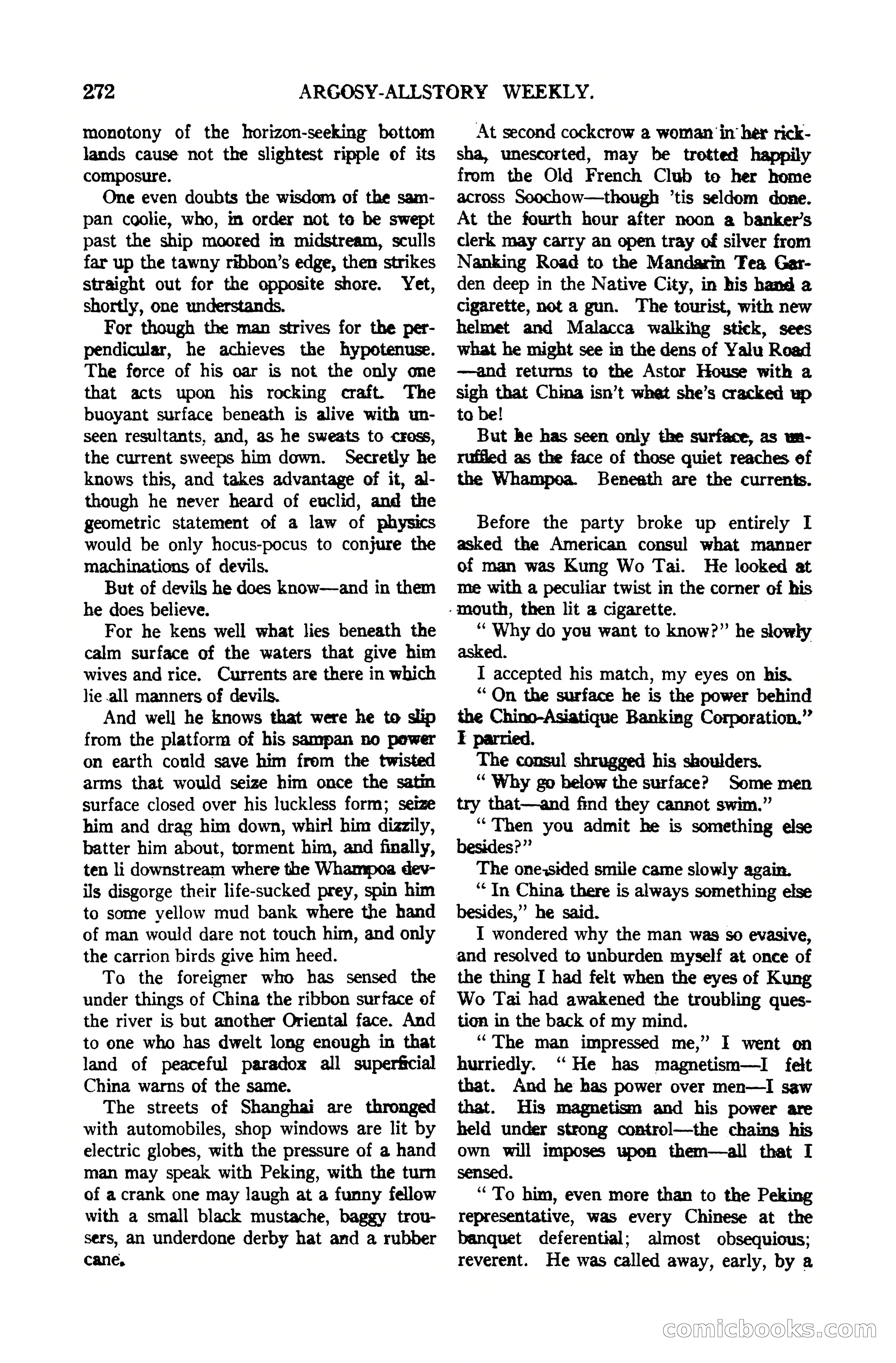
A restored page from Pulp Fiction, 1922. Page through the whole issue in the reader above.
📄 Transcribed text from this page (OCR, searchable)
Machine-transcribed from the original scan — historical spelling and the odd misread are preserved.
242 monotony of the horizon-seeking bottom lands cause not the slightest ripple of its composure. One even doubts the wisdom of the sam- pan cgolie, who, m order not to be swept past the ship moored in midstream, sculls far up the tawny rrbbon’s edge, then strikes straight out for the apposite shore. Yet, shortly, one understands. For though the man strives for the per- pendicular, he achieves the hypotenuse. The force of his oar is not the only one that acts upon his rocking craft. The buoyant surface beneath is alive with un- seen resultants, and, as he sweats to cross, the current sweeps him down. Secretly he knows this, and takes advantage of it, al- though he never heard of euclid, and the geometric statement of a law of physics would be only hocus-pocus to conjure the machinations of devils. But of devils he does know—and in them he does believe. For he kens well what lies beneath the calm surface of the waters that give him wives and rice. Currents are there in which lie all manners of devils. And well he knows that were he te slip from the platform of his sampan no power on earth could save him from the twisted arms that would seize him once the satin surface closed over his luckless form; sere him and drag him down, whirl him dizzily, batter him about, torment him, and finally, ten li downstream where the Whampoa dev- ils disgorge their life-sucked prey, spin him to some yellow mud bank where the hand of man would dare not touch him, and only the carrion birds give him heed. To the foreigner who has sensed the under things of China the ribbon surface of the river is but another Oriental face. And to one who has dwelt long enough in that land of peaceful paradox all superficial China warns of the same. The streets of Shanghai are thronged with automobiles, shop windows are lit by electric globes, with the pressure of a hand man may speak with Peking, with the turn of a crank one may laugh at a funny fellow with a small black mustache, baggy trou- sers, an underdone derby hat and a rubber cane, ARGOSY-ALLSTORY WEEKLY. At second cockcrow a woman in’ her rick- sha, unescorted, may be trotted happily from the Old French Club to her home across Soochow—though ’tis seldom done. At the fourth hour after noon a banker’s clerk may carry an open tray of silver from Nanking Road to the Mandarin Tea Gar- den deep in the Native City, in his hand a Cigarette, not a gun. The tourist, with new helmet and Malacca walking stick, sees what he might see in the dens of Yalu Road —and returns to the Astor House with a sigh that China isn’t whet she’s cracked up to be! But he has seen only the surface, as wn- ruffled as the face of those quiet reaches ef the Whampoa. Beneath are the currents. Before the party broke up entirely I asked the American consul what manner of man was Kung Wo Tai. He looked at me with a peculiar twist in the corner of his - mouth, then lit a cigarette. ‘“ Why do you want to know?” he slowly ed I accepted his match, my eyes on his. “Qn the surface he is the power behind the Chino-Asiatique Banking Corporation.” The consul shrugged his shoulders. “Why go below the surface? Some men try that—and find they cannot swim.” ‘Then you admit he is something else besides?” The one.sided smile came slowly again. ‘In China there is always something else besides,”’ he said. I wondered why the man was so evasive, and resolved to unburden myself at once of the thing I had felt when the eyes of Kung Wo Tai had awakened the troubling ques- tion in the back of my mind. “The man impressed me,” I went on hurriedly. ‘He has magnetism—I felt that. And he has power over men—I saw that. His magnetism and his power are held under strong control—the chains his own will imposes upon them—all that I sensed. ‘To him, even mere than to the Peking representative, was every Chinese at the banquet deferential; almost obsequious; reverent. He was called away, early, by a comicboooks C©