
Pulp Fiction, 1922 · page 92 of 172
Argosy All-Story Weekly, July 1, 1922 — page 92: what you’re looking at
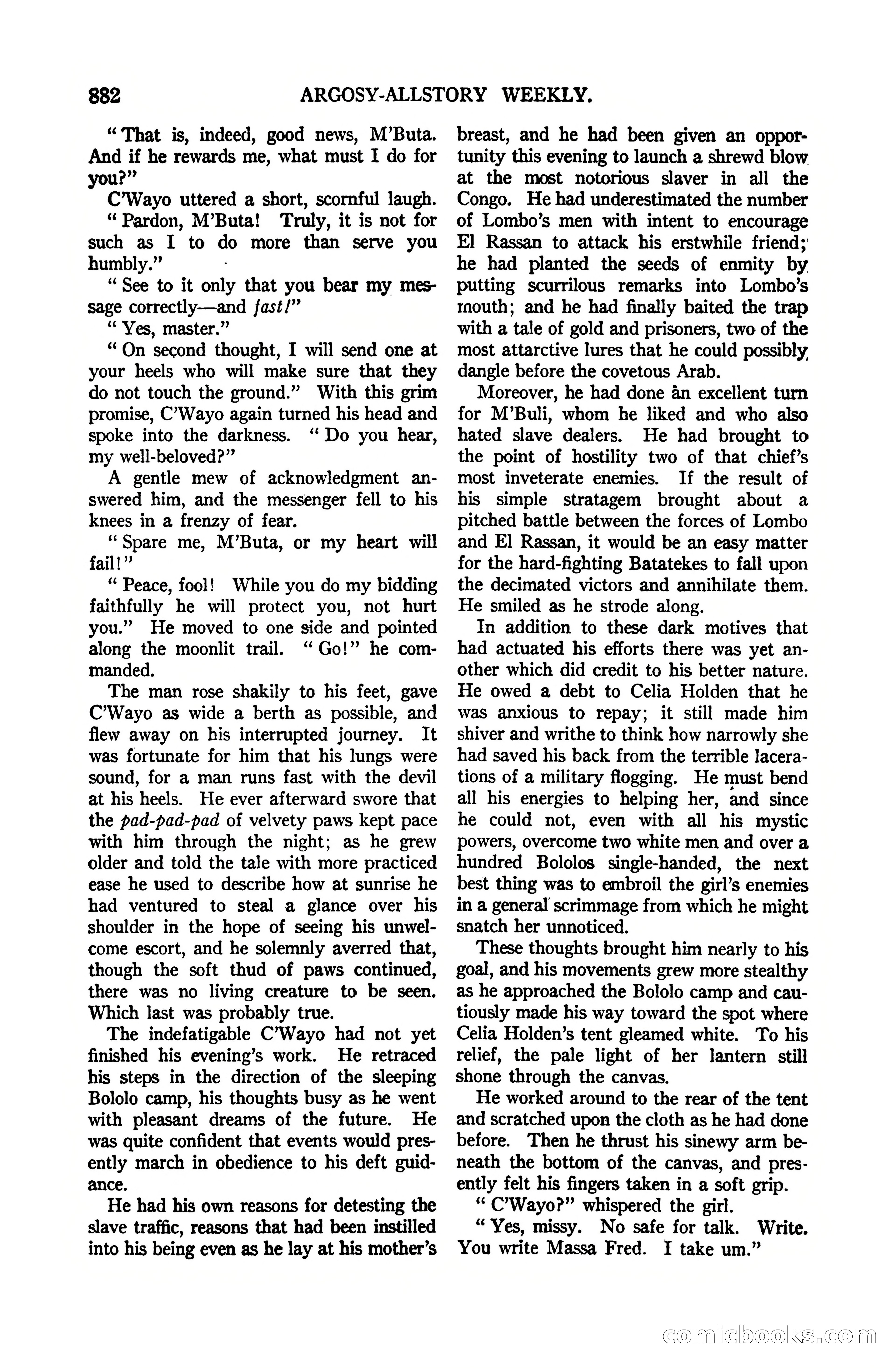
A restored page from Pulp Fiction, 1922. Page through the whole issue in the reader above.
📄 Transcribed text from this page (OCR, searchable)
Machine-transcribed from the original scan — historical spelling and the odd misread are preserved.
882 “That is, indeed, good news, M’Buta. And if he rewards me, what must I do for you?” C’Wayo uttered a short, scornful laugh. “ Pardon, M’Buta! Truly, it is not for such as I to do more than serve you humbly.” “See to it only that you bear my mes- sage correctly—and fast!” “Yes, master.” “On second thought, I will send one at your heels who will make sure that they do not touch the ground.” With this grim promise, C’Wayo again turned his head and spoke into the darkness. ‘‘ Do you hear, my well-beloved?” A gentle mew of acknowledgment an- swered him, and the messenger fell to his knees in a frenzy of fear. ‘‘Spare me, M’Buta, or my heart will fail!” “* Peace, fool! While you do my bidding faithfully he will protect you, not hurt you.” He moved to one side and pointed along the moonlit trail. “Go!” he com- manded. The man rose shakily to his feet, gave C’Wayo as wide a berth as possible, and flew away on his interrupted journey. It was fortunate for him that his lungs were sound, for a man runs fast with the devil at his heels. He ever afterward swore that the pad-pad-pad of velvety paws kept pace with him through the night; as he grew older and told the tale with more practiced ease he used to describe how at sunrise he had ventured to steal a glance over his shoulder in the hope of seeing his unwel- come escort, and he solemnly averred that, though the soft thud of paws continued, there was no living creature to be seen. Which last was probably true. The indefatigable C’Wayo had not yet finished his evening’s work. He retraced his steps in the direction of the sleeping Bololo camp, his thoughts busy as he went with pleasant dreams of the future. He was quite confident that events would pres- ently march in obedience to his deft guid- ance. He had his own reasons for detesting the slave traffic, reasons that had been instilled into his being even as he lay at his mother’s ARGOSY-ALLSTORY WEEKLY. breast, and he had been given an oppor- tunity this evening to launch a shrewd blow at the most notorious slaver in all the Congo. He had underestimated the number of Lombo’s men with intent to encourage FE] Rassan to attack his erstwhile friend; he had planted the seeds of enmity by putting scurrilous remarks into Lombo’s tnouth; and he had finally baited the trap with a tale of gold and prisoners, two of the most attarctive lures that he could possibly dangle before the covetous Arab. Moreover, he had done 4n excellent turn for M’Buli, whom he liked and who also hated slave dealers. He had brought to the point of hostility two of that chief’s most inveterate enemies. If the result of his simple stratagem brought about a pitched battle between the forces of Lombo and El Rassan, it would be an easy matter for the hard-fighting Batatekes to fall upon the decimated victors and annihilate them. He smiled as he strode along. In addition to these dark motives that had actuated his efforts there was yet an- other which did credit to his better nature. He owed a debt to Celia Holden that he was anxious to repay; it still made him shiver and writhe to think how narrowly she had saved his back from the terrible lacera- tions of a military flogging. He must bend all his energies to helping her, and since he could not, even with all his mystic powers, overcome two white men and over a hundred Bololos single-handed, the next best thing was to embroil the girl’s enemies in a general scrimmage from which he might snatch her unnoticed. These thoughts brought him nearly to his goal, and his movements grew more stealthy as he approached the Bololo camp and cau- tiously made his way toward the spot where Celia Holden’s tent gleamed white. To his relief, the pale light of her lantern still shone through the canvas. He worked around to the rear of the tent and scratched upon the cloth as he had done before. Then he thrust his sinewy arm be- neath the bottom of the canvas, and pres- ently felt his fingers taken in a soft grip. “‘ C’Wayo?” whispered the girl. “Yes, missy. No safe for talk. Write. You write Massa Fred. I take um.” comicloool C©