
Pulp Fiction, 1922 · page 55 of 172
Argosy All-Story Weekly, July 1, 1922 — page 55: what you’re looking at
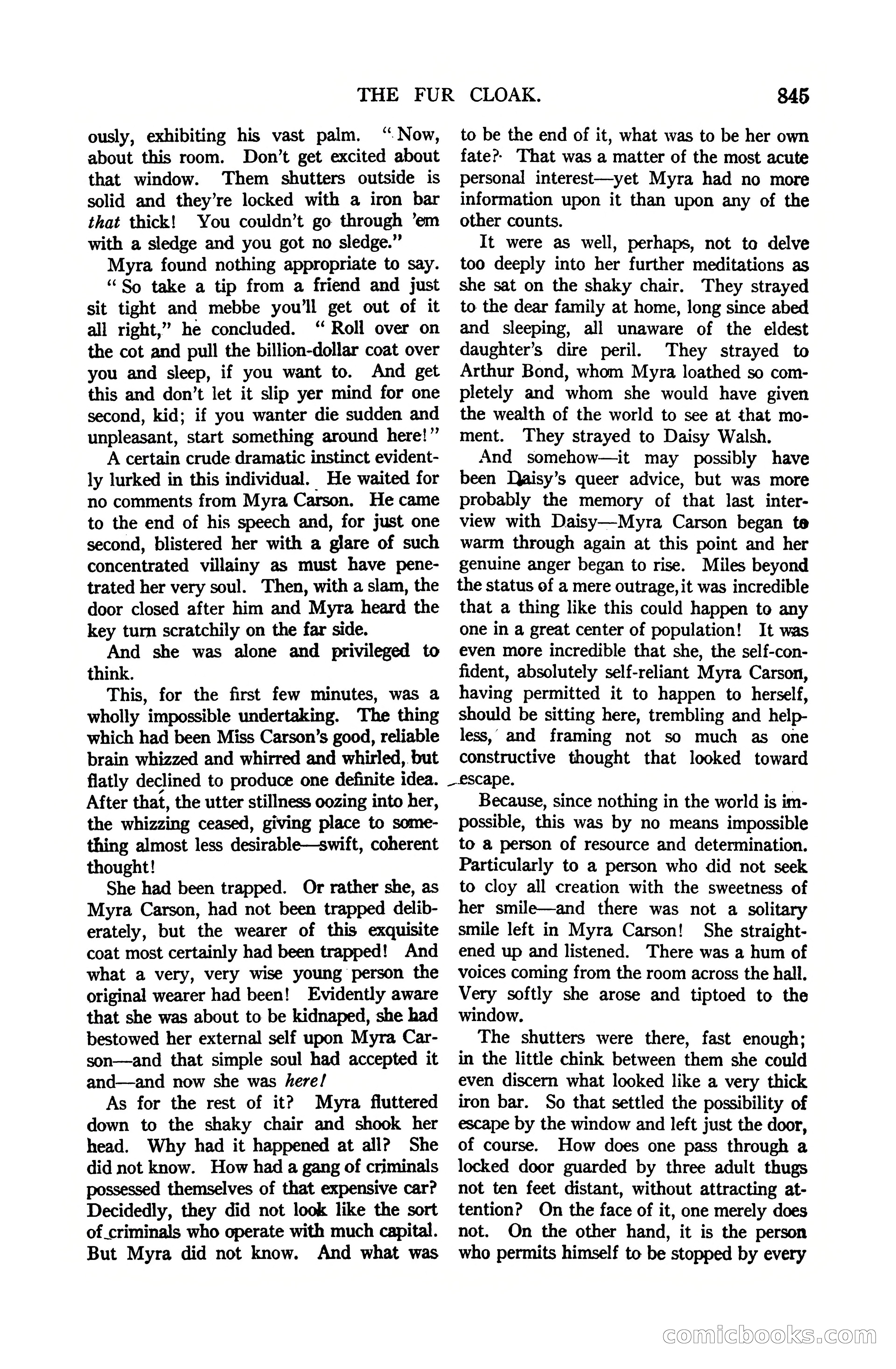
A restored page from Pulp Fiction, 1922. Page through the whole issue in the reader above.
📄 Transcribed text from this page (OCR, searchable)
Machine-transcribed from the original scan — historical spelling and the odd misread are preserved.
THE FUR CLOAK. ously, exhibiting his vast palm. “Now, about this room. Don’t get excited about that window. Them shutters outside is solid and they’re locked with a iron bar that thick! You couldn’t go through ’em with a sledge and you got no sledge.” Myra found nothing appropriate to say. “So take a tip from a friend and just sit tight and mebbe you'll get out of it all right,” he concluded. “ Roll over on the cot and pull the billion-dollar coat over you and sleep, if you want to. And get this and don’t let it slip yer mind for one second, kid; if you wanter die sudden and unpleasant, start something around here!” A certain crude dramatic instinct evident- ly lurked in this individual. He waited for no comments from Myra Carson. He came to the end of his speech and, for just one second, blistered her with a glare of such concentrated villainy as must have pene- trated her very soul. Then, with a slam, the door closed after him and Myra heard the key turn scratchily on the far side. And she was alone and privileged to think. This, for the first few minutes, was a wholly impossible undertaking. The thing which had been Miss Carson’s good, reliable brain whizzed and whirred and whirled, but flatly declined to produce one definite idea. After that, the utter stillness oozing into her, the whizzing ceased, giving place to some- thing almost less desirable—swift, coherent thought! She had been trapped. Or rather she, as Myra Carson, had not been trapped delib- erately, but the wearer of this exquisite coat most certainly had been trapped! And what a very, very wise young person the original wearer had been! Evidently aware that she was about to be kidnaped, she had bestowed her external self upon Myra Car- son—and that simple soul had accepted it and—and now she was here/ As for the rest of it? Myra fluttered down to the shaky chair and shook her head. Why had it happened at alle She did not know. How had a gang of criminals possessed themselves of that expensive car? Decidedly, they did not look like the sort of_criminals who operate with much capital. But Myra did not know. And what was 845 to be the end of it, what was to be her own fate?’ That was a matter of the most acute personal interest—yet Myra had no more information upon it than upon any of the other counts. It were as well, perhaps, not to delve too deeply into her further meditations as she sat on the shaky chair. They strayed to the dear family at home, long since abed and sleeping, all unaware of the eldest daughter’s dire peril. They strayed to Arthur Bond, whom Myra loathed so com- pletely and whom she would have given the wealth of the world to see at that mo- ment. They strayed to Daisy Walsh. And somehow—it may possibly have been Taisy’s queer advice, but was more probably the memory of that last inter- view with Daisy—Myra Carson began te warm through again at this point and her genuine anger began to rise. Miles beyond the status of a mere outrage, it was incredible that a thing like this could happen to any one in a great center of population! It was even more incredible that she, the self-con- fident, absolutely self-reliant Myra Carson, having permitted it to happen to herself, should be sitting here, trembling and help- less, and framing not so much as one constructive thought that looked toward _escape. Because, since nothing in the world is im- possible, this was by no means impossible to a person of resource and determination. Particularly to a person who did not seek to cloy all creation with the sweetness of her smile—and there was not a solitary smile left in Myra Carson! She straight- ened up and listened. There was a hum of voices coming from the room across the hall. Very softly she arose and tiptoed to the window. The shutters were there, fast enough; in the little chink between them she could even discern what looked like a very thick iron bar. So that settled the possibility of escape by the window and left just the door, of course. How does one pass through a locked door guarded by three adult thugs not ten feet distant, without attracting at- tention? On the face of it, one merely does not. On the other hand, it is the person who permits himself to be stopped by every DOOK C©