
Pulp Fiction, 1922 · page 165 of 172
Argosy All-Story Weekly, July 1, 1922 — page 165: what you’re looking at
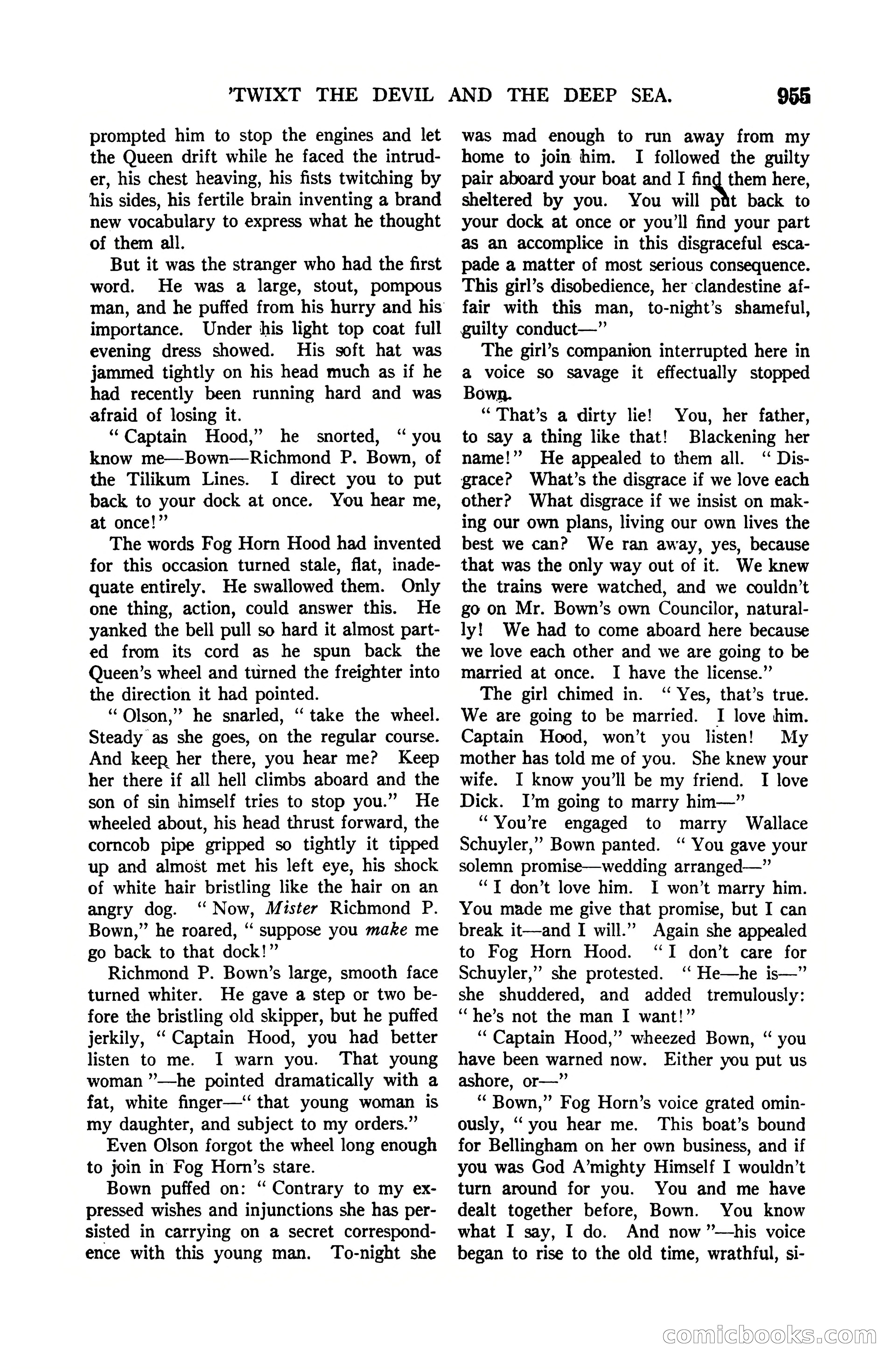
A restored page from Pulp Fiction, 1922. Page through the whole issue in the reader above.
📄 Transcribed text from this page (OCR, searchable)
Machine-transcribed from the original scan — historical spelling and the odd misread are preserved.
TWIXT THE DEVIL AND THE DEEP SEA. prompted him to stop the engines and let the Queen drift while he faced the intrud- er, his chest heaving, his fists twitching by his sides, his fertile brain inventing a brand new vocabulary to express what he thought of them all. But it was the stranger who had the first word. He was a large, stout, pompous man, and he puffed from his hurry and his importance. Under his light top coat full evening dress showed. His soft hat was jammed tightly on his head much as if he had recently been running hard and was afraid of losing it. ‘“‘Captain Hood,” he snorted, “ you know me—Bown—Richmond P. Bown, of the Tilikum Lines. I direct you to put back to your dock at once. You hear me, at once!” The words Fog Horn Hood had invented for this occasion turned stale, flat, inade- quate entirely. He swallowed them. Only one thing, action, could answer this. He yanked the bell pull so hard it almost part- ed from its cord as he spun back the Queen’s wheel and turned the freighter into the direction it had pointed. “Olson,” he snarled, ‘‘ take the wheel. Steady as she goes, on the regular course. And keep her there, you hear me? Keep her there if all hell climbs aboard and the son of sin himself tries to stop you.” He wheeled about, his head thrust forward, the corncob pipe gripped so tightly it tipped up and almost met his left eye, his shock of white hair bristling like the hair on an angry dog. ‘“‘ Now, Mister Richmond P. Bown,” he roared, “‘ suppose you make me go back to that dock!” Richmond P. Bown’s large, smooth face turned whiter. He gave a step or two be- fore the bristling old skipper, but he puffed jerkily, ‘“‘ Captain Hood, you had better listen to me. I warn you. That young woman ”—he pointed dramatically with a fat, white finger—‘‘ that young woman is my daughter, and subject to my orders.” Even Olson forgot the wheel long enough to join in Fog Horn’s stare. Bown puffed on: “ Contrary to my ex- pressed wishes and injunctions she has per- sisted in carrying on a secret correspond- ence with this young man. To-night she 955 was mad enough to run away from my home to join him. I followed the guilty pair aboard your boat and I find them here, sheltered by you. You will pat back to your dock at once or you’ll find your part as an accomplice in this disgraceful esca- pade a matter of most serious consequence. This girl’s disobedience, her clandestine af- fair with this man, to-night’s shameful, guilty conduct—”’ The girl’s companion interrupted here in a voice so savage it effectually stopped Bown. “That’s a dirty lie! to say a thing like that! Blackening her name!” He appealed to them all. ‘“ Dis- gracee What’s the disgrace if we love each other? What disgrace if we insist on mak- ing our own plans, living our own lives the best we can? We ran away, yes, because that was the only way out of it. We knew the trains were watched, and we couldn’t go on Mr. Bown’s own Councilor, natural- ly! We had to come aboard here because we love each other and we are going to be married at once. I have the license.” The girl chimed in. ‘“ Yes, that’s true. We are going to be married. I love him. Captain Hood, won’t you listen! My mother has told me of you. She knew your wife. I know you’ll be my friend. I love Dick. I’m going to marry him—” ‘““You’re engaged to marry Wallace Schuyler,” Bown panted. “ You gave your solemn promise—wedding arranged—” “YT don’t love him. I won’t marry him. You made me give that promise, but I can break it—and I will.” Again she appealed to Fog Horn Hood. “I don’t care for Schuyler,” she protested. ‘‘ He—he is—” she shuddered, and added tremulously: “he’s not the man I want!” ‘““Captain Hood,” wheezed Bown, “ you have been warned now. Either you put us ashore, or—” ‘“‘ Bown,” Fog Horn’s voice grated omin- ously, ““ you hear me. This boat’s bound for Bellingham on her own business, and if you was God A’mighty Himself I wouldn’t turn around for you. You and me have dealt together before, Bown. You know what I say, I do. And now ’’—his voice began to rise to the old time, wrathful, si- You, her father, DOOK C©