
Pulp Fiction, 1922 · page 163 of 172
Argosy All-Story Weekly, July 1, 1922 — page 163: what you’re looking at
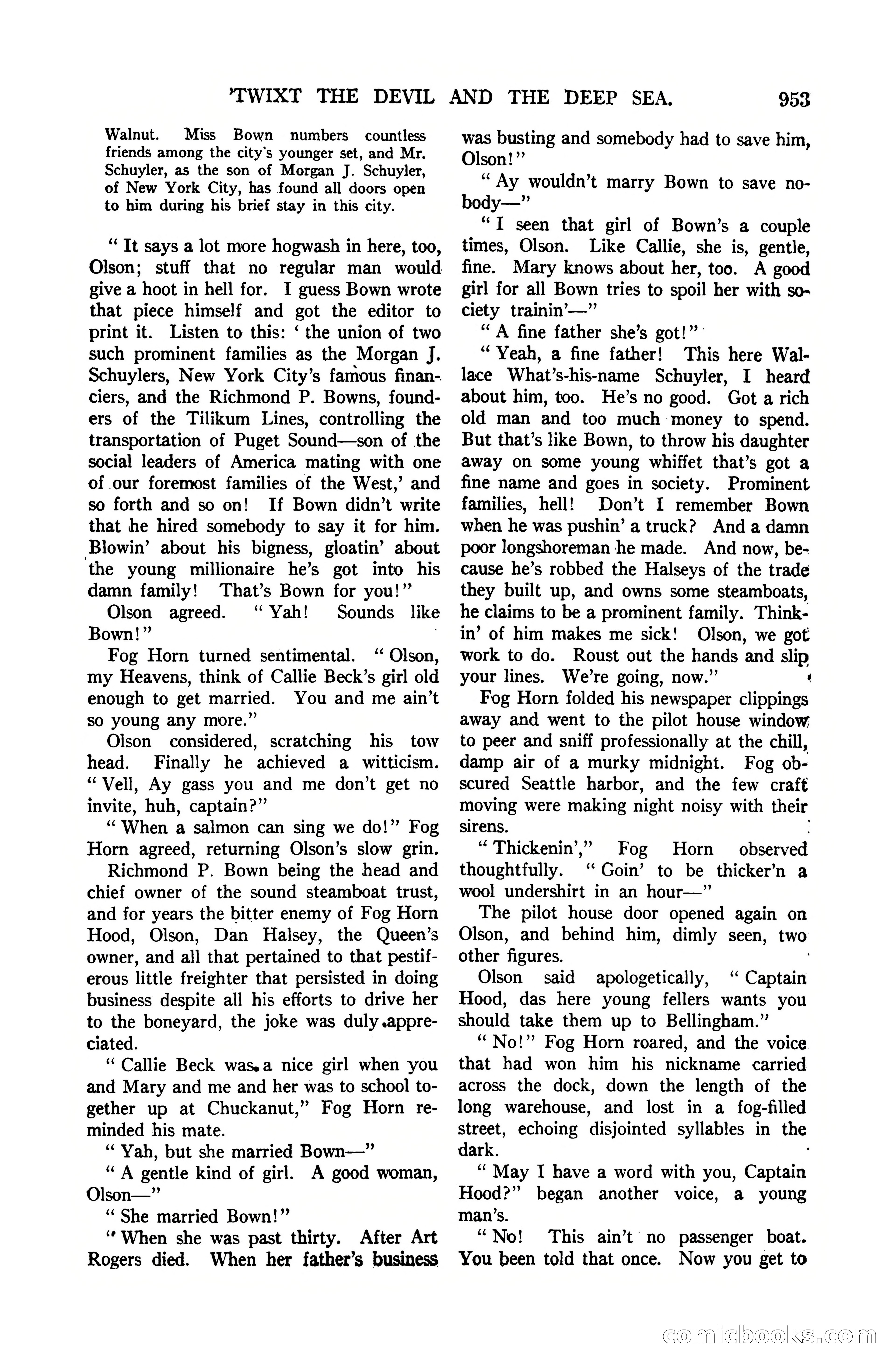
A restored page from Pulp Fiction, 1922. Page through the whole issue in the reader above.
📄 Transcribed text from this page (OCR, searchable)
Machine-transcribed from the original scan — historical spelling and the odd misread are preserved.
"TWIXT THE DEVIL AND THE DEEP SEA. Walnut. Miss Bown numbers countless friends among the city’s younger set, and Mr. Schuyler, as the son of Morgan J. Schuyler, of New York City, has found all doors open to him during his brief stay in this city. “‘ It says a lot more hogwash in here, too, Olson; stuff that no regular man would give a hoot in hell for. I guess Bown wrote that piece himself and got the editor to print it. Listen to this: ‘ the union of two such prominent families as the Morgan J. Schuylers, New York City’s famous finan- ciers, and the Richmond P. Bowns, found- ers of the Tilikum Lines, controlling the transportation of Puget Sound—son of the social leaders of America mating with one of our foremost families of the West,’ and so forth and so on! If Bown didn’t write that he hired somebody to say it for him. Blowin’ about his bigness, gloatin’ about the young millionaire he’s got into his damn family! That’s Bown for you!” Olson agreed. ‘“ Yah! Sounds like Bown!” Fog Horn turned sentimental. ‘“‘ Olson, my Heavens, think of Callie Beck’s girl old enough to get married. You and me ain’t so young any more.” Olson considered, scratching his tow head. Finally he achieved a_ witticism. “Vell, Ay gass you and me don’t get no invite, huh, captain?” “When a salmon can sing we do!” Fog Horn agreed, returning Olson’s slow grin. Richmond P. Bown being the head and chief owner of the sound steamboat trust, and for years the bitter enemy of Fog Horn Hood, Olson, Dan Halsey, the Queen’s owner, and all that pertained to that pestif- erous little freighter that persisted in doing business despite all his efforts to drive her to the boneyard, the joke was duly .appre- ciated. | “Callie Beck wasea nice girl when you and Mary and me and her was to school to- gether up at Chuckanut,” Fog Horn re- minded his mate. “Yah, but she married Bown—” “A gentle kind of girl. A good woman, Olson—”’ ‘‘ She married Bown!” ‘When she was past thirty. After Art Rogers died. When her father’s business 953 was busting and somebody had to save him, Olson!” ‘““Ay wouldn’t marry Bown to save no- body—” “T seen that girl of Bown’s a couple times, Olson. Like Callie, she is, gentle, fine. Mary knows about her, too. A good girl for all Bown tries to spoil her with so- ciety trainin’—”’ ‘““A fine father she’s got!” “Yeah, a fine father! This here Wal- lace What’s-his-name Schuyler, I heard about him, too. He’s no good. Got a rich old man and too much money to spend. But that’s like Bown, to throw his daughter away on some young whiffet that’s got a fine name and goes in society. Prominent families, hell! Don’t I remember Bown when he was pushin’ a truck? And a damn poor longshoreman he made. And now, be- cause he’s robbed the Halseys of the trade they built up, and owns some steamboats, he claims to be a prominent family. Think- in’ of him makes me sick! Olson, we got work to do. Roust out the hands and slip your lines. We're going, now.” ‘ Fog Horn folded his newspaper clippings away and went to the pilot house window, to peer and sniff professionally at the chill, damp air of a murky midnight. Fog ob- scured Seattle harbor, and the few craft moving were making night noisy with their Sirens. “‘Thickenin’,’” Fog Horn observed thoughtfully. “‘ Goin’ to be thicker’n a wool undershirt in an hour—”’ The pilot house door opened again on Olson, and behind him, dimly seen, two other figures. Olson said apologetically, ‘‘ Captain Hood, das here young fellers wants you should take them up to Bellingham.” “No!” Fog Horn roared, and the voice that had won him his nickname carried across the dock, down the length of the long warehouse, and lost in a fog-filled street, echoing disjointed syllables in the dark. ‘‘ May I have a word with you, Captain Hood?” began another voice, a young man’s. “No! This ain’t' no passenger boat. You been told that once. Now you get to DOOK C©