
Pulp Fiction, 1922 · page 128 of 172
Argosy All-Story Weekly, July 1, 1922 — page 128: what you’re looking at
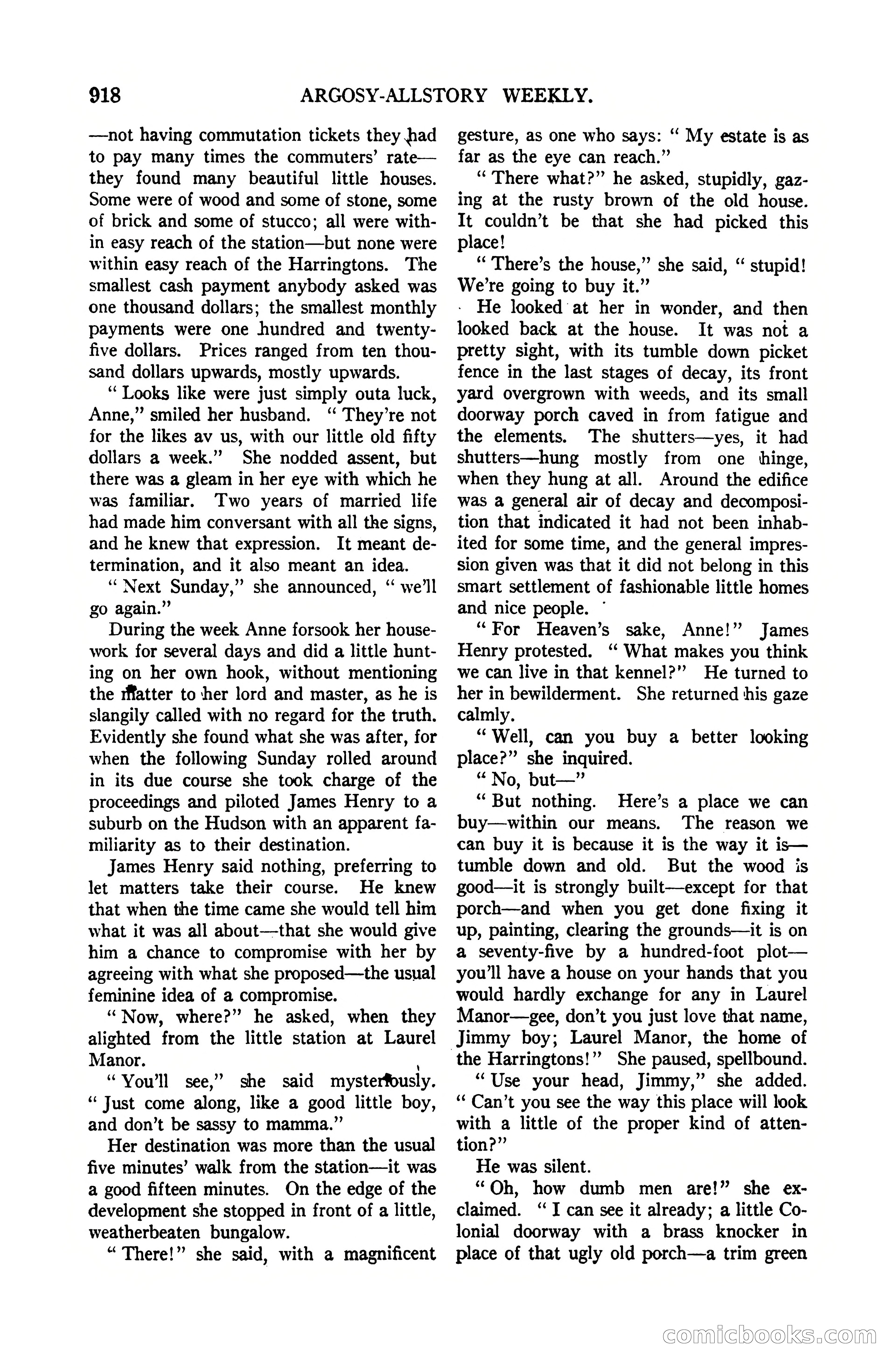
A restored page from Pulp Fiction, 1922. Page through the whole issue in the reader above.
📄 Transcribed text from this page (OCR, searchable)
Machine-transcribed from the original scan — historical spelling and the odd misread are preserved.
918 —not having commutation tickets they had to pay many times the commuters’ rate— they found many beautiful little houses. Some were of wood and some of stone, some of brick and some of stucco; all were with- in easy reach of the station—but none were within easy reach of the Harringtons. The smallest cash payment anybody asked was one thousand dollars; the smallest monthly payments were one hundred and twenty- five dollars. Prices ranged from ten thou- sand dollars upwards, mostly upwards. ‘“ Looks like were just simply outa luck, Anne,” smiled her husband. ‘“ They’re not for the likes av us, with our little old fifty dollars a week.” She nodded assent, but there was a gleam in her eye with which he was familiar. Two years of married life had made him conversant with all the signs, and he knew that expression. It meant de- termination, and it also meant an idea. ‘““Next Sunday,” she announced, ‘ we’ll go again.” During the week Anne forsook her house- work for several days and did a little hunt- ing on her own hook, without mentioning the rffatter to ‘her lord and master, as he is slangily called with no regard for the truth. Evidently she found what she was after, for when the following Sunday rolled around in its due course she took charge of the proceedings and piloted James Henry to a suburb on the Hudson with an apparent fa- miliarity as to their destination. James Henry said nothing, preferring to let matters take their course. He knew that when the time came she would tell him what it was all about—that she would give him a chance to compromise with her by agreeing with what she proposed—the usual feminine idea of a compromise. “Now, where?” he asked, when they alighted from the little station at Laurel Manor. “You'll see,” she said mysterfously. ‘‘ Just come along, like a good little boy, and don’t be sassy to mamma.” Her destination was more than the usual five minutes’ walk from the station—it was a good fifteen minutes. On the edge of the development she stopped in front of a little, weatherbeaten bungalow. “There!” she said, with a magnificent ARGOSY-ALLSTORY WEEKLY. gesture, as one who says: “ My estate is as far as the eye can reach.” ‘“ There what?” he asked, stupidly, gaz- ing at the rusty brown of the old house. It couldn’t be that she had picked this place! “There’s the house,” she said, “ stupid! We're going to buy it.” - He looked at her in wonder, and then looked back at the house. It was not a pretty sight, with its tumble down picket fence in the last stages of decay, its front yard overgrown with weeds, and its small doorway porch caved in from fatigue and the elements. The shutters—yes, it had shutters—hung mostly from one hinge, when they hung at all. Around the edifice was a general air of decay and decomposi- tion that indicated it had not been inhab- ited for some time, and the general impres- sion given was that it did not belong in this smart settlement of fashionable little homes and nice people. ~ “For Heaven’s sake, Anne!” James Henry protested. ‘“ What makes you think we can live in that kennel?” He turned to her in bewilderment. She returned his gaze calmly. “Well, can you buy a better looking place?” she inquired. “ No, but—” “But nothing. MHere’s a place we can buy—within our means. The reason we can buy it is because it is the way it is— tumble down and old. But the wood is good—it is strongly built—except for that porch—and when you get done fixing it up, painting, clearing the grounds—it is on a seventy-five by a hundred-foot plot— you'll have a house on your hands that you would hardly exchange for any in Laurel Manor—gee, don’t you just love that name, Jimmy boy; Laurel Manor, the home of the Harringtons!’’ She paused, spellbound. ““Use your head, Jimmy,” she added. ‘“‘ Can’t you see the way this place will look with a little of the proper kind of atten- tion?” He was silent. “Oh, how dumb men are!” she ex- claimed. ‘I can see it already; a little Co- lonial doorway with a brass knocker in place of that ugly old porch—a trim green comicloool C©