
Pulp Fiction, 1922 · page 119 of 172
Argosy All-Story Weekly, July 1, 1922 — page 119: what you’re looking at
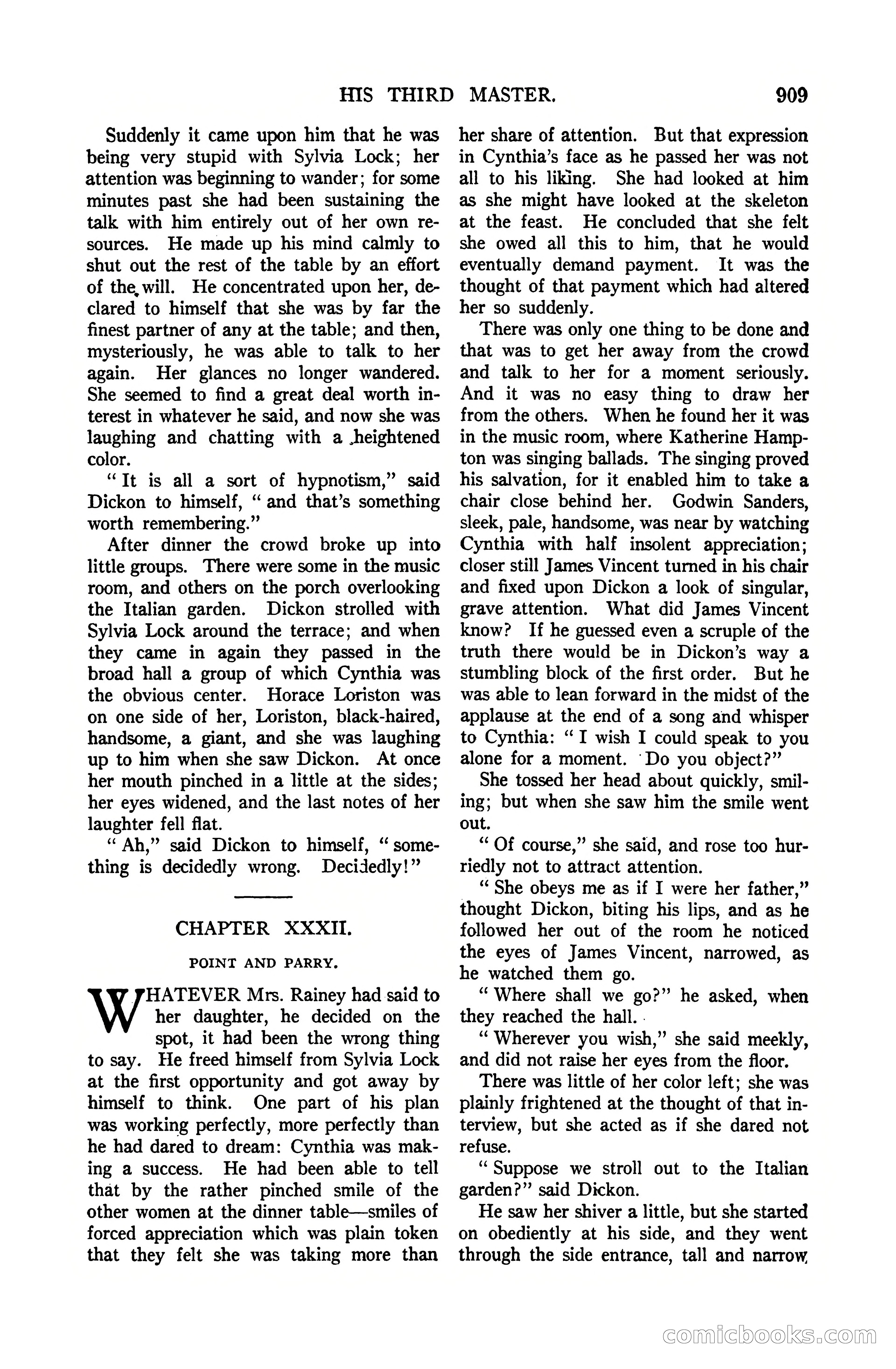
A restored page from Pulp Fiction, 1922. Page through the whole issue in the reader above.
📄 Transcribed text from this page (OCR, searchable)
Machine-transcribed from the original scan — historical spelling and the odd misread are preserved.
HIS THIRD MASTER, Suddenly it came upon him that he was being very stupid with Sylvia Lock; her attention was beginning to wander; for some minutes past she had been sustaining the talk with him entirely out of her own re- sources. He made up his mind calmly to shut out the rest of the table by an effort of the, will. He concentrated upon her, de- clared to himself that she was by far the finest partner of any at the table; and then, mysteriously, he was able to talk to her again. Her glances no longer wandered. She seemed to find a great deal worth in- terest in whatever he said, and now she was laughing and chatting with a .heightened color. “Tt is all a sort of hypnotism,” said Dickon to himself, “ and that’s something worth remembering.” After dinner the crowd broke up into little groups. There were some in the music room, and others on the porch overlooking the Italian garden. Dickon strolled with Sylvia Lock around the terrace; and when they came in again they passed in the broad hall a group of which Cynthia was the obvious center. Horace Loriston was on one side of her, Loriston, black-haired, handsome, a giant, and she was laughing up to him when she saw Dickon. At once her mouth pinched in a little at the sides; her eyes widened, and the last notes of her laughter fell flat. “Ah,” said Dickon to himself, “ some- thing is decidedly wrong. Decidedly!” CHAPTER XXXII. POINT AND PARRY. YHATEVER Mrs. Rainey had said to her daughter, he decided on the spot, it had been the wrong thing to say. He freed himself from Sylvia Lock at the first opportunity and got away by himself to think. One part of his plan was working perfectly, more perfectly than he had dared to dream: Cynthia was mak- ing a success. He had been able to tell that by the rather pinched smile of the other women at the dinner table—smiles of forced appreciation which was plain token that they felt she was taking more than 909 her share of attention. But that expression in Cynthia’s face as he passed her was not all to his liking. She had looked at him as she might have looked at the skeleton at the feast. He concluded that she felt she owed all this to him, that he would eventually demand payment. It was the thought of that payment which had altered her so suddenly. There was only one thing to be done and that was to get her away from the crowd and talk to her for a moment seriously. And it was no easy thing to draw her from the others. When he found her it was in the music room, where Katherine Hamp- ton was singing ballads. The singing proved his salvation, for it enabled him to take a chair close behind her. Godwin Sanders, sleek, pale, handsome, was near by watching Cynthia with half insolent appreciation; closer still James Vincent turned in his chair and fixed upon Dickon a look of singular, grave attention. What did James Vincent know? If he guessed even a scruple of the truth there would be in Dickon’s way a stumbling block of the first order. But he was able to lean forward in the midst of the applause at the end of a song and whisper to Cynthia: ‘I wish I could speak to you alone for a moment. ‘Do you object?” She tossed her head about quickly, smil- ing; but when she saw him the smile went out. “‘ Of course,” she said, and rose too hur- riedly not to attract attention. _ “She obeys me as if I were her father,” thought Dickon, biting his lips, and as he followed her out of the room he noticed the eyes of James Vincent, narrowed, as he watched them go. ‘Where shall we go?” he asked, when they reached the hall. . ‘“Wherever you wish,” she said meekly, and did not raise her eyes from the floor. There was little of her color left; she was plainly frightened at the thought of that in- terview, but she acted as if she dared not refuse. ‘“‘ Suppose we stroll out to the Italian garden?”’ said Dickon. He saw her shiver a little, but she started on obediently at his side, and they went through the side entrance, tall and narrow, DOOK C©