
Pulp Fiction, 1922 · page 115 of 172
Argosy All-Story Weekly, July 1, 1922 — page 115: what you’re looking at
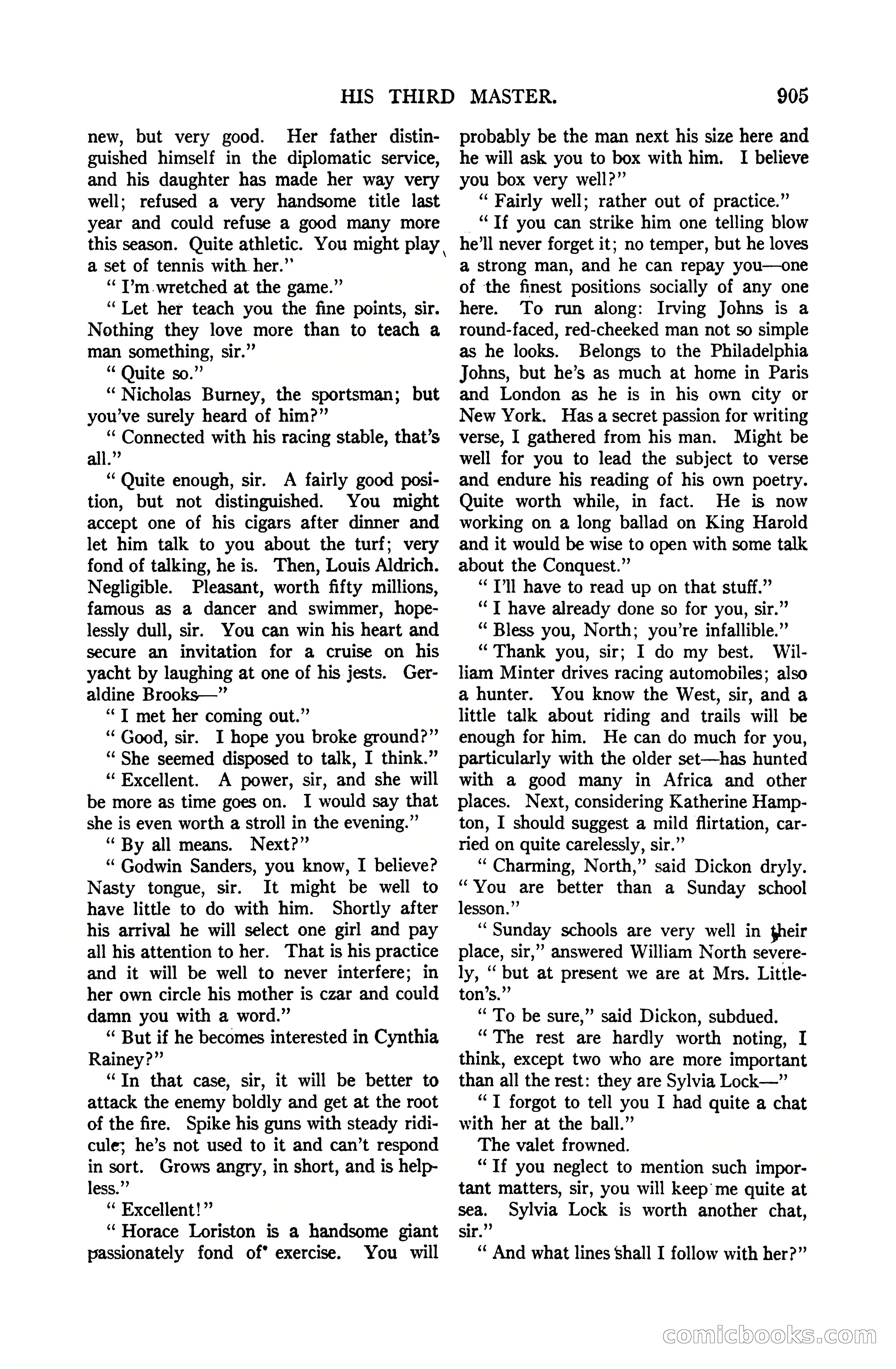
A restored page from Pulp Fiction, 1922. Page through the whole issue in the reader above.
📄 Transcribed text from this page (OCR, searchable)
Machine-transcribed from the original scan — historical spelling and the odd misread are preserved.
HIS THIRD new, but very good. Her father distin- guished himself in the diplomatic service, and his daughter has made her way very well; refused a very handsome title last year and could refuse a good many more this season. Quite athletic. You might play | a set of tennis with her.”’ ‘“‘1’m.wretched at the game.” “Let her teach you the fine points, sir. Nothing they love more than to teach a man something, sir.” “ Quite so.” “Nicholas Burney, the sportsman; but you’ve surely heard of him?” “ Connected with his racing stable, that’s all.” “Quite enough, sir. A fairly good posi- tion, but not distinguished. You might accept one of his cigars after dinner and let him talk to you about the turf; very fond of talking, he is. Then, Louis Aldrich. Negligible. Pleasant, worth fifty millions, famous as a dancer and swimmer, hope- lessly dull, sir. You can win his heart and secure an invitation for a cruise on his yacht by laughing at one of his jests. Ger- aldine Brooks—” “J met her coming out.” “ Good, sir. I hope you broke ground?”’ ‘“‘ She seemed disposed to talk, I think.” “Excellent. A power, sir, and she will be more as time goes on. I would say that she is even worth a stroll in the evening.” ‘“‘ By all means. Next?” “ Godwin Sanders, you know, I believe? Nasty tongue, sir. It might be well to have little to do with him. Shortly after his arrival he will select one girl and pay all his attention to her. That is his practice and it will be well to never interfere; in her own circle his mother is czar and could damn you with a word.” “ But if he becomes interested in Cynthia Rainey?” “In that case, sir, it will be better to attack the enemy boldly and get at the root of the fire. Spike his guns with steady ridi- cule; he’s not used to it and can’t respond in sort. Grows angry, in short, and is help- less.” “ Excellent!” “Horace Loriston is a handsome giant passionately fond of* exercise. You will MASTER. 905 probably be the man next his size here and he will ask you to box with him, I believe you box very well?” “Fairly well; rather out of practice.” _“Tf you can strike him one telling blow he’ll never forget it; no temper, but he loves a strong man, and he can repay you—one of the finest positions socially of any one here. To run along: Irving Johns is a round-faced, red-cheeked man not so simple as he looks. Belongs to the Philadelphia Johns, but he’s as much at home in Paris and London as he is in his own city or New York. Has a secret passion for writing verse, I gathered from his man. Might be well for you to lead the subject to verse and endure his reading of his own poetry. Quite worth while, in fact. He is now working on a long ballad on King Harold and it would be wise to open with some talk about the Conquest.” ‘“‘T’ll have to read up on that stuff.” ‘“‘T have already done so for you, sir.” “ Bless you, North; you’re infallible.” “Thank you, sir; I do my best. Wil- liam Minter drives racing automobiles; also a hunter. You know the West, sir, and a little talk about riding and trails will be enough for him. He can do much for you, particularly with the older set—has hunted with a good many in Africa and other places. Next, considering Katherine Hamp- ton, I should suggest a mild flirtation, car- ried on quite carelessly, sir.” ‘““ Charming, North,” said Dickon dryly. “You are better than a Sunday school lesson.”’ ‘Sunday schools are very well in heir place, sir,” answered William North severe- ly, “ but at present we are at Mrs. Little- ton’s.”’ “To be sure,” said Dickon, subdued. “The rest are hardly worth noting, I think, except two who are more important than all the rest: they are Sylvia Lock—” “IT forgot to tell you I had quite a chat with her at the ball.” The valet frowned. “If you neglect to mention such impor- tant matters, sir, you will keep'me quite at sea. Sylvia Lock is worth another chat, sir.”’ ‘* And what lines Shall I follow with her?” DOOK C©