
Pulp Fiction, 1922 · page 79 of 172
Argosy All-Story Weekly, January 21, 1922 — page 79: what you’re looking at
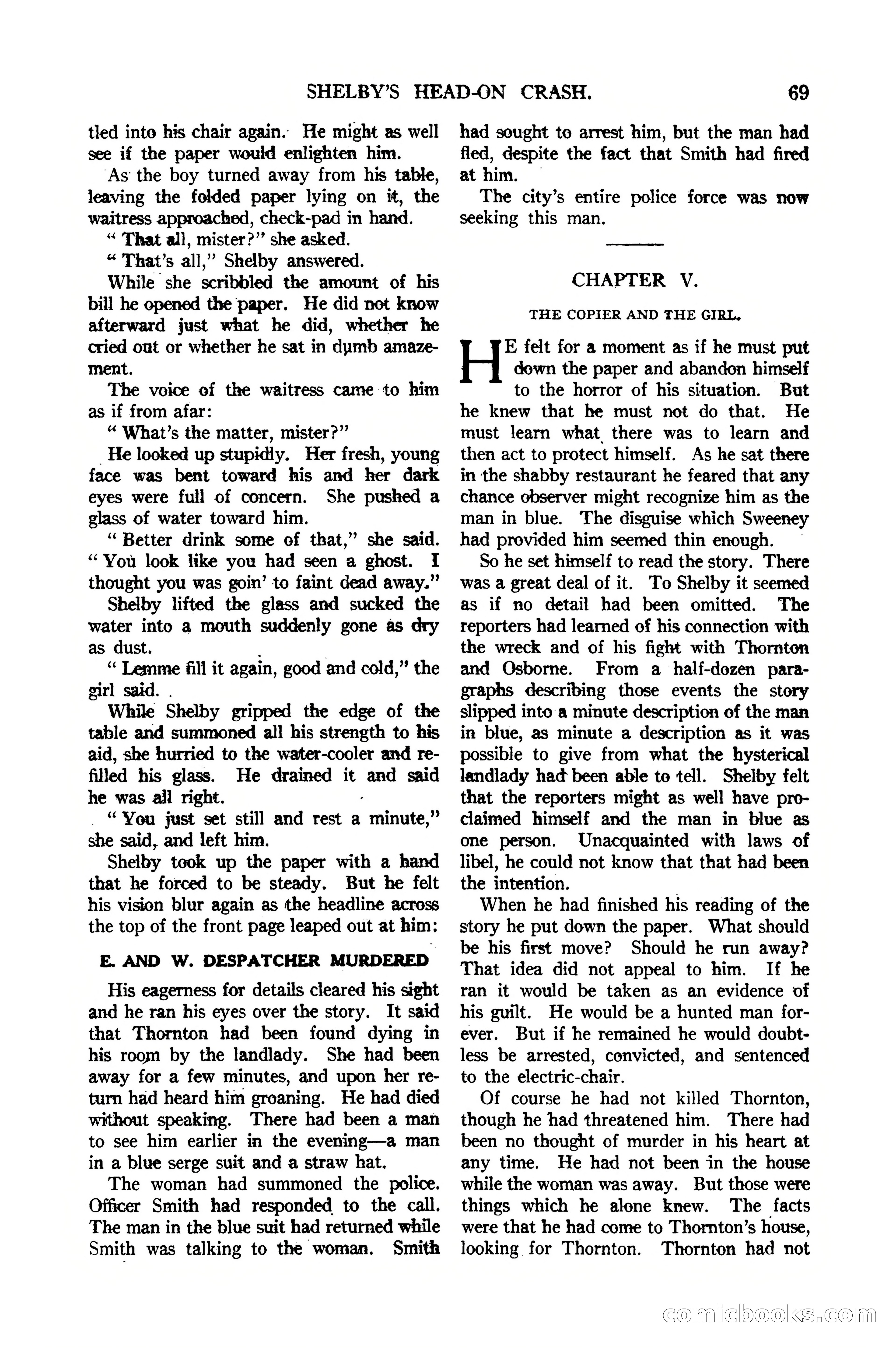
A restored page from Pulp Fiction, 1922. Page through the whole issue in the reader above.
📄 Transcribed text from this page (OCR, searchable)
Machine-transcribed from the original scan — historical spelling and the odd misread are preserved.
SHELBY’S HEAD-ON CRASH. tled into his chair again. He might as well see if the paper would enlighten him. ‘As the boy turned away from his table, leaving the folded paper lying on it, the waitress approached, check-pad in hand. “ That all, mister?” she asked. “ That’s all,” Shelby answered. While she scribbled the amount of his bill he opened the paper. He did net know afterward just what he did, whether he cried out or whether he sat in dumb amaze- ment. The voice of the waitress came to him as if from afar: “ What’s the matter, mister?” He looked up stupidly. Her fresh, young face was bent toward his and her dark eyes were full of concern. She pushed a glass of water toward him. “ Better drink some of that,” she said. “You look like you had seen a ghost. [ thought you was goin’ to faint dead away.” Shelby lifted the glass and sucked the water into a mouth suddenly gone as dry as dust. | “ Lemme fill it again, good and cold,”’ the girl said. . While Shelby gripped the edge of the table and summoned all his strength to his aid, she hurried to the water-cooler and re- filled his glass. He drained it and said he was ail right. _ “You just set still and rest a minute,” she said, and left him. Shelby took up the paper with a hand that he forced to be steady. But he felt his vision blur again as the headline across the top of the front page leaped out at him: E. AND W. DESPATCHER MURDERED His eagerness for details cleared his sight and he ran his eyes over the story. It said that Thornton had been found dying in his room by the landlady. She had been away for a few minutes, and upon her re- turn had heard him groaning. He had died without speaking. There had been a man to see him earlier in the evening—a man in a blue serge suit and a straw hat. The woman had summoned the police. Officer Smith had responded to the call. The man in the blue suit had returned while Smith was talking to the woman. Smith 69 had sought to arrest him, but the man had fled, despite the fact that Smith had fired at him. — The city’s entire police force was now seeking this man. CHAPTER V. THE COPIER AND THE GIRL, E felt for a moment as if he must put down the paper and abandon himself to the horror of his situation. But he knew that he must not do that. He must learn what there was to learn and then act to protect himself. As he sat there in the shabby restaurant he feared that any chance observer might recognize him as the man in blue. The disguise which Sweeney had provided him seemed thin enough. _ So he set himself to read the story. There was a great deal of it. To Shelby it seemed as if no detail had been omitted. The reporters had learned of his connection with the wreck and of his fight with Thornton and Osborne. From a half-dozen para- graphs describing those events the story slipped into a minute description of the man in blue, as minute a description as it was possible to give from what the hysterical landlady had been able to tell. Shelby felt that the reporters might as well have pro- claimed himself and the man in blue as one person. Unacquainted with laws of libel, he could not know that that had been the intention. | When he had finished his reading of the story he put down the paper. What should be his first move? Should he run away? That idea did not appeal to him. If he ran it would be taken as an evidence of his guilt. He would be a hunted man for- ever. But if he remained he would doubt- less be arrested, convicted, and sentenced to the electric-chair. Of course he had not killed Thornton, though he had threatened him. There had been no thought of murder in his heart at any time. He had not been in the house while the woman was away. But those were things which he alone knew. The facts were that he had come to Thornton’s house, looking for Thornton. Thornton had not COMmiclboo SS C©