
Pulp Fiction, 1922 · page 70 of 172
Argosy All-Story Weekly, January 21, 1922 — page 70: what you’re looking at
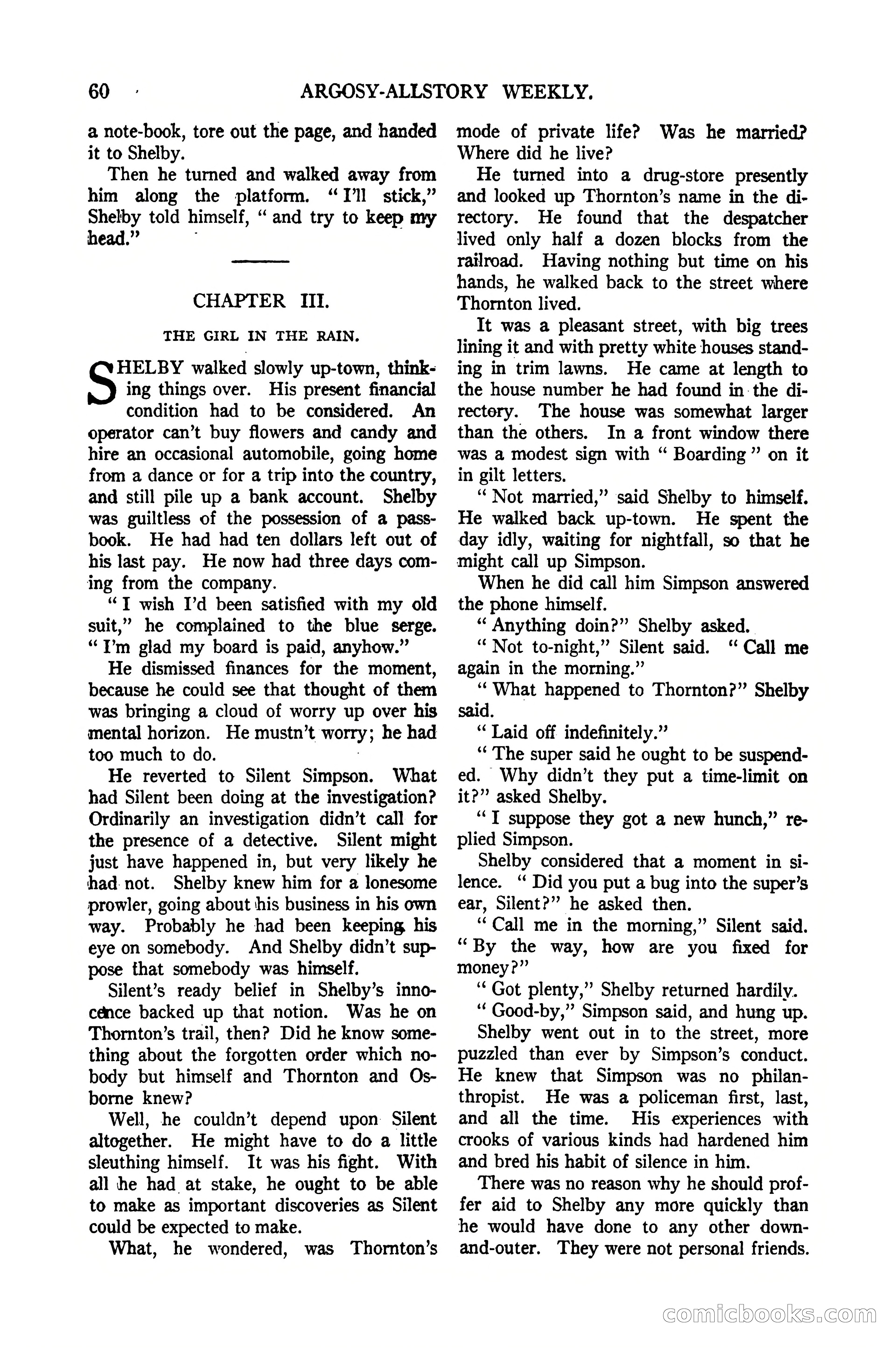
A restored page from Pulp Fiction, 1922. Page through the whole issue in the reader above.
📄 Transcribed text from this page (OCR, searchable)
Machine-transcribed from the original scan — historical spelling and the odd misread are preserved.
60 a note-book, tore out the page, and handed it to Shelby. Then he turned and walked away from him along the platform. “I'll stick,” Shelby told himself, “ and try to keep my head.” CHAPTER III. THE GIRL IN THE RAIN. HELBY walked slowly up-town, think- ing things over. His present financial condition had to be considered. An operator can’t buy flowers and candy and hire an occasional automobile, going home from a dance or for a trip into the country, and still pile up a bank account. Shelby was guiltless of the possession of a pass- book. He had had ten dollars left out of his last pay. He now had three days com- ing from the company. “TI wish I’d been satisfied with my old suit,” he complained to the blue serge. “I’m glad my board is paid, anyhow.” He dismissed finances for the moment, because he could see that thought of them was bringing a cloud of worry up over his mental horizon. He mustn’t worry; he had too much to do. : He reverted to Silent Simpson. What had Silent been doing at the investigation? Ordinarily an investigation didn’t call for the presence of a detective. Silent might just have happened in, but very likely he had-not. Shelby knew him for a lonesome prowler, going about his business in his own way. Probably he had been keeping his eye on somebody. And Shelby didn’t sup- pose that somebody was himself. Silent’s ready belief in Shelby’s inno- cance backed up that notion. Was he on Thornton’s trail, then? Did he know some- thing about the forgotten order which no- body but himself and Thornton and Os- borne knew? Well, he couldn’t depend upon Silent altogether. He might have to do a little sleuthing himself. It was his fight. With all he had at stake, he ought to be able to make as important discoveries as Silent could be expected to make. What, he wondered, was Thornton’s ARGOSY-ALLSTORY WEEKLY. mode of private lifep Was he married? Where did he live? He turned into a drug-store presently and looked up Thornton’s name in the di- rectory. He found that the despatcher lived only half a dozen blocks from the railroad. Having nothing but time on his hands, he walked back to the street where Thornton lived. It was a pleasant street, with big trees lining it and with pretty white houses stand- ing in trim lawns. He came at length to the house number he had found in the di- rectory. The house was somewhat larger than the others. In a front window there was a modest sign with “ Boarding ” on it in gilt letters. ‘“Not married,” said Shelby to himself. He walked back up-town. He spent the day idly, waiting for nightfall, so that he might call up Simpson. When he did call him Simpson answered the phone himself. “‘ Anything doin?” Shelby asked. ‘“‘ Not to-night,” Silent said. ‘ Call me again in the morning.” ‘‘What happened to Thornton?” Shelby said. ‘Laid off indefinitely.” ‘* The super said he ought to be suspend- ed. Why didn’t they put a time-limit on it?” asked Shelby. ‘““T suppose they got a new hunch,” re- plied Simpson. Shelby considered that a moment in si- lence. “ Did you put a bug into the super’s ear, Silent?” he asked then. ‘Call me in the morning,” Silent said. ‘““By the way, how are you fixed for money ?”’ ‘Got plenty,” Shelby returned hardily. ‘‘ Good-by,” Simpson said, and hung up. Shelby went out in to the street, more puzzled than ever by Simpson’s conduct. He knew that Simpson was no philan- thropist. He was a policeman first, last, and all the time. His experiences with crooks of various kinds had hardened him and bred his habit of silence in him. There was no reason why he should prof- fer aid to Shelby any more quickly than he would have done to any other down- and-outer. They were not personal friends. COMmiclboo SS C©