
Pulp Fiction, 1922 · page 59 of 172
Argosy All-Story Weekly, January 21, 1922 — page 59: what you’re looking at
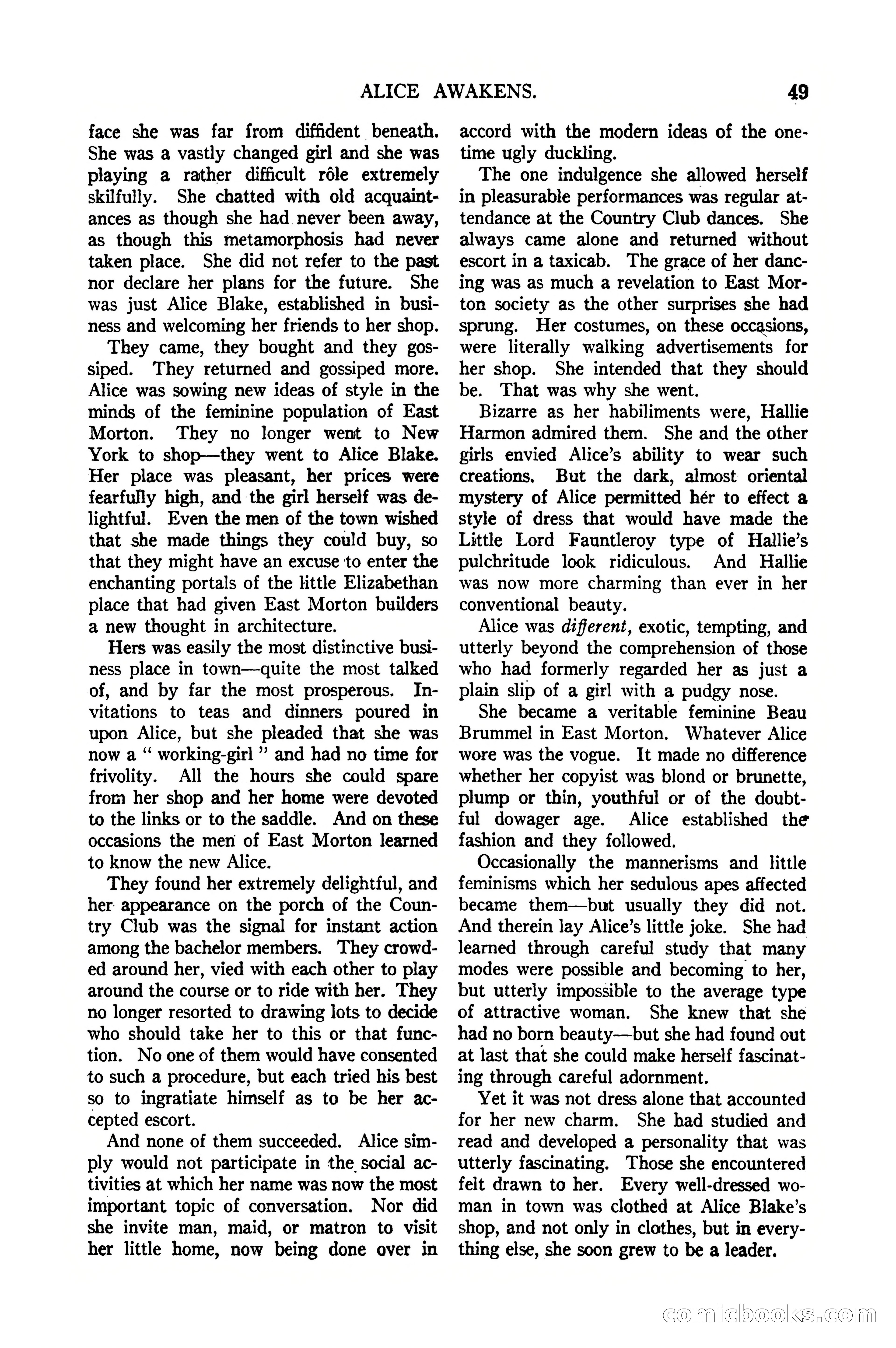
A restored page from Pulp Fiction, 1922. Page through the whole issue in the reader above.
📄 Transcribed text from this page (OCR, searchable)
Machine-transcribed from the original scan — historical spelling and the odd misread are preserved.
ALICE AWAKENS. face she was far from diffident beneath. She was a vastly changed girl and she was playing a rather difficult réle extremely skilfully. She chatted with old acquaint- ances as though she had never been away, as though this metamorphosis had never taken place. She did not refer to the past nor declare her plans for the future. She was just Alice Blake, established in busi- ness and welcoming her friends to her shop. They came, they bought and they gos- siped. They returned and gossiped more. Alice was sowing new ideas of style in the minds of the feminine population of East Morton. They no longer went to New York to shop—they went to Alice Blake. Her place was pleasant, her prices were fearfully high, and the girl herself was de- lightful. Even the men of the town wished that she made things they could buy, so that they might have an excuse to enter the enchanting portals of the little Elizabethan place that had given East Morton builders a new thought in architecture. Hers was easily the most distinctive busi- ness place in town—quite the most talked of, and by far the most prosperous. In- vitations to teas and dinners poured in upon Alice, but she pleaded that she was now a “ working-girl ’’ and had no time for frivolity. All the hours she could spare from her shop and her home were devoted to the links or to the saddle. And on these occasions the men of East Morton learned to know the new Alice. They found her extremely delightful, and her: appearance on the porch of the Coun- try Club was the signal for instant action among the bachelor members. They crowd- ed around her, vied with each other to play around the course or to ride with her. They no longer resorted to drawing lots to decide who should take her to this or that func- tion. No one of them would have consented to such a procedure, but each tried his best so to ingratiate himself as to be her ac- cepted escort. And none of them succeeded. Alice sim- ply would not participate in the social ac- tivities at which her name was now the most important topic of conversation. Nor did she invite man, maid, or matron to visit her little home, now being done over in 49 accord with the modern ideas of the one- time ugly duckling. The one indulgence she allowed herself in pleasurable performances was regular at- tendance at the Country Club dances. She always came alone and returned without escort in a taxicab. The grace of her danc- ing was as much a revelation to East Mor- ton society as the other surprises she had sprung. Her costumes, on these occasions, were literally walking advertisements for her shop. She intended that they should be. That was why she went. Bizarre as her habiliments were, Hallie Harmon admired them. She and the other girls envied Alice’s ability to wear such creations. But the dark, almost oriental mystery of Alice permitted hér to effect a style of dress that would have made the Little Lord Fauntleroy type of Hallie’s pulchritude look ridiculous. And Hallie was now more charming than ever in her conventional beauty. Alice was different, exotic, tempting, and utterly beyond the comprehension of those who had formerly regarded her as just a plain slip of a girl with a pudgy nose. She became a veritable feminine Beau Brummel in East Morton. Whatever Alice wore was the vogue. It made no difference whether her copyist was blond or brunette, plump or thin, youthful or of the doubt- ful dowager age. Alice established the fashion and they followed. Occasionally the mannerisms and little feminisms which her sedulous apes affected became them—but usually they did not. And therein lay Alice’s little joke. She had learned through careful study that many modes were possible and becoming to her, but utterly impossible to the average type of attractive woman. She knew that she had no born beauty—but she had found out at last that she could make herself fascinat- ing through careful adornment. Yet it was not dress alone that accounted for her new charm. She had studied and read and developed a personality that was utterly fascinating. Those she encountered felt drawn to her. Every well-dressed wo- man in town was clothed at Alice Blake’s shop, and not only in clothes, but in every- thing else, she soon grew to be a leader. comicloool C©