
Pulp Fiction, 1922 · page 53 of 172
Argosy All-Story Weekly, January 21, 1922 — page 53: what you’re looking at
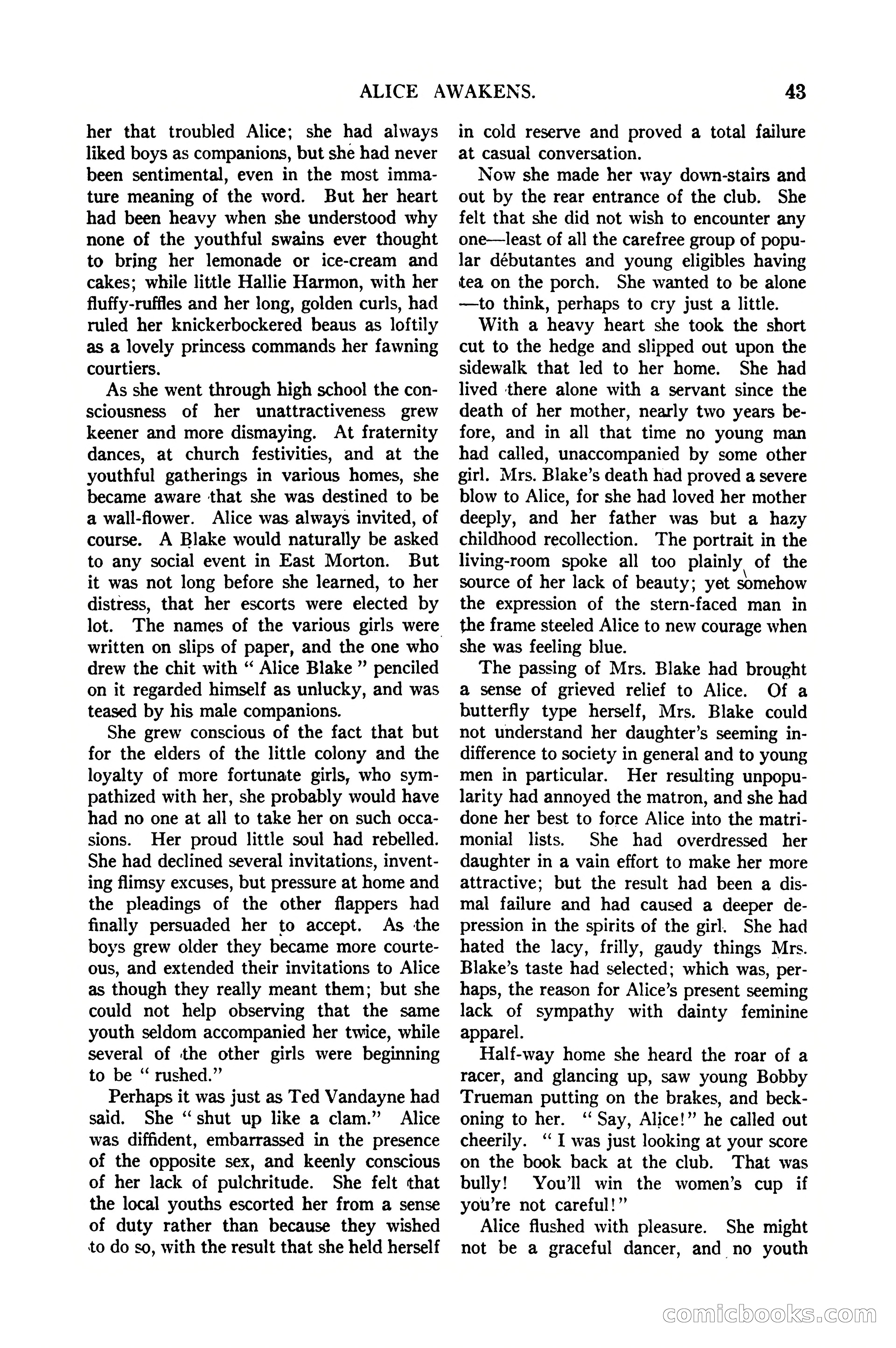
A restored page from Pulp Fiction, 1922. Page through the whole issue in the reader above.
📄 Transcribed text from this page (OCR, searchable)
Machine-transcribed from the original scan — historical spelling and the odd misread are preserved.
ALICE her that troubled Alice; she had always liked boys as companions, but she had never been sentimental, even in the most imma- ture meaning of the word. But her heart had been heavy when she understood why none of the youthful swains ever thought to bring her lemonade or ice-cream and cakes; while little Hallie Harmon, with her fluffy-ruffles and her long, golden curls, had ruled her knickerbockered beaus as loftily as a lovely princess commands her fawning courtiers. As she went through high school the con- sciousness of her unattractiveness grew keener and more dismaying. At fraternity dances, at church festivities, and at the youthful gatherings in various homes, she became aware that she was destined to be a wall-flower. Alice was always invited, of course. A Blake would naturally be asked to any social event in East Morton. But it was not long before she learned, to her distress, that her escorts were elected by lot. The names of the various girls were written on slips of paper, and the one who drew the chit with “ Alice Blake ” penciled on it regarded himself as unlucky, and was teased by his male companions. She grew conscious of the fact that but for the elders of the little colony and the loyalty of more fortunate girls, who sym- pathized with her, she probably would have had no one at all to take her on such occa- sions. Her proud little soul had rebelled. She had declined several invitations, invent- ing flimsy excuses, but pressure at home and the pleadings of the other flappers had finally persuaded her to accept. As the boys grew older they became more courte- ous, and extended their invitations to Alice as though they really meant them; but she could not help observing that the same youth seldom accompanied her twice, while several of the other girls were beginning to be “ rushed.” Perhaps it was just as Ted Vandayne had said. She “shut up like a clam.” Alice was diffident, embarrassed in the presence of the opposite sex, and keenly conscious of her lack of pulchritude. She felt that the local youths escorted her from a sense of duty rather than because they wished to do so, with the result that she held herself AWAKENS. 43 in cold reserve and proved a total failure at casual conversation. Now she made her way down-stairs and out by the rear entrance of the club. She felt that she did not wish to encounter any one—least of all the carefree group of popu- lar débutantes and young eligibles having tea on the porch. She wanted to be alone —to think, perhaps to cry just a little. With a heavy heart she took the short cut to the hedge and slipped out upon the sidewalk that led to her home. She had lived there alone with a servant since the death of her mother, nearly two years be- fore, and in all that time no young man had called, unaccompanied by some other girl. Mrs. Blake’s death had proved a severe blow to Alice, for she had loved her mother deeply, and her father was but a hazy childhood recollection. The portrait in the living-room spoke all too plainly of the source of her lack of beauty; yet somehow the expression of the stern-faced man in the frame steeled Alice to new courage when she was feeling blue. The passing of Mrs. Blake had brought a sense of grieved relief to Alice. Of a butterfly type herself, Mrs. Blake could not understand her daughter’s seeming in- difference to society in general and to young men in particular. Her resulting unpopu- larity had annoyed the matron, and she had done her best to force Alice into the matri- monial lists. She had overdressed her daughter in a vain effort to make her more attractive; but the result had been a dis- mal failure and had caused a deeper de- pression in the spirits of the girl. She had hated the lacy, frilly, gaudy things Mrs. Blake’s taste had selected; which was, per- haps, the reason for Alice’s present seeming lack of sympathy with dainty feminine apparel. Half-way home she heard the roar of a racer, and glancing up, saw young Bobby Trueman putting on the brakes, and beck- oning to her. ‘‘ Say, Alice!” he called out cheerily. ‘“‘ I was just looking at your score on the book back at the club. That was bully! You'll win the women’s cup if you’re not careful!” Alice flushed with pleasure. She might not be a graceful dancer, and no youth COMmiclboo SS C©