
Pulp Fiction, 1922 · page 23 of 172
Argosy All-Story Weekly, January 21, 1922 — page 23: what you’re looking at
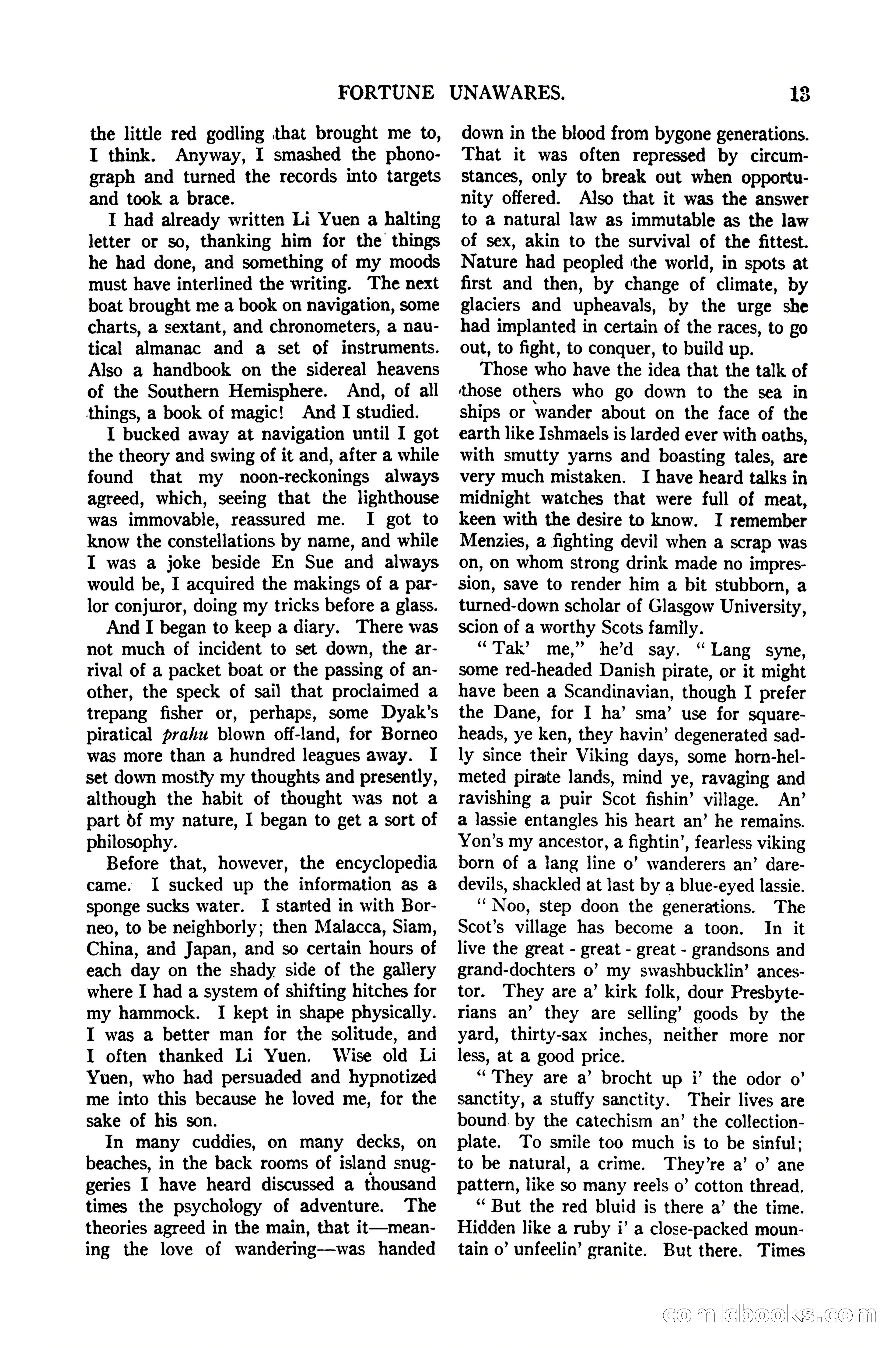
A restored page from Pulp Fiction, 1922. Page through the whole issue in the reader above.
📄 Transcribed text from this page (OCR, searchable)
Machine-transcribed from the original scan — historical spelling and the odd misread are preserved.
FORTUNE UNAWARES. 15 the little red godling that brought me to, I think. Anyway, I smashed the phono- graph and turned the records into targets and took a brace. I had already written Li Yuen a halting letter or so, thanking him for the things he had done, and something of my moods must have interlined the writing. The next boat brought me a book on navigation, some charts, a sextant, and chronometers, a nau- tical almanac and a set of instruments. Also a handbook on the sidereal heavens of the Southern Hemisphere. And, of all things, a book of magic! And I studied. I bucked away at navigation until I got the theory and swing of it and, after a while found that my noon-reckonings always agreed, which, seeing that the lighthouse was immovable, reassured me. I got to know the constellations by name, and while I was a joke beside En Sue and always would be, I acquired the makings of a par- lor conjuror, doing my tricks before a glass. And I began to keep a diary. There was not much of incident to set down, the ar- rival of a packet boat or the passing of an- other, the speck of sail that proclaimed a trepang fisher or, perhaps, some Dyak’s piratical prahw blown off-land, for Borneo was more than a hundred leagues away. I set down mostly my thoughts and presently, although the habit of thought was not a part Of my nature, I began to get a sort of philosophy. Before that, however, the encyclopedia came. I sucked up the information as a sponge sucks water. I started in with Bor- neo, to be neighborly; then Malacca, Siam, China, and Japan, and so certain hours of each day on the shady side of the gallery where I had a system of shifting hitches for my hammock. I kept in shape physically. I was a better man for the solitude, and I often thanked Li Yuen. Wise old Li Yuen, who had persuaded and hypnotized me into this because he loved me, for the sake of his son. In many cuddies, on many decks, on beaches, in the back rooms of island snug- geries I have heard discussed a thousand times the psychology of adventure. The theories agreed in the main, that it—mean- ing the love of wandering—was handed down in the blood from bygone generations. That it was often repressed by circum- stances, only to break out when opportu- nity offered. Also that it was the answer to a natural law as immutable as the law of sex, akin to the survival of the fittest. Nature had peopled tthe world, in spots at first and then, by change of climate, by glaciers and upheavals, by the urge she had implanted in certain of the races, to go out, to fight, to conquer, to build up. Those who have the idea that the talk of ‘those others who go down to the sea in ships or wander about on the face of the earth like Ishmaels is larded ever with oaths, with smutty yarns and boasting tales, are very much mistaken. I have heard talks in midnight watches that were full of meat, keen with the desire to know. I remember Menzies, a fighting devil when a scrap was on, on whom strong drink made no impres- sion, save to render him a bit stubborn, a turned-down scholar of Glasgow University, scion of a worthy Scots family. “ Tak’ me,” he’d say. “Lang syne, some red-headed Danish pirate, or it might have been a Scandinavian, though I prefer the Dane, for I ha’ sma’ use for square- heads, ye ken, they havin’ degenerated sad- ly since their Viking days, some horn-hel- meted pirate lands, mind ye, ravaging and ravishing a puir Scot fishin’ village. An’ a lassie entangles his heart an’ he remains. Yon’s my ancestor, a fightin’, fearless viking born of a lang line o’ wanderers an’ dare- devils, shackled at last by a blue-eyed lassie. ‘“Noo, step doon the generations. The Scot’s village has become a toon. In it live the great - great - great - grandsons and grand-dochters o’ my swashbucklin’ ances- tor. They are a’ kirk folk, dour Presbyte- rians an’ they are selling’ goods by the yard, thirty-sax inches, neither more nor less, at a good price. “They are a’ brocht up i’ the odor o’ sanctity, a stuffy sanctity. Their lives are bound. by the catechism an’ the collection- plate. To smile too much is to be sinful; to be natural, a crime. They’re a’ o’ ane pattern, like so many reels o’ cotton thread. “‘ But the red bluid is there a’ the time. Hidden like a ruby i’ a close-packed moun- tain o’ unfeelin’ granite. But there. Times comiclboooks C©