
Pulp Fiction, 1922 · page 159 of 172
Argosy All-Story Weekly, January 21, 1922 — page 159: what you’re looking at
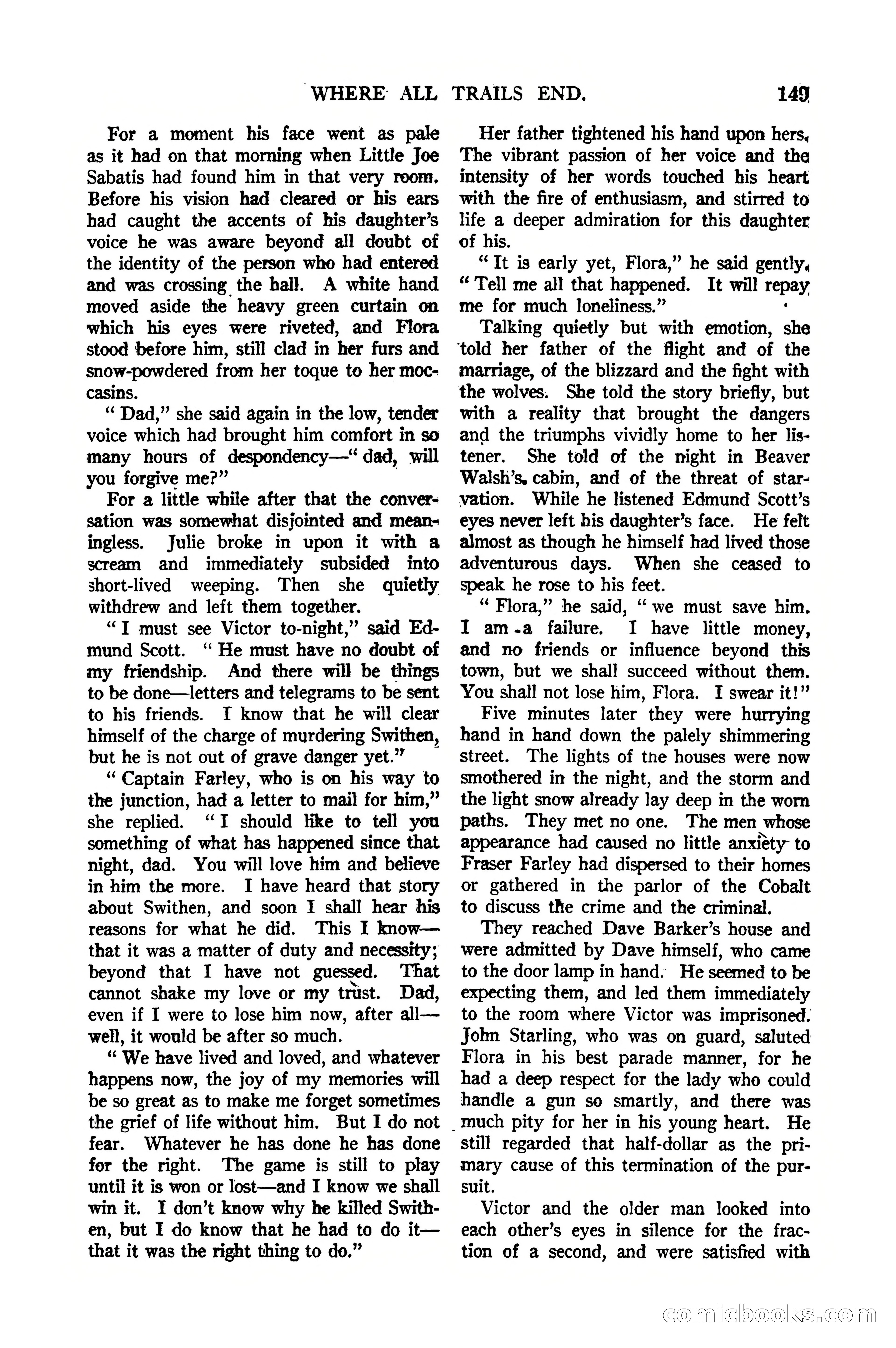
A restored page from Pulp Fiction, 1922. Page through the whole issue in the reader above.
📄 Transcribed text from this page (OCR, searchable)
Machine-transcribed from the original scan — historical spelling and the odd misread are preserved.
‘WHERE ALL For a moment his face went as pale as it had on that morning when Little Joe Sabatis had found him in that very reom,. Before his vision had. cleared or his ears had caught the accents of his daughter’s voice he was aware beyond all doubt of the identity of the person who had entered and was crossing the hall. A white hand moved aside the heavy green curtain on which his eyes were riveted, and Flora stood before him, still clad in her furs and snow-powdered from her toque to her moc- casins. “ Dad,” she said again in the low, tender voice which had brought him comfort in so many hours of despondency—“ dad, will you forgive me?” For a little while after that the conver- sation was somewhat disjointed and mean- ingless. Julie broke in upon it with a scream and immediately subsided into short-lived weeping. Then she quietly withdrew and left them together. “T must see Victor to-night,” said Ed- mund Scott. ‘‘ He must have no doubt of my friendship. And there will be things to be done—letters and telegrams to be sent to his friends. I know that he will clear himself of the charge of murdering Swithen, but he is not out of grave danger yet.” “ Captain Farley, who is on his way to the junction, had a letter to mail for him,” she replied. ‘‘I should lke to tell you something of what has happened since that night, dad. You will love him and believe in him the more. I have heard that story about Swithen, and soon I shall hear his reasons for what he did. This I know— that it was a matter of duty and necessity; beyond that I have not guessed. That cannot shake my love or my trust. Dad, even if I were to lose him now, after all— well, it would be after so much. ‘We have lived and loved, and whatever happens now, the joy of my memories will be so great as to make me forget sometimes the grief of life without him. But I do not fear. Whatever he has done he has done fer the right. The game is still to play until it is won or lost—and I know we shall win it. I don’t know why he killed Swith- en, but I do know that he had to do it— that it was the right thing to do.” TRAILS END. 149 Her father tightened his hand upon hers, The vibrant passion of her voice and the intensity of her words touched his heart with the fire of enthusiasm, and stirred to life a deeper admiration for this daughter of his. “It is early yet, Flora,” he said gently, “Tell me all that happened. It will repay, me for much loneliness.” Talking quietly but with emotion, she ‘told her father of the flight and of the marriage, of the blizzard and the fight with the wolves. She told the story briefly, but with a reality that brought the dangers and the triumphs vividly home to her lis- tener. She told of the night in Beaver Walsh’s, cabin, and of the threat of star- vation. While he listened Edmund Scott’s eyes never left his daughter’s face. He felt almost as though he himself had lived those adventurous days. When she ceased to speak he rose to his feet. “ Flora,” he said, “‘ we must save him. I am-a failure. I have little money, and no friends or influence beyond this town, but we shall succeed without them. You shall not lose him, Flora. I swear it!” Five minutes later they were hurrying hand in hand down the palely shimmering street. The lights of the houses were now smothered in the night, and the storm and the light snow already lay deep in the worm paths. They met no one. The men whose appearance had caused no little anxiety to Fraser Farley had dispersed to their homes or gathered in the parlor of the Cobalt to discuss the crime and the criminal. They reached Dave Barker’s house and were admitted by Dave himself, who came to the door lamp in hand. He seemed to be expecting them, and led them immediately to the room where Victor was imprisoned. John Starling, who was on guard, saluted Flora in his best parade manner, for he had a deep respect for the lady who could handle a gun so smartly, and there was _™much pity for her in his young heart. He still regarded that half-dollar as the pri- mary cause of this termination of the pur- suit. Victor and the older man looked into each other’s eyes in silence for the frac- tion of a second, and were satisfted with COMmiclboo SS C©