
Pulp Fiction, 1922 · page 131 of 172
Argosy All-Story Weekly, January 21, 1922 — page 131: what you’re looking at
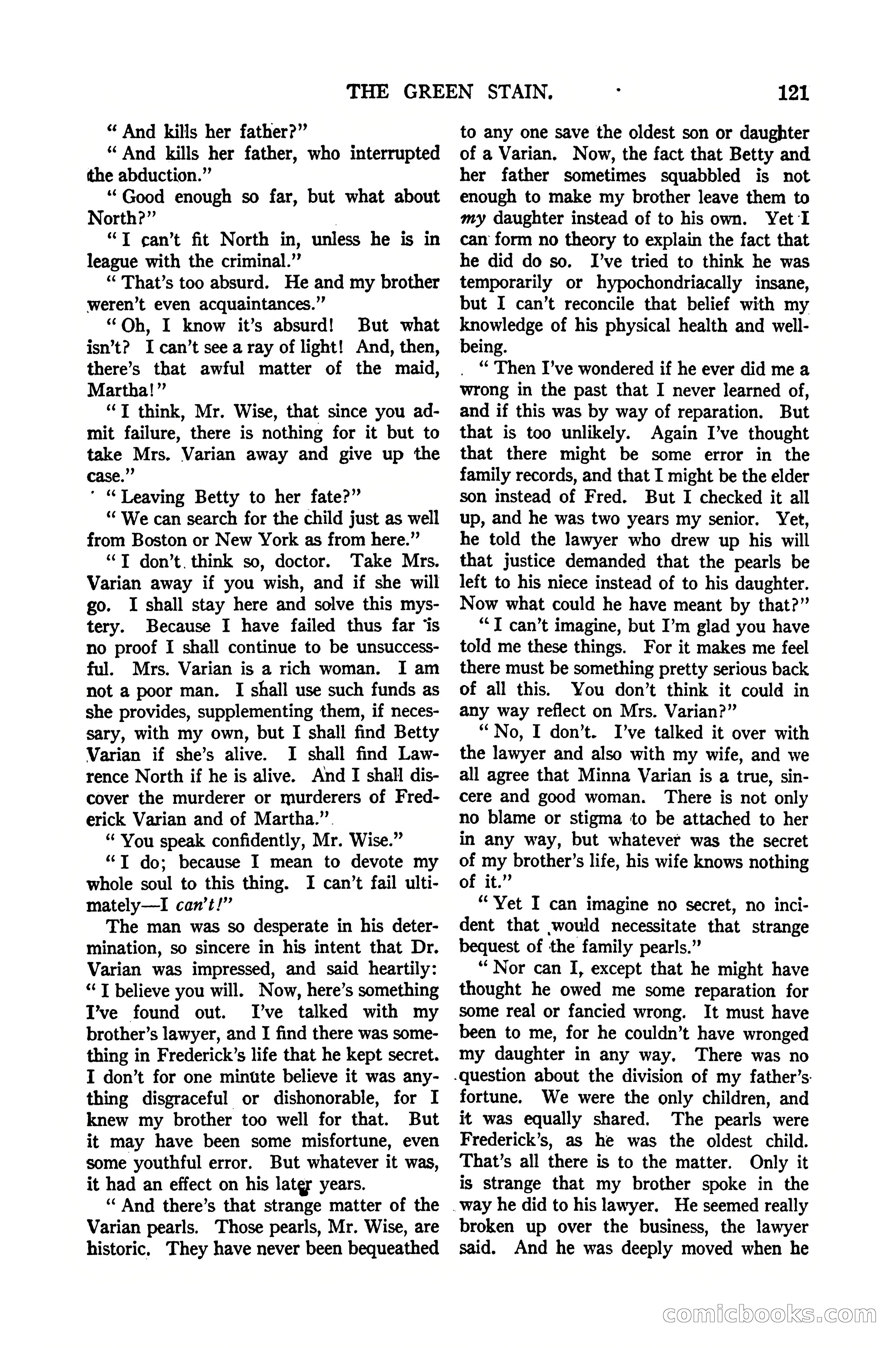
A restored page from Pulp Fiction, 1922. Page through the whole issue in the reader above.
📄 Transcribed text from this page (OCR, searchable)
Machine-transcribed from the original scan — historical spelling and the odd misread are preserved.
THE GREEN STAIN. “ And kills her father?” “ And kills her father, who interrupted the abduction.” ‘““Good enough so far, but what about North?” | “JT can’t fit North in, unless he is in league with the criminal.” “ That’s too absurd. He and my brother weren’t even acquaintances.” “Oh, I know it’s absurd! But what isn’t? I can’t see a ray of light! And, then, there’s that awful matter of the maid, Martha!” “TI think, Mr. Wise, that since you ad- mit failure, there is nothing for it but to take Mrs. Varian away and give up the case.”’ ' “Leaving Betty to her fate?” ‘“‘ We can search for the child just as well from Boston or New York as from here.” “TI don’t. think so, doctor. Take Mrs. Varian away if you wish, and if she will go. I shall stay here and solve this mys- tery. Because I have failed thus far ‘is no proof I shall continue to be unsuccess- ful. Mrs. Varian is a rich woman. I am not a poor man. I shall use such funds as she provides, supplementing them, if neces- sary, with my own, but I shall find Betty Varian if she’s alive. I shall find Law- rence North if he is alive. And I shall dis- cover the murderer or murderers of Fred- erick Varian and of Martha.” “ You speak confidently, Mr. Wise.” ““I do; because I mean to devote my whole soul to this thing. I can’t fail ulti- mately—I can’t!” The man was so desperate in his deter- mination, so sincere in his intent that Dr. Varian was impressed, and said heartily: ‘“T believe you will. Now, here’s something I’ve found out. I’ve talked with my brother’s lawyer, and I find there was some- thing in Frederick’s life that he kept secret. I don’t for one mintte believe it was any- thing disgraceful or dishonorable, for I knew my brother too well for that. But it may have been some misfortune, even some youthful error. But whatever it was, it had an effect on his later years. ‘“‘ And there’s that strange matter of the Varian pearls. Those pearls, Mr. Wise, are historic, They have never been bequeathed 121 to any one save the oldest son or daughter of a Varian. Now, the fact that Betty and her father sometimes squabbled is not enough to make my brother leave them to my daughter instead of to his own. Yet I can form no theory to explain the fact that he did do so. I’ve tried to think he was temporarily or hypochondriacally insane, but I can’t reconcile that belief with my knowledge of his physical health and well- being. _ “Then I’ve wondered if he ever did me a wrong in the past that I never learned of, and if this was by way of reparation. But that is too unlikely. Again I’ve thought that there might be some error in the family records, and that I might be the elder son instead of Fred. But I checked it all up, and he was two years my senior. Yet, he told the lawyer who drew up his will that justice demanded that the pearls be left to his niece instead of to his daughter. Now what could he have meant by that?” “*T can’t imagine, but I’m glad you have told me these things. For it makes me feel there must be something pretty serious back of all this. You don’t think it could in any way reflect on Mrs. Varian?” “No, I don’t. I’ve talked it over with the lawyer and also with my wife, and we all agree that Minna Varian is a true, sin- cere and good woman. There is not only no blame or stigma to be attached to her in any way, but whatever was the secret of my brother’s life, his wife knows nothing of it.” “Yet I can imagine no secret, no inci- dent that would necessitate that strange bequest of the family pearls.” “Nor can I, except that he might have thought he owed me some reparation for some real or fancied wrong. It must have been to me, for he couldn’t have wronged my daughter in any way. There was no -question about the division of my father’s: fortune. We were the only children, and it was equally shared. The pearls were Frederick’s, as he was the oldest child. That’s all there is to the matter. Only it is strange that my brother spoke in the _way he did to his lawyer. He seemed really broken up over the business, the lawyer said. And he was deeply moved when he comiclboooks C©