
Pulp Fiction, 1921 · page 83 of 157
Argosy All-Story Weekly, April 16, 1921 — page 83: what you’re looking at
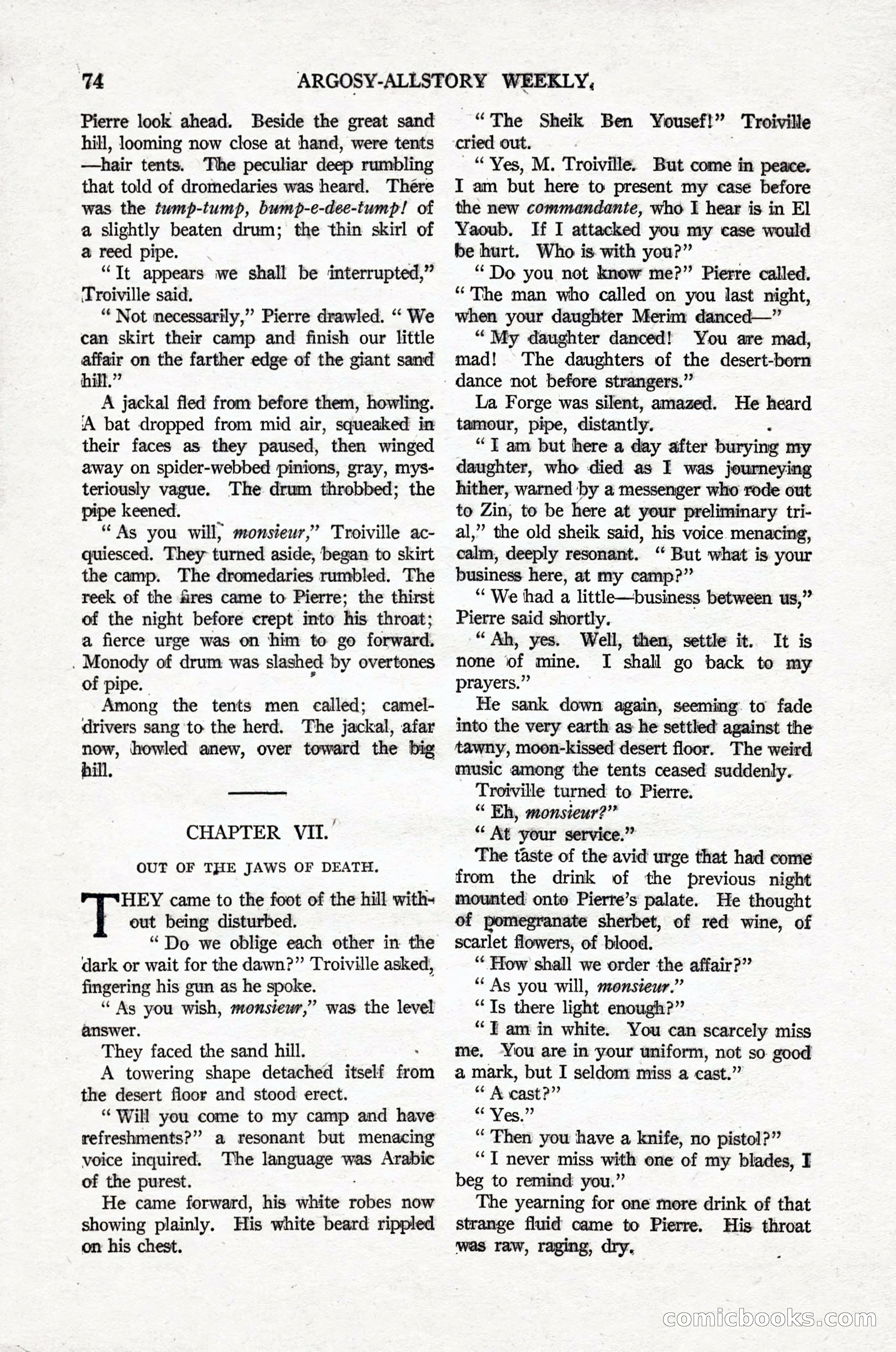
A restored page from Pulp Fiction, 1921. Page through the whole issue in the reader above.
📄 Transcribed text from this page (OCR, searchable)
Machine-transcribed from the original scan — historical spelling and the odd misread are preserved.
74 Pierre look ahead. Beside the great sand hill, looming now close at hand, were tents —hair tents. The peculiar deep rumbling that told of dromedaries was heard. There was the tump-tump, bump-e-dee-tump! of a slightly beaten drum; the thin skirl of a reed pipe. “Tt appears we shall be interrupted,” Troiville said. “‘ Not mecessarily,” Pierre drawled. ““ We can skirt their camp and finish our little affair on the farther edge of the giant sand hill.” A jackal fled from before them, howling. A bat dropped from mid air, squeaked in their faces as they paused, then winged away on spider-webbed pinions, gray, mys- teriously vague. The drum throbbed; the pipe keened. “ As you will, monsieur,” Troiville ac- quiesced. They turned aside, began to skirt the camp. The dromedaries rumbled. The reek of the ares came to Pierre; the thirst of the night before crept into his throat; a fierce urge was on him to go forward. Monody of drum was slashed by overtones of pipe. Among the tents men called; camel- drivers sang to the herd. The jackal, afar now, howled anew, over toward the big bill. CHAPTER VII. OUT OF THE JAWS OF DEATH, HEY came to the foot of the hill with- out being disturbed. “ Do we oblige each other in the dark or wait for the dawn?” Troiville asked, fingering his gun as he spoke. “As you wish, monsiewr,” was the level answer. They faced the sand hill. A towering shape detached itself from the desert floor and stood erect. “Will you come to my camp and have refreshments?” a resonant but menacing voice inquired. The language was Arabic of the purest. He came forward, his white eiies now showing plainly. His white beard rippled on his chest. ARGOSY-ALLSTORY WEEKLY, “The Sheik Ben Yousef!” _ Troiville ‘cried out. . “Yes, M. Troiville. But come in peace. I am but here to present my case before the new commandante, who I hear is in El Yaoub. If I attacked you my case would be hurt. Who is with you?” “Do you not know me?” Pierre called. “The man who called on you last night, when your daughter Merim danced—” “My daughter danced! ‘You are mad, mad! The daughters of the desert-born - dance not before strangers.” La Forge was silent, amazed. He heard tamour, pipe, distantly. “TI am but here a day after burying my daughter, who died as I was journeying hither, warned by a messenger who rode out to Zin, to be here at your preliminary tri- al,” the old sheik said, his voice menacing, calm, deeply resonant. “ But what is your business here, at my camp?” “We had a little—business between us,” Pierre said shortly. “Ah, yes. Well, then, settle it. It is none of mine. I shall go back to my prayers.” He sank down again, seeming to fade into the very earth as he settled against the tawny, moon-kissed desert floor. The weird music among the tents ceased suddenly. Troiville turned to Pierre. “ Eh, monsieur?” “* At your service.” The taste of the avid urge that had come from the drink of the previous night mounted onto Pierre’s palate. He thought of pomegranate sherbet, of red wine, of scarlet flowers, of blood. “* How shall we order the affair?” *“* As you will, monsieur.”’ “Is there light enough?” “Tt am in white. You can scarcely miss me, Yiu are in your uniform, not so good a mark, but I seldom miss a cast.” ** A cast?” <¢ Yes.” ‘Phen you have a knife, no pistol?” “I never miss with one of my blades, I beg to remind you.” The yearning for one more drink of that strange fluid came to Pierre. His throat was Taw, raging, dry, cCoOmiclbool (C©