
Pulp Fiction, 1921 · page 34 of 157
Argosy All-Story Weekly, April 16, 1921 — page 34: what you’re looking at
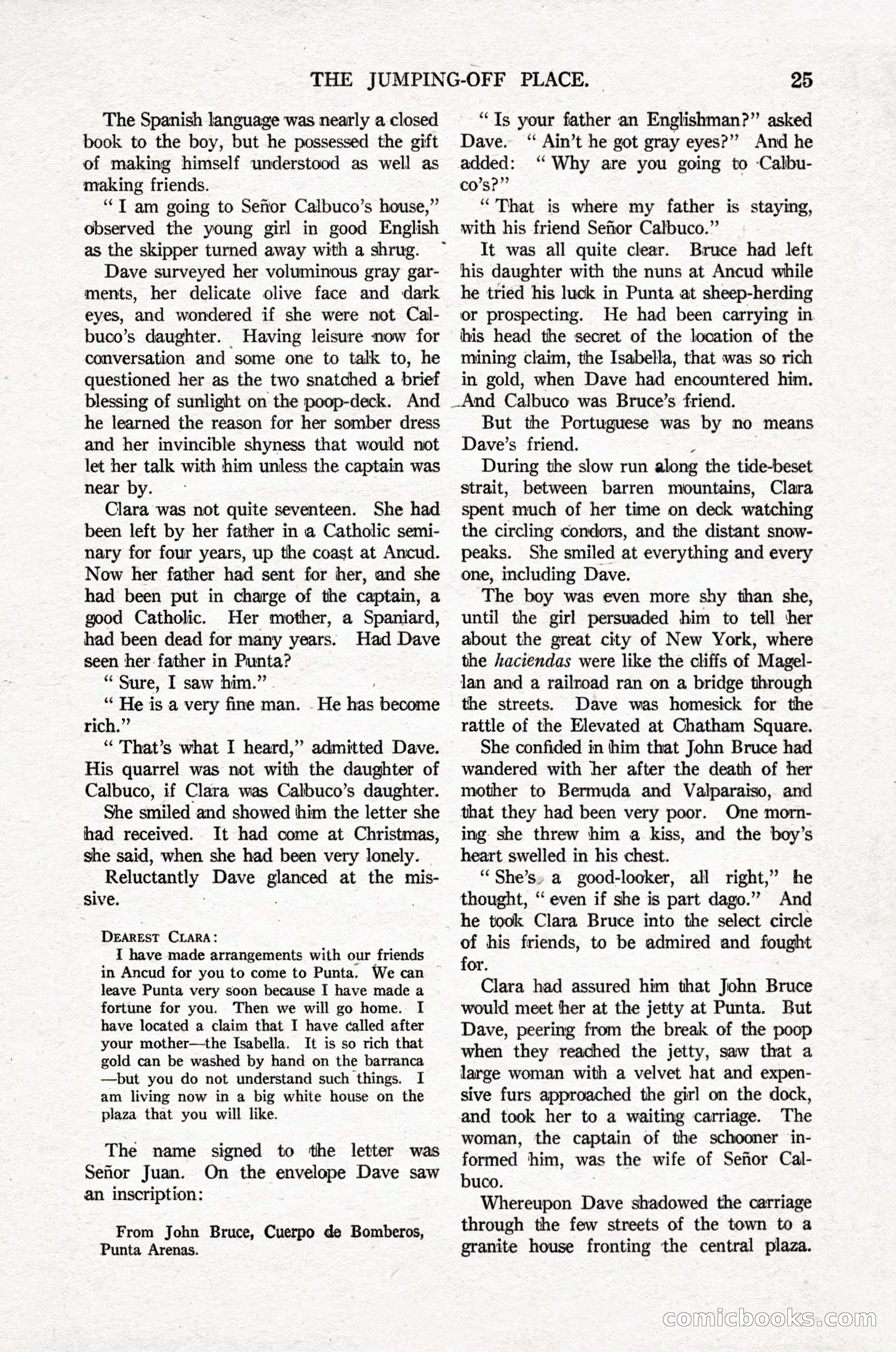
A restored page from Pulp Fiction, 1921. Page through the whole issue in the reader above.
📄 Transcribed text from this page (OCR, searchable)
Machine-transcribed from the original scan — historical spelling and the odd misread are preserved.
THE JUMPING-OFF PLACE. The Spanish language was nearly a closed book to the boy, but he possessed the gift of making himself understood as well as making friends. “IT am going to Senor Calbuco’s house,” observed the young girl in good English as the skipper turned away with a shrug. Dave surveyed her voluminous gray gar- ments, her delicate olive face and dark eyes, and wondered if she were not Cal- buco’s daughter. Having leisure now for conversation and some one to talk to, he questioned her as the two snatched a brief blessing of sunlight on the poop-deck. And he learned the reason for her somber dress and her invincible shyness that would not let her talk with him unless the captain was near by. Clara was not quite seventeen. She had been left by her father in a Catholic semi- nary for four years, up the coast at Ancud. Now her father had sent for her, and she had been put in charge of the captain, a good Catholic. Her mother, a Spaniard, had been dead for many years. Had Dave seen her father in Punta? “ Sure, I saw him.” s He: is a very fine man. -He bee become ric es ‘That’s what I heard,” admitted Dave. His quarrel was not with the daughter of Calbuco, if Clara was Calbuco’s daughter. She smiled and showed him the letter she had received. It had come at Christmas, she said, when she had been very lonely. Reluctantly Dave vanced at the mis- sive. DEAREST CLARA: I have made arrangements with our friends in Ancud for you to come to Punta. We can leave Punta very soon because I have made a fortune for you. Then we will go home. I have located a claim that I have ¢alled after your mother—the Isabella. It is so rich that gold can be washed by hand on the barranca —but you do not understand such things. I am living now in a big white house on the plaza that you will like. The name signed to the letter was Senor Juan. On the envelope Dave saw an inscription: From John Bruce, Cuerpo de Bomberos, Punta Arenas. 25 “Ts your father an Englishman?” asked Dave. ‘“ Ain’t he got gray eyes?” And he added: ‘Why are you going to -Calbu- co’s?”’ “That is where my father is staying, with his friend Sefior Calbuco.”’ It was all quite clear. Bruce had left his daughter with the nuns at Ancud while he tried his luck in Punta at sheep-herding or prospecting. He had been carrying in his head the secret of the location of the mining claim, the Isabella, that was so rich in gold, when Dave had encountered him. _And Calbuco was Bruce’s friend. But the Portuguese was by no means Dave’s friend. During the slow run along the tide-beset strait, between barren mountains, Clara spent much of her time on deck watching the circling condors, and the distant snow- peaks. She smiled at everything and every one, including Dave. The boy was even more shy than she, until the girl persuaded him to tell ther about the great city of New York, where the haciendas were like the cliffs of Magel- lan and a railroad ran on a bridge through the streets. Dave was homesick for the rattle of the Elevated at Chatham Square. She confided in him that John Bruce had wandered with her after the death of her mother to Bermuda and Valparaiso, and that they had been very poor. One morn- ing she threw him a kiss, and the boy’s heart swelled in his chest. ‘“‘ She’s. a good-looker, all right,” he thought, “‘ even if she is part dago.”” And he took Clara Bruce into the select circle of his friends, to be admired and fought for. Clara had assured him that John Bruce would meet her at the jetty at Punta. But Dave, peering from the break of the poop when they reached the jetty, saw that a large woman with a velvet hat and expen- sive furs approached the girl on the dock, and took her to a waiting carriage. The woman, the captain of the schooner in- formed him, was the wife of Senor Cal- buco. Whereupon Dave shadowed the carriage through the few streets of the town to a granite house fronting the central plaza. Go NOOK = a (C@