
Pulp Fiction, 1921 · page 18 of 157
Argosy All-Story Weekly, April 16, 1921 — page 18: what you’re looking at
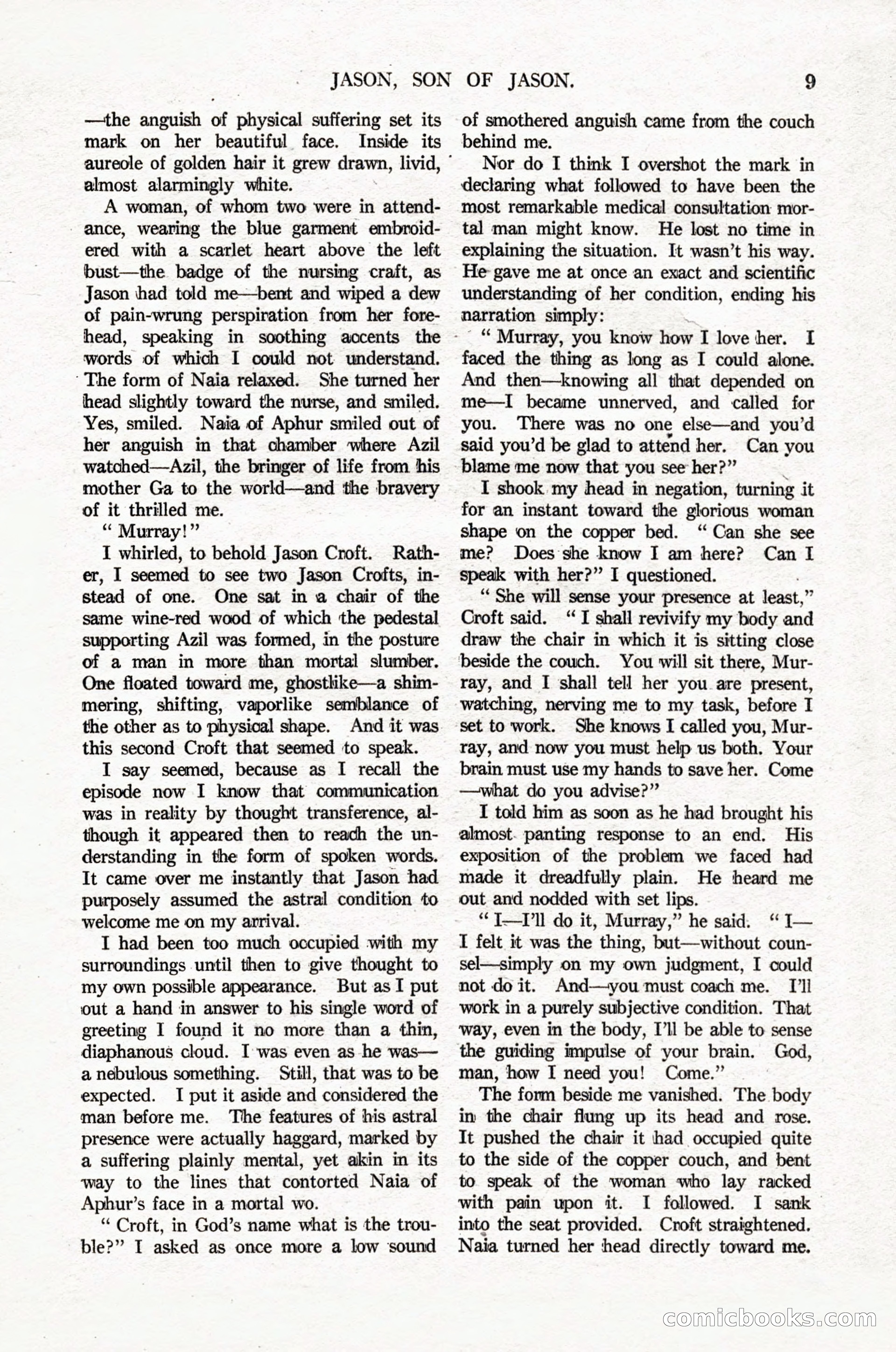
A restored page from Pulp Fiction, 1921. Page through the whole issue in the reader above.
📄 Transcribed text from this page (OCR, searchable)
Machine-transcribed from the original scan — historical spelling and the odd misread are preserved.
JASON, —the anguish of physical suffering set its mark on her beautiful face. Inside its aureole of golden hair it grew drawn, livid, © almost alarmingly white. A woman, of whom two were in attend- ance, wearing the blue garment embroid- ered with a scarlet heart above the left bust—the badge of the nursing craft, as Jason had told me—bent and wiped a dew of pain-wrung perspiration from her fore- head, speaking in soothing accents the - words of which I could not understand. ‘The form of Naia relaxed. She turned her head slightly toward the nurse, and smiled. Yes, smiled. Naia of Aphur smiled out of her anguish in that chamber where Azil watched—Azil, the bringer of life from his mother Ga to the world—and the bravery of it thrilled me. “ Murray!” I whirled, to behold Jason Croft. Rath- er, I seemed to see two Jason Crofts, in- stead of one. One sat in a chair of the same wine-red wood of which the pedestal supporting Azil was formed, in the posture of a man in more than mortal slumber. One floated toward me, ghostlike—a shim- mering, shifting, vaporlike semblance of the other as to physical shape. And it was this second Croft that seemed to speak. I say seemed, because as I recall the episode now I know that communication was in reality by thought transference, al- though it appeared then to reach the un- derstanding in the form of spoken words. It came over me instantly that Jason had purposely assumed the astral condition to welcome me on my arrival. I had been too much occupied with my surroundings until then to give thought to my own possible appearance. But as I put out a hand in answer to his single word of greeting I found it no more than a thin, diaphanous cloud. I was even as he was— a nebulous something. Still, that was to be expected. I put it aside and considered the man before me. The features of his astral presence were actually haggard, marked by a suffering plainly mental, yet akin in its way to the lines that contorted Naia of Aphur’s face in a mortal wo. “ Croft, in God’s name what is the trou- ble?” I asked as once more a low sound SON OF JASON. 9 of smothered anguish came from the couch behind me. Nor do I think I overshot the mark in declaring what followed to have been the most remarkable medical consultation mor- tal man might know. He lost no time in explaining the situation. It wasn’t his way. He gave me at once an exact and scientific understanding of her condition, ending his narration simply: _ “ Murray, you know how I love her. I faced the thing as long as I could alone. And then—knowing all that depended on me—I became unnerved, and called for you. There was no one else—and you'd said you’d be glad to attend her. Can you blame me now that you see her?” I shook my head in negation, turning it for an instant toward the glorious woman shape on the copper bed. ‘“ Can she see me? Does she know I am here? Can I speak with her?” I questioned. “She will sense your presence at least,” Croft said. “I shall revivify my body and draw the chair in which it is sitting close beside the couch. You will sit there, Mur- ray, and I shall tell her you are present, watching, nerving me to my task, before I set to work. She knows I called you, Mur- ray, and now you must help us both. Your brain must use my hands to save her. Come —what do you advise?” I told him as soon as he had brought his almost. panting response to an end. His exposition of the problem we faced had made it dreadfully plain. He heard me out and nodded with set lips. “*T—Ill do it, Murray,” he said. “ I— I felt it was the thing, but—without coun- sel—simply on my own judgment, I could not do it. And—you must coach me. I[’ll work in a purely subjective condition. That way, even in the body, I’ll be able to sense the guiding impulse of your brain. God, man, how I need you! Come.” The form beside me vanished. The body in the chair flung up its head and rose. It pushed the chair it had occupied quite to the side of the copper couch, and bent to speak of the woman who lay racked with pain upon it. I followed. I sank into the seat provided. Croft straightened. Naia turned her head directly toward me. cConmicloool< C©