
Pulp Fiction, 1921 · page 136 of 157
Argosy All-Story Weekly, April 16, 1921 — page 136: what you’re looking at
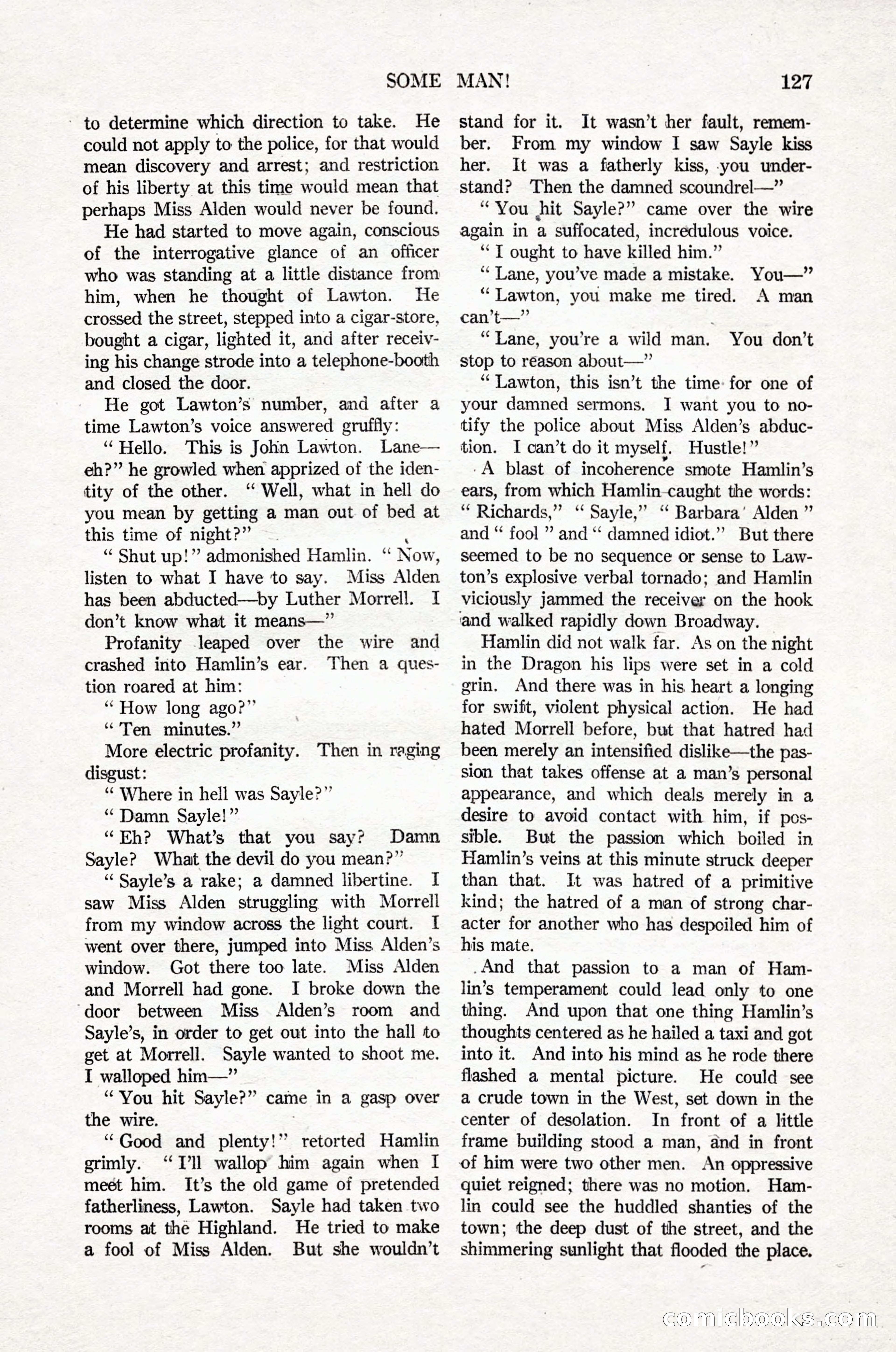
A restored page from Pulp Fiction, 1921. Page through the whole issue in the reader above.
📄 Transcribed text from this page (OCR, searchable)
Machine-transcribed from the original scan — historical spelling and the odd misread are preserved.
SOME - to determine which direction to take. He could not apply to the police, for that would mean discovery and arrest; and restriction of his liberty at this time would mean that perhaps Miss Alden would never be found. He had started to move again, conscious of the interrogative glance of an officer who was standing at a little distance from him, when he thought of Lawton. He crossed the street, stepped into a cigar-store, bought a cigar, lighted it, and after receiv- ing his change strode into a telephone-booth and closed the door. He got Lawton’s number, and after a time Lawton’s voice answered gruffly: “ Hello. This is John Lawton. Lane— eh?” he growled when apprized of the iden- tity of the other. ‘‘ Well, what in hell do you mean by getting a man out of bed at this time of night?” “ Shut up!” admonished Hamlin. “ Now, listen to what I have to say. Miss Alden has been abducted—by Luther Morrell. 1| don’t know what it means—”’ Profanity leaped over the wire and crashed into Hamlin’s ear. Then a ques- tion roared at him: “How long ago?” “Ten minutes.” More electric profanity. disgust: “Where in hell was Sayle?”’ “ Damn Sayle!” “Eh? What’s that you say? Damn Sayle? What the devil do you mean?”’ “ Sayle’s a rake; a damned libertine. I saw Miss Alden struggling with Morrell from my window across the light court. I went over there, jumped into Miss Alden’s window. Got there too late. Miss Alden and Morrell had gone. I broke down the ‘door between Miss Alden’s room and Sayle’s, in order to get out into the hall to get at Morrell. Sayle wanted to shoot me. I walloped him—” “You hit Sayle?” came in a gasp over the wire. “Good and plenty!” retorted Hamlin erimly. “Tl wallop him again when I meét him. It’s the old game of pretended fatherliness, Lawton. Sayle had taken two rooms at the Highland. He tried to make a fool of Miss Alden. But she wouldn’t Then in raging MAN! 127 stand for it. ber. It wasn’t her fault, remem- From my window I saw Sayle kiss her. It was a fatherly kiss, -you under- stand? Then the damned scoundrel—” ‘You jit Sayle?” came over the wire again in a suffocated, incredulous voice. “TI ought to have killed him.” “Lane, you’ve made a mistake. You—” “Lawton, you make me tired. A man can’t—”’ “Lane, you’re a wild man. stop to reason about—”’ ‘“‘ Lawton, this isn’t the time: for one of your damned sermons. I want you to no- tify the police about Miss Alden’s abduc- tion. I can’t do it myself. Hustle!” -A blast of incoherence smote Hamlin’s ears, from which Hamlin-caught the words: ‘* Richards,” “ Sayle,’”’ ‘“‘ Barbara’ Alden ”’ and “ fool ” and “‘ damned idiot.” But there seemed to be no sequence or sense to Law- ton’s explosive verbal tornado; and Hamlin viciously jammed the receiver on the hook and walked rapidly down Broadway. Hamlin did not walk far. As on the night in the Dragon his lips were set in a cold grin. And there was in his heart a longing for swift, violent physical action. He had hated Morrell before, but that hatred had been merely an intensified dislike—the pas- sion that takes offense at a man’s personal appearance, and which deals merely in a desire to avoid contact with him, if pos- sible. But the passion which boiled in Hamlin’s veins at this minute struck deeper than that. It was hatred of a primitive kind; the hatred of a man of strong char- acter for another who has despoiled him of his mate. .And that passion to a man of Ham- lin’s temperament could lead only to one thing. And upon that one thing Hamlin’s thoughts centered as he hailed a taxi and got into it. And into his mind as he rode there flashed a mental picture. He could see a crude town in the West, set down in the center of desolation. In front of a little frame building stood a man, and in front of him were two other men. An oppressive quiet reigned; there was no motion. Ham- lin could see the huddled shanties of the town; the deep dust of the street, and the shimmering sunlight that flooded the place. You don’t CORICLOO S (C@ S|