
Pulp Fiction, 1921 · page 124 of 157
Argosy All-Story Weekly, April 16, 1921 — page 124: what you’re looking at
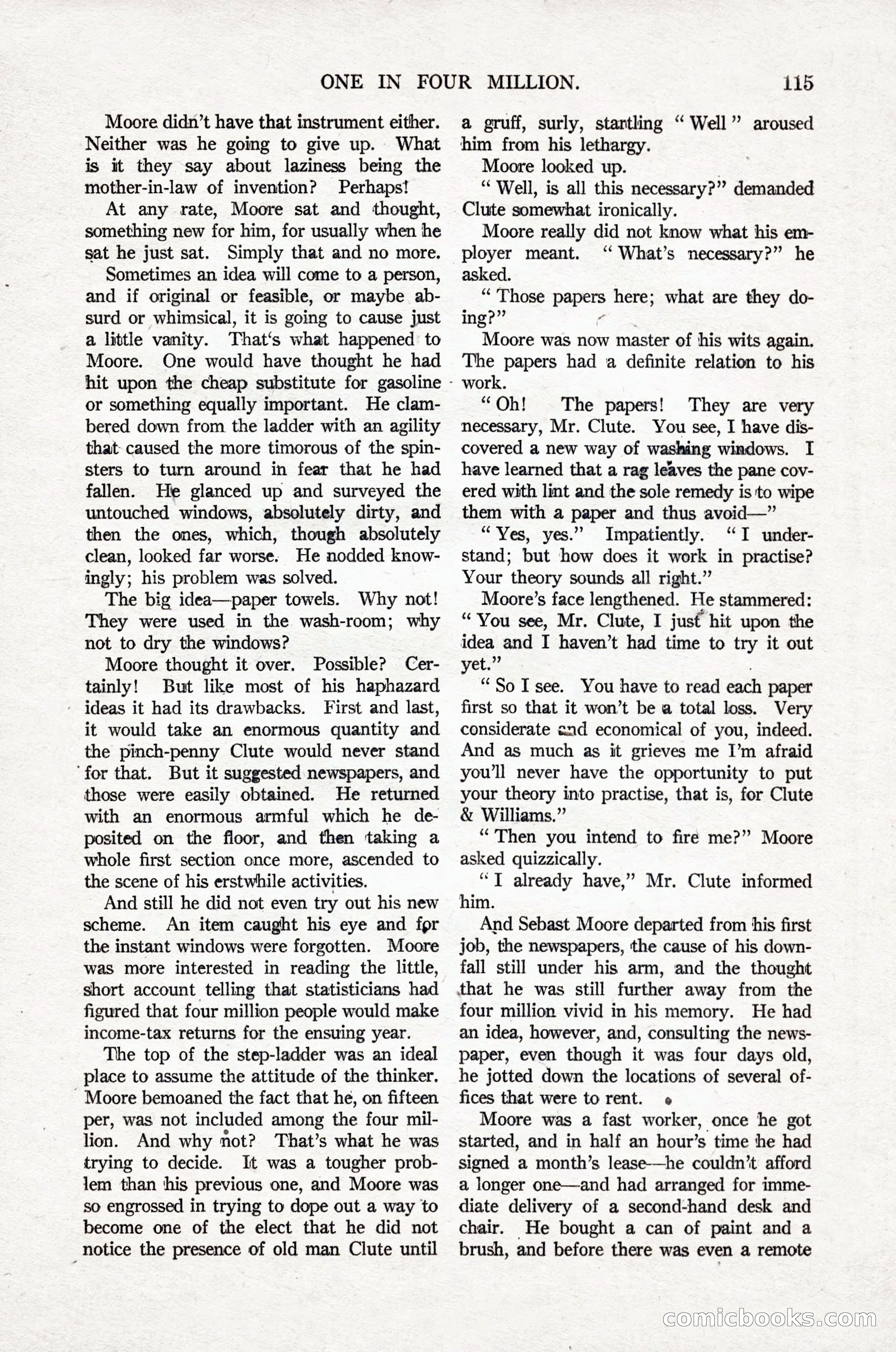
A restored page from Pulp Fiction, 1921. Page through the whole issue in the reader above.
📄 Transcribed text from this page (OCR, searchable)
Machine-transcribed from the original scan — historical spelling and the odd misread are preserved.
ONE IN FOUR MILLION. Moore didn’t have that instrument either. Neither was he going to give up. What is it they say about laziness being the mother-in-law of invention? Perhaps! At any rate, Moore sat and thought, something new for him, for usually when he sat he just sat. Simply that and no more. Sometimes an idea will come to a person, and if original or feasible, or maybe ab- surd or whimsical, it is going to cause just a little vanity. That‘s what happened to Moore. One would have thought he had hit upon the cheap substitute for gasoline - or something equally important. He clam- bered down from the ladder with an agility that caused the more timorous of the spin- sters to turn around in fear that he had fallen. He glanced up and surveyed the untouched windows, absolutely dirty, and then the ones, which, though absolutely clean, looked far worse. He nodded know- ingly; his problem was solved. The big idea—paper towels. Why not! They were used in the wash-room; why not to dry the windows? Moore thought it over. Possible? Cer- tainly! But like most of his haphazard ideas it had its drawbacks. First and last, it would take an enormous quantity and the pinch-penny Clute would never stand ‘for that. But it suggested newspapers, and those were easily obtained. He returned with an enormous armful which he de- posited on the floor, and then taking a whole first section once more, ascended to the scene of his erstwhile activities. And still he did not even try out his new scheme. An item caught his eye and fpr the instant windows were forgotten. Moore was more interested in reading the little, short account telling that statisticians had figured that four million people would make income-tax returns for the ensuing year. The top of the step-ladder was an ideal place to assume the attitude of the thinker. - Moore bemoaned the fact that he, on fifteen per, was not included among the four mil- lion. And why not? That’s what he was trying to decide. It was a tougher prob- lem than his previous one, and Moore was so engrossed in trying to dope out a way to become one of the elect that he did not notice the presence of old man Clute until 115 a gruff, surly, startling “ Well” aroused him from his lethargy. Moore looked up. | “Well, is all this necessary?” demanded Clute somewhat ironically. Moore really did not know what his em- ployer meant. ‘‘ What’s necessary?” he asked. “Those papers here; what are they do- ing?” ee Moore was now master of his wits again. The papers had a definite relation to his work. “Oh! The papers! They are very necessary, Mr. Clute. You see, I have dis- covered a new way of washing windows. I have learned that a rag leaves the pane cov- ered with lint and the sole remedy is ‘to wipe them with a paper and thus avoid—” “Yes, yes.”’ Impatiently. “I under- stand; but how does it work in practise? Your theory sounds all right.” Moore’s face lengthened. He stammered: “You see, Mr. Clute, I just hit upon the idea and I haven’t had time to try it out yet.” “So I see. You have to read each paper first so that it won’t be a total loss. Very considerate and economical of you, indeed. And as much as it grieves me I’m afraid you'll never have the opportunity to put your theory into practise, that is, for Clute & Williams.” “Then you intend to fire me?” Moore asked quizzically. “TI already have,” Mr. Clute informed him. And Sebast Moore departed from his first job, the newspapers, the cause of his down- fall still under his arm, and the thought that he was still further away from the four million vivid in his memory. He had an idea, however, and, consulting the news- paper, even though it was four days old, he jotted down the locations of several of- fices that were to rent. Moore was a fast worker, once he got started, and in half an hour’s time the had signed a month’s lease—he couldn’t afford a longer one—and had arranged for imme- diate delivery of a second-hand desk and chair. He bought a can of paint and a brush, and before there was even a remote COnmmiclbooks (© S|