
Pulp Fiction, 1921 · page 121 of 157
Argosy All-Story Weekly, April 16, 1921 — page 121: what you’re looking at
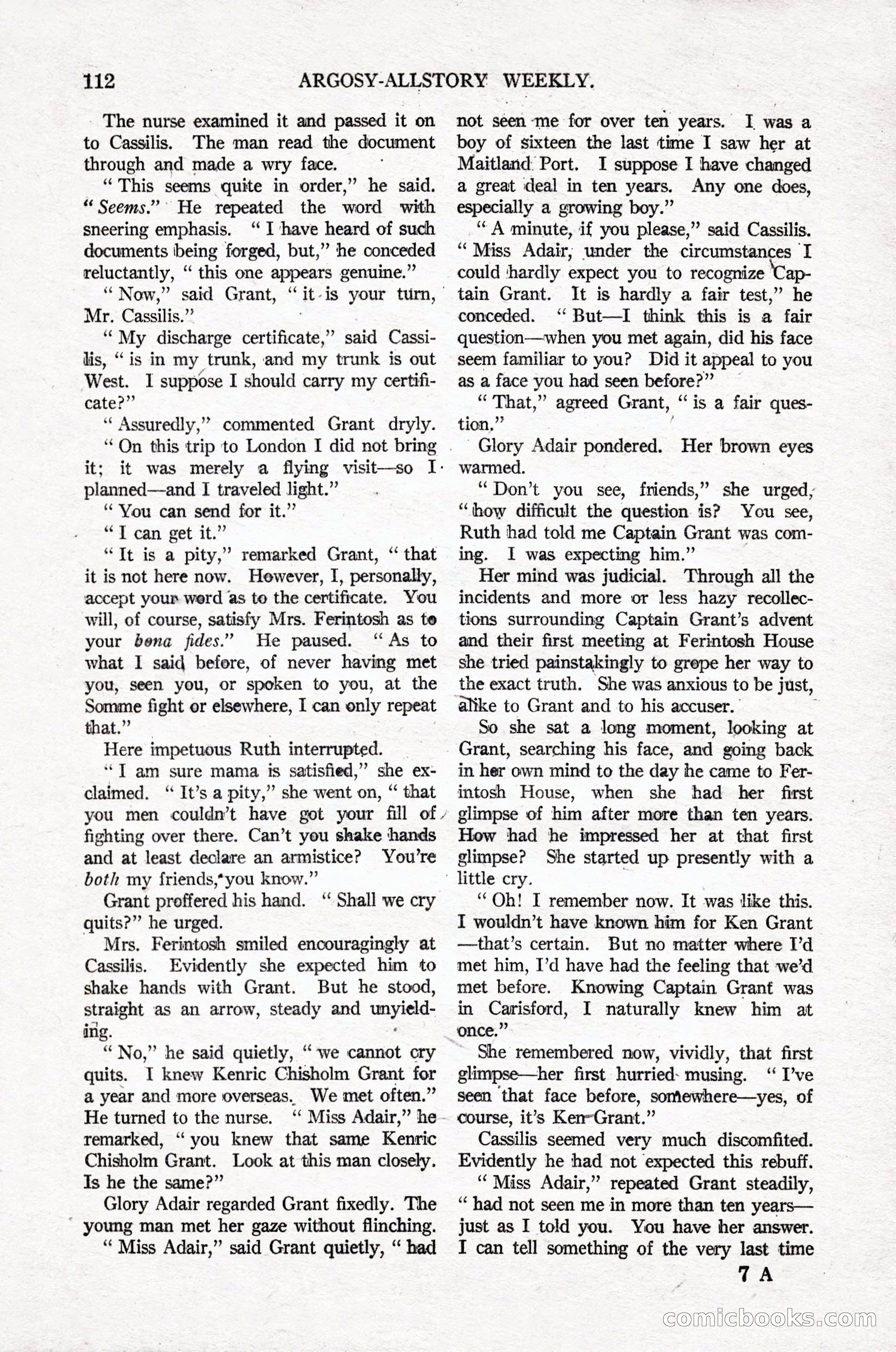
A restored page from Pulp Fiction, 1921. Page through the whole issue in the reader above.
📄 Transcribed text from this page (OCR, searchable)
Machine-transcribed from the original scan — historical spelling and the odd misread are preserved.
112 The nurse examined it and passed it on to Cassilis. The man read the document through and made a wry face. “This seems quite in order,” he said. “ Seems.” He repeated the word with sneering emphasis. ‘“ I have heard of such documents being forged, but,” he conceded reluctantly, ‘‘ this one appears genuine.” “Now,” said Grant, “ it is your turn, Mr. Cascilis e ‘““My discharge tee said Cassi- lis, “is in my trunk, and my trunk is out West. I suppose I should carry my certifi- cate?” ‘“‘ Assuredly,” commented Grant dryly. ‘On this trip to London I did not bring . it; it was merely a flying visit—so I- planned—and I traveled light.” ‘You can send for it.” “T can get it.” “Tt is a pity,” remarked Grant, “ that it is not here now. Hewever, I, personally, accept your werd as to the certificate. You will, of course, satisfy Mrs. Ferintosh as to your bena fides.” He paused. “As to what I said before, of never having met you, seen you, or spoken to you, at the Somme fight or elsewhere, I can only repeat dhat:”” = = | Here impetuous Ruth interrupted. ‘T am sure mama is satisfied,” she ex- claimed. ‘“ It’s a pity,” she went on, “ that you men couldn’t have got your fill of. fighting over there. Can’t you shake hands and at least declare an armistice? You're both my friends,*you know.” Grant proffered his hand. quits?” he urged. Mrs. Ferintosh smiled encouragingly at Cassilis. Evidently she expected him to shake hands with Grant. But he stood, straight as an arrow, steady and unyield- ing. “No,” he said quietly, ‘““ we cannot cry quits. I knew Kenric Chisholm Grant for a year and more overseas. We met often.” He turned to the nurse. ‘‘ Miss Adair,” he remarked, “you knew that same Kenric Chisholm Grant. Look at this man closely. Is he the same?”’ Glory Adair regarded Grant fixedly. The - young man met her gaze without flinching. ‘“‘ Miss Adair,” said Grant quietly, “ had ‘« Shall we cry ARGOSY-ALLSTORY WEEKLY. not seen me for over ten years. I was a boy of sixteen the last time I saw her at Maitland: Port. I suppose I have changed a great deal in ten years. Any one does, especially a growing boy.” ‘“A minute, if you please,” said Cassilis. “Miss Adair; under the circumstances I could ‘hardly expect you to recognize Cap- tain Grant. It is hardly a fair test,” he conceded. ‘“‘ But—I think this is a fair question—when you met again, did his face seem familiar to you? Did it appeal to you as a face you had seen before?” si That, ” agreed Grant, “is a fair ques- tion,” Glory Adair pondered. Her brown eyes warmed. ‘Don’t you see, friends,” she urged, “ihow difficult the question is? You see, Ruth had told me Captain Grant was com- ing. I was expecting him.” Her mind was judicial. Through all the incidents and more or less hazy recollec- tions surrounding Captain Grant’s advent and their first meeting at Ferintosh House she tried painstakingly to grepe her way to the exact truth. She was anxious to be just, alike to Grant and to his accuser. So she sat a long moment, looking at Grant, searching his face, and going back in her own mind to the day he came to Fer- intosh House, when she had her first glimpse of him after more than ten years. How had he impressed her at that first glimpse? She started up presently with a ' little cry. ‘““Oh! I remember now. It was like this. I wouldn’t have known him for Ken Grant —that’s certain. But no matter where I’d met him, I’d have had the feeling that we’d met before. Knowing Captain Grant was in Carisford, I naturally knew him at once.” She remembered now, vividly, that first glimpse—her first hurried- musing. ‘“ I’ve seen that face before, sontewhere—yes, of course, it’s Ken-Grant.” Cassilis seemed very much discomfited. Evidently he had not expected this rebuff. ‘Miss Adair,” repeated Grant steadily, ‘‘ had not seen me in more than ten years— just as I told you. You have her answer. I can tell something of the very last time TA CORnNICLOO S C@