
Pulp Fiction, 1921 · page 11 of 157
Argosy All-Story Weekly, April 16, 1921 — page 11: what you’re looking at
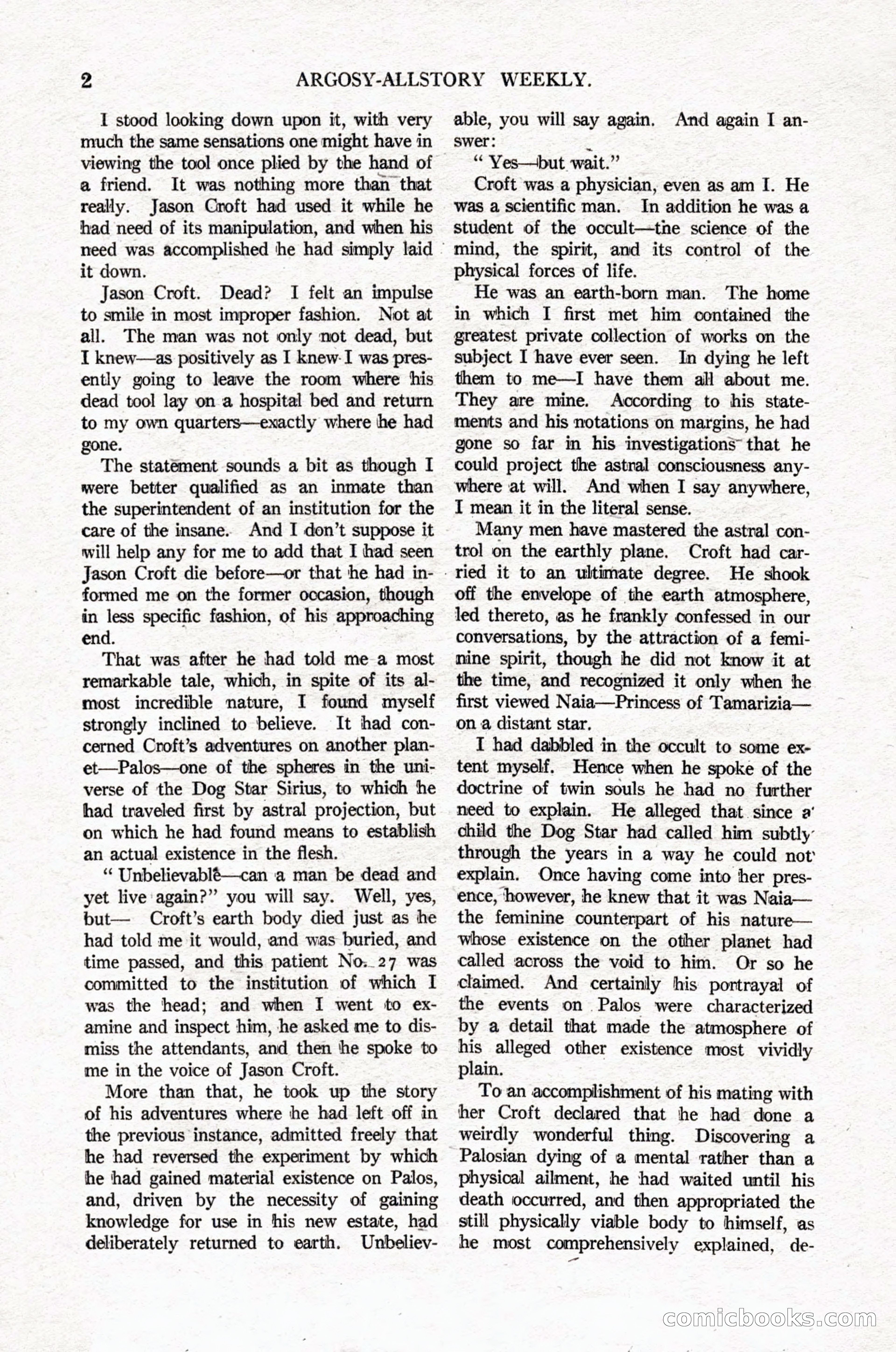
A restored page from Pulp Fiction, 1921. Page through the whole issue in the reader above.
📄 Transcribed text from this page (OCR, searchable)
Machine-transcribed from the original scan — historical spelling and the odd misread are preserved.
2 ARGOSY-ALLSTORY I stood looking down upon it, with very much the same sensations one might have in viewing the tool once plied by the hand of a friend. It was nothing more than that really. Jason Croft had used it while he had need of its manipulation, and when his need was accomplished the had simply laid - it down. Jason Croft. Dead? I felt an impulse to smile in most improper fashion. Not at all. The man was not only not dead, but I knew—as positively as I knew-I was pres- ently going to leave the room where his dead tool lay on a hospital bed and return to my own quarters—exactly where he had gone. The statement sounds a bit as though I were better qualified as an inmate than the superintendent of an institution for the care of the insane. And I don’t suppose it will help any for me to add that I had seen Jason Croft die before—or that he had in- formed me on the former occasion, though in less specific fashion, of his approaching end. That was after he had told me a most remarkable tale, which, in spite of its al- most incredible nature, I found myself strongly inclined to believe. It had con- cerned Croft’s adventures on another plan- et—Palos—one of the spheres in the uni- verse of the Dog Star Sirius, to which he had traveled first by astral projection, but on which he had found means to establish an actual existence in the flesh. “ Unbelievablé—can a man be dead and yet live again?” you will say. Well, yes, but— Croft’s earth body died just as he had told me it would, and was buried, and time passed, and this patient No._27 was committed to the institution of which I was the head; and when I went to ex- amine and inspect him, he asked me to dis- miss the attendants, and then ‘he spoke to me in the voice of Jason Croft. More than that, he took up the story of his adventures where he had left off in the previous instance, admitted freely that he had reversed the experiment by which he had gained material existence on Palos, and, driven by the necessity of gaining knowledge for use in his new estate, had deliberately returned to earth. Unbeliev- -ried it to an ultimate degree. WEEKLY. able, you will say again. And again I an- swer: . “ Yes—but wait.” Croft was a physician, even as am I. He was a scientific man. In addition he was a student of the occult—the science of the mind, the spirit, and its control of the physical forces of life. He was an earth-born man. The home in which I first met him contained the greatest private collection of works on the subject I have ever seen. In dying he left them to me—I have them ail about me. They are mine. According to his state- ments and his notations on margins, he had gone so far in his investigations that he could project the astral consciousness any- where at will. And when I say anywhere, I mean it in the literal sense. Many men have mastered the astral con- trol on the earthly plane. Croft had car- He shook off the envelope of the earth atmosphere, led thereto, as he frankly confessed in our conversations, by the attraction of a femi- mine spirit, though he did not know it at the time, and recognized it only when he first viewed Naia—Princess of Tamarizia— on a distant star, I had dabbled in the occult to some ex- tent myself. Hence when he spoke of the doctrine of twin souls he had no further need to explain. He alleged that since a’ child the Dog Star had called him subtly’ through the years in a way he could not’ explain. Once having come into her pres- ence, however, he knew that it was Naia— the feminine counterpart of his nature— whose existence on the other planet had called across the void to him. Or so he claimed. And certainly this portrayal of the events on Palos were characterized by a detail that made the atmosphere of his alleged other existence most vividly plain. To an accomplishment of his mating with her Croft declared that he had done a weirdly wonderful thing. Discovering a Palosian dying of a mental rather than a physical ailment, he had waited until his death occurred, and then appropriated the still physically viable body to himself, as he most comprehensively explained, de- COmiICLOO S C©