
Pulp Fiction, 1920 · page 98 of 164
Argosy All-Story Weekly, November 13, 1920 — page 98: what you’re looking at
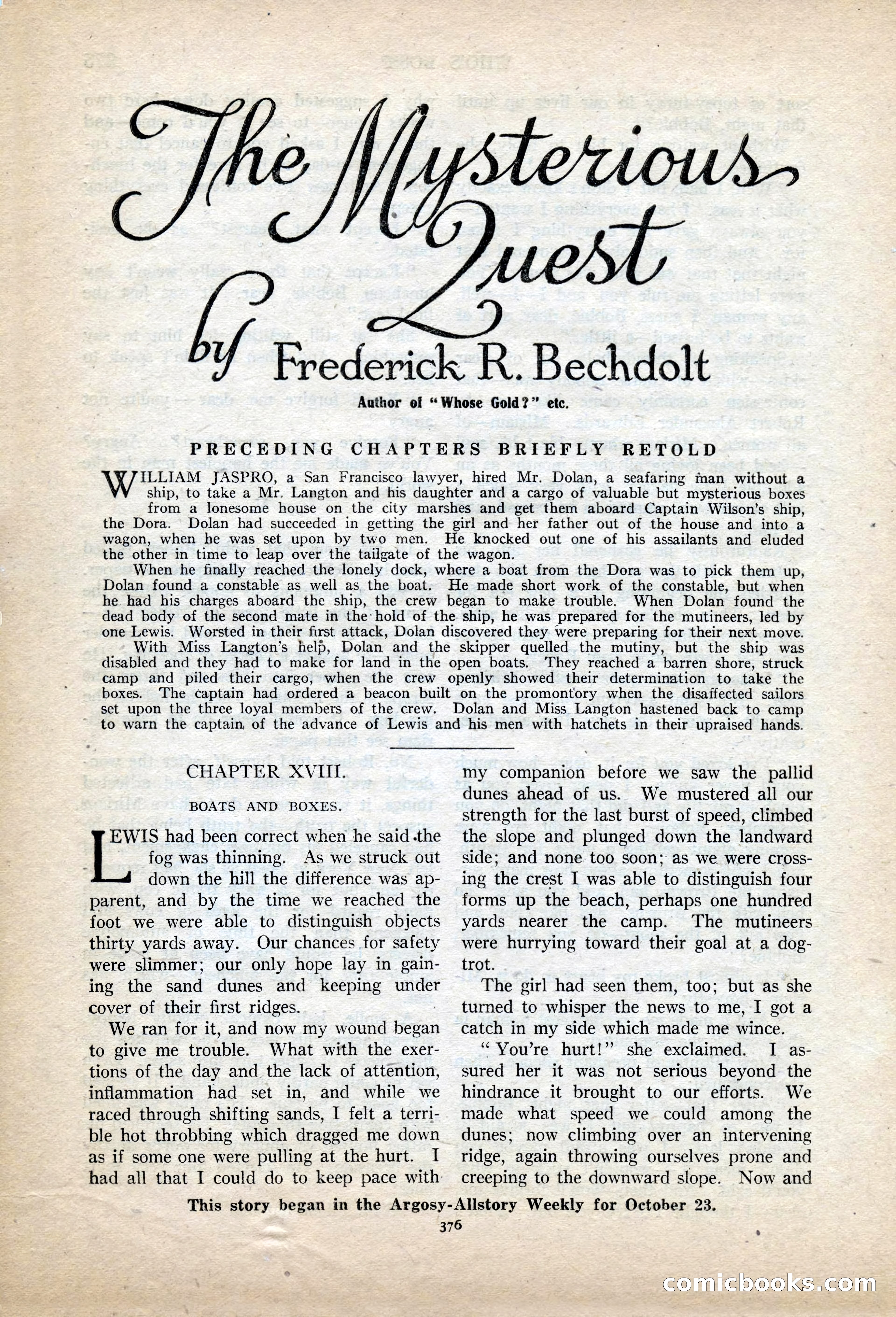
A restored page from Pulp Fiction, 1920. Page through the whole issue in the reader above.
📄 Transcribed text from this page (OCR, searchable)
Machine-transcribed from the original scan — historical spelling and the odd misread are preserved.
Sys ge reas Frederick R. Bechdolt Author of “Whose Gold?” etc PRECEDING CHAPTERS BRIEFLY RETOLD ILLIAM JASPRO, a San Francisco lawyer, hired Mr. Dolan, a seafaring man without a ship, to take a Mr. Langton and his daughter and a cargo of valuable but mysterious boxes from a lonesome house on the city marshes and get them aboard Captain Wilson’s ship, the Dora. wagon, when he was set upon by two men. Dolan had succeeded in getting the girl and her father out of the house and into a He knocked out one of his assailants and eluded the other in time to leap over the tailgate of the wagon. When he finally reached the lonely dock, where a boat from the Dora was to pick them up, Dolan found a constable as well as the boat. He made short work of the constable, but when he had his charges aboard the ship, the crew began to make trouble. When Dolan found the dead body of the second mate in the-hold of the ship, he was prepared for the mutineers, led by one Lewis. Worsted in their first attack, Dolan discovered they were preparing for their next move. With Miss Langton’s help, Dolan and the skipper quelled the mutiny, but the ship was disabled and they had to make for land in the open boats. They reached a barren shore, struck camp and piled their cargo, when the crew openly showed their determination to take the boxes. The captain had ordered a beacon built on the promontory when the disaffected sailors set upon the three loyal members of the crew. Dolan and Miss Langton hastened back to camp to warn the captain, of the advance of Lewis and his men with hatchets in their upraised hands. CHAPTER XVIII. BOATS AND BOXES. EWIS had been correct when he said -the L. fog was thinning. As we struck out down the hill the difference was ap- parent, and by the time we reached the foot we were able to distinguish objects thirty yards away. Our chances for safety were slimmer; our only hope lay in gain- ing the cand dunes and keeping under cover of their first ridges. We ran for it, and now my wound petan to give me trouble. What with the exer- tions of the day and the lack of attention, inflammation had set in, and while we raced through shifting sands, I felt a terri- ble hot throbbing which dragged me down as if some one were pulling at the hurt. I had all that I could do to keep pace with my companion before we saw the pallid dunes ahead of us. We mustered all our strength for the last burst of speed, climbed the slope and plunged down the landward side; and none too soon; as we were Cross- ing the crest I was able to distinguish four forms up the beach, perhaps one hundred yards nearer the camp. The mutineers were hurrying toward their goal at a dog- trot. The girl had seen them, too; but as she turned to whisper the news to me, I got a catch in my side which made me wince. ‘“You’re hurt!” she exclaimed. I as- sured her it was not serious beyond the hindrance it brought to our efforts. We made what speed we could among the dunes; now climbing over an intervening ridge, again throwing ourselves prone and creeping to the downward slope. Now and This story began in the Argosy-Allstory Weekly for October 23. 376 IOOKS =) a (ECO) mn