
Pulp Fiction, 1920 · page 85 of 164
Argosy All-Story Weekly, November 13, 1920 — page 85: what you’re looking at
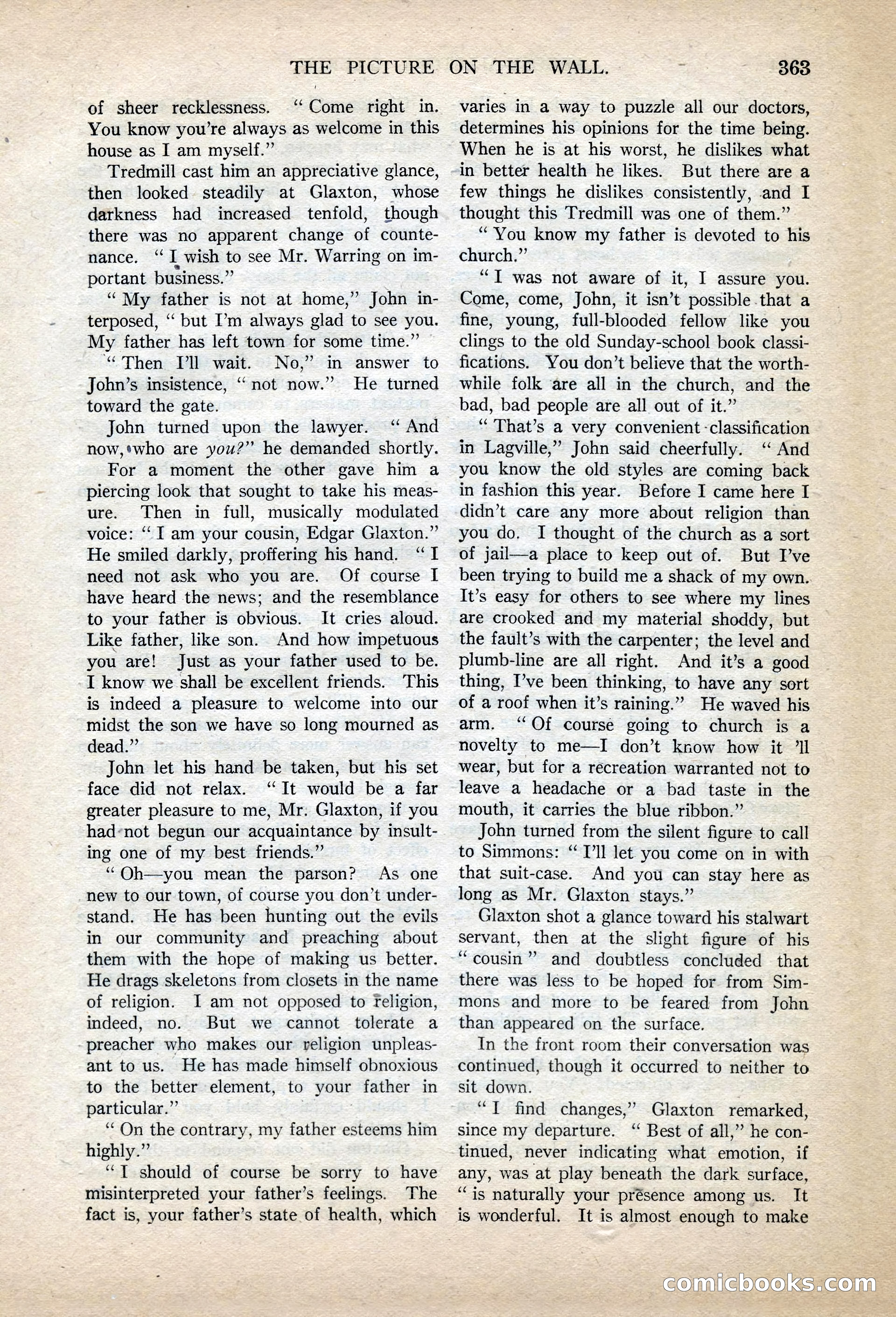
A restored page from Pulp Fiction, 1920. Page through the whole issue in the reader above.
📄 Transcribed text from this page (OCR, searchable)
Machine-transcribed from the original scan — historical spelling and the odd misread are preserved.
THE PICTURE ON THE WALL. of sheer recklessness. ‘“ Come right in. You know you’re always as welcome in this house as I am myself.” Tredmill cast him an appreciative glance, then looked steadily at Glaxton, whose darkness had increased tenfold, though there was no apparent change of counte- nance. “I wish to see Mr. Warring on im- portant business.” “My father is not at home,” John in- terposed, “ but I’m always glad to see you. My father has left town for some time.” “Then Vl wait. No,” in answer to John’s insistence, “not now.” He turned toward the gate. John turned upon the lawyer. “ And now,*who are you?”’ he demanded shortly. For a moment the other gave him a piercing look that sought to take his meas- ure. Then in full, musically modulated voice: ‘‘ I am your cousin, Edgar Glaxton.”’ He smiled darkly, proffering his hand. “TI need not ask who you are. Of course I have heard the news; and the resemblance to your father is obvious. It cries aloud. Like father, like son. And how impetuous you are! Just as your father used to be. I know we shall be excellent friends. This is indeed a pleasure to welcome into our midst the son we have so long mourned as dead.” John let his hand be taken, but his set face did not relax. ‘It would be a far greater pleasure to me, Mr. Glaxton, if you had-not begun our acquaintance by insult- ing one of my best friends.” ‘“Oh—you mean the parson? As one new to our town, of course you don’t under- stand. He has been hunting out the evils in our community and preaching about them with the hope of making us better. He drags skeletons from closets in the name of religion. I am not opposed to religion, indeed, no. But we cannot tolerate a preacher who makes our religion unpleas- ant to us. He has made himself obnoxious to the better element, to your father in particular.”’ : : ‘On the contrary, my father esteems him highly.” ‘““T should of course be sorry to have misinterpreted your father’s feelings. The fact is, your father’s state of health, which 363 varies in a way to puzzle all our doctors, determines his opinions for the time being. When he is at his worst, he dislikes what in better health he likes. But there are a few things he dislikes consistently, and I thought this Tredmill was one of them.” “You know my father is devoted to his church.” “I was not aware of it, I assure you. Come, come, John, it isn’t possible.that a fine, young, full-blooded fellow like you clings to the old Sunday-school book classi- fications. You don’t believe that the worth- while folk are all in the church, and the bad, bad people are all out of it.” ‘“ That’s a very convenient -classification in Lagville,” John said cheerfully. “ And you know the old styles are coming back in fashion this year. Before I came here I didn’t care any more about religion than you do. I thought of the church as a sort of jail—a place to keep out of. But I’ve been trying to build me a shack of my own. It’s easy for others to see where my lines are crooked and my material shoddy, but the fault’s with the carpenter; the level and plumb-line are all right. And it’s a good thing, I’ve been thinking, to have any sort of a roof when it’s raining.” He waved his arm. ‘Of course going to church is a novelty to me—I don’t know how it Il wear, but for a recreation warranted not to leave a headache or a bad taste in the mouth, it carries the blue ribbon.” John turned from the silent figure to call to Simmons: “ T’ll let you come on in with that suit-case. And you can stay here as long as Mr. Glaxton stays.” Glaxton shot a glance toward his stalwart servant, then at the slight figure of his “cousin” and doubtless concluded that there was less to be hoped for from Sim- mons and more to be feared from John than appeared on the surface. In the front room their conversation was continued, though it occurred to neither to sit down. ‘I find changes,” Glaxton remarked, since my departure. ‘“ Best of all,” he con- tinued, never indicating what emotion, if any, was at play beneath the dark surface, ‘is naturally your présence among us. It is wonderful. It is almost enough to make cEomichbooks (EO)