
Pulp Fiction, 1920 · page 151 of 164
Argosy All-Story Weekly, November 13, 1920 — page 151: what you’re looking at
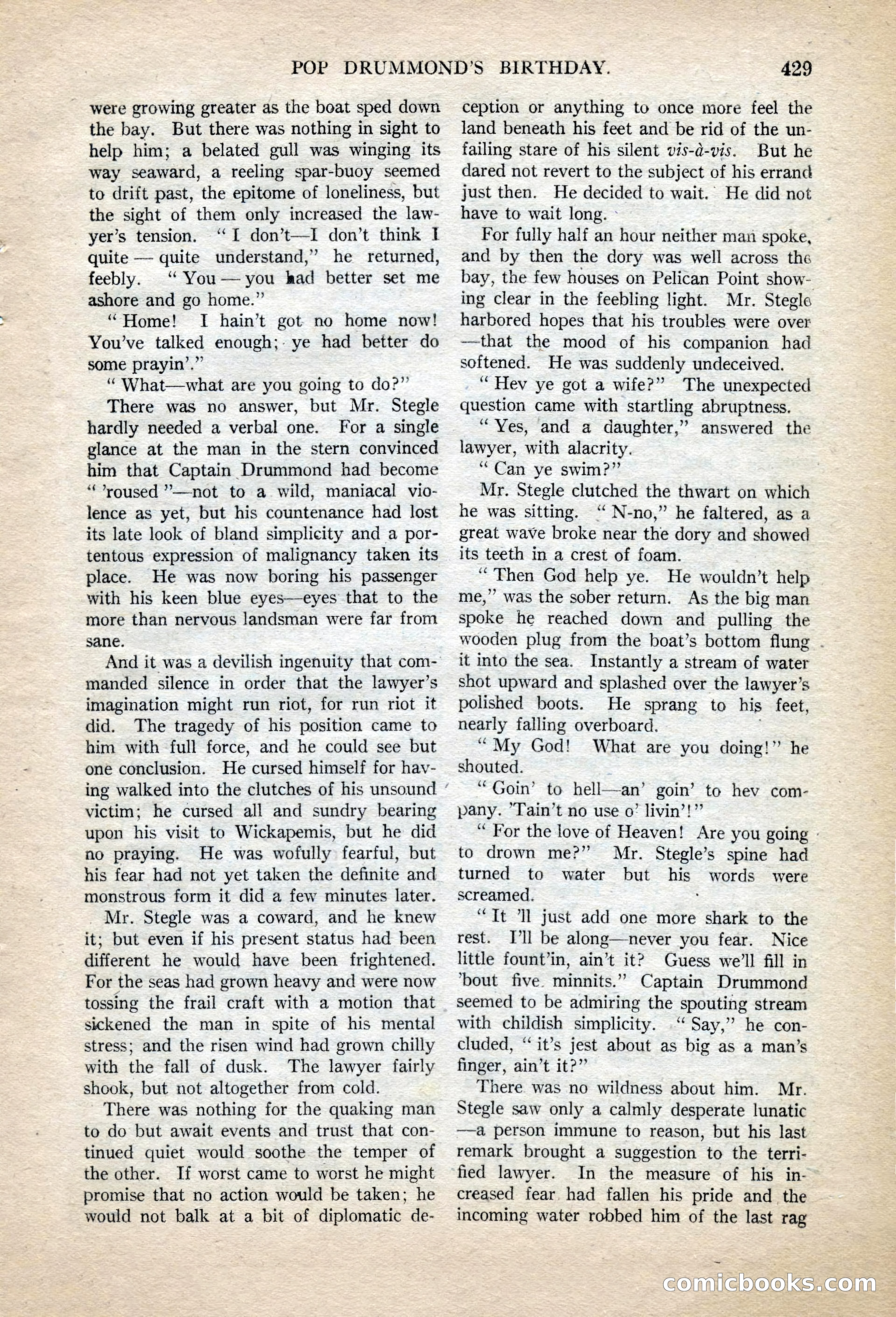
A restored page from Pulp Fiction, 1920. Page through the whole issue in the reader above.
📄 Transcribed text from this page (OCR, searchable)
Machine-transcribed from the original scan — historical spelling and the odd misread are preserved.
POP were growing greater as the boat sped down the bay. But there was nothing in sight to help him; a belated gull was winging its way seaward, a reeling spar-buoy seemed to drift past, the epitome of loneliness, but the sight of them only increased the law- yer’s tension. ‘I don’t—TI don’t think I quite —- quite understand,” he returned, feebly. ‘“ You— you had better set me ashore and go home.” “Home! I hain’t got no home now! You’ve talked enough;: ye had better do some prayin’.”’ ‘“‘What—what are you going to do?”’ There was no answer, but Mr. Stegle hardly needed a verbal one. For a single glance at the man in the stern convinced him that Captain Drummond had become “roused ”—not to a wild, maniacal vio- lence as yet, but his countenance had lost its late look of bland simplicity and a por- tentous expression of malignancy taken its place. He was now boring his passenger with his keen blue eyes—eyes that to the more than nervous landsman were far from sane. And it was a devilish ingenuity that com- manded silence in order that the lawyer’s imagination might run riot, for run riot it did. The tragedy of his position came to him with full force, and he could see but one conclusion. He cursed himself for hav- ing walked into the clutches of his unsound ‘ victim; he cursed all and sundry bearing upon his visit to Wickapemis, but he did no praying. He was wofully fearful, but his fear had not yet taken the definite and monstrous form it did a few minutes later. Mr. Stegle was a coward, and he knew it; but even if his present status had been different he would have been frightened. For the seas had grown heavy and were now tossing the frail craft with a motion that sickened the man in spite of his mental stress; and the risen wind had grown chilly with the fall of dusk. The lawyer fairly shook, but not altogether from cold. There was nothing for the quaking man to do but await events and trust that con- tinued quiet would soothe the temper of the other. If worst came to worst he might promise that no action would be taken; he would not balk at a bit of diplomatic de- DRUMMOND’S BIRTHDAY. 429 ception or anything to once more feel the land beneath his feet and be rid of the un- failing stare of his silent vis-a-vis. But he dared not revert to the subject of his errand just then. He decided to wait. He did not have to wait long. - For fully half an hour neither man spoke, and by then the dory was well across the bay, the few houses on Pelican Point show- ing clear in the feebling light. Mr. Stegle harbored hopes that his troubles were over —that the mood of his companion had softened. He was suddenly undeceived. ‘“Hev ye got a wife?” The unexpected question came with startling abruptness. “Yes, and a daughter,” answered the lawyer, with alacrity. “Can ye swim?” Mr. Stegle clutched the thwart on which he was sitting. “ N-no,” he faltered, as a great wave broke near the dory and showed its teeth in a crest of foam. “Then God help ye. He wouldn’t help me,’’ was the sober return. As the big man spoke he reached down and pulling the wooden plug from the boat’s bottom flung - it into the sea. Instantly a stream of water shot upward and splashed over the lawyer’s polished boots. He sprang to his feet, nearly falling overboard. : ‘““My God! What are you doing!” he shouted. ‘Goin’ to hell—an’ goin’ to hev com- pany. “Tain’t no use o? livin’!”’ “ For the love of Heaven! Are you going - to drown me?” Mr. Stegle’s spine had turned to water but his words were screamed. : “It ‘ll just add one more shark to the rest. I'll be along—never you fear. Nice little fount’in, ain’t it? Guess we’ll fill in ‘bout five. minnits.”” Captain Drummond seemed to be admiring the spouting stream with childish simplicity. “ Say,” he con- cluded, “it’s jest about as big as a man’s finger, ain’t it?” There was no wildness about him. Mr. Stegle saw only a calmly desperate lunatic —a person immune to reason, but his last remark brought a suggestion to the terri- fied lawyer. In the measure of his in- creased fear had fallen his pride and the incoming water robbed him of the last rag ~ Gomichbooks (E(0)