
Pulp Fiction, 1920 · page 132 of 164
Argosy All-Story Weekly, November 13, 1920 — page 132: what you’re looking at
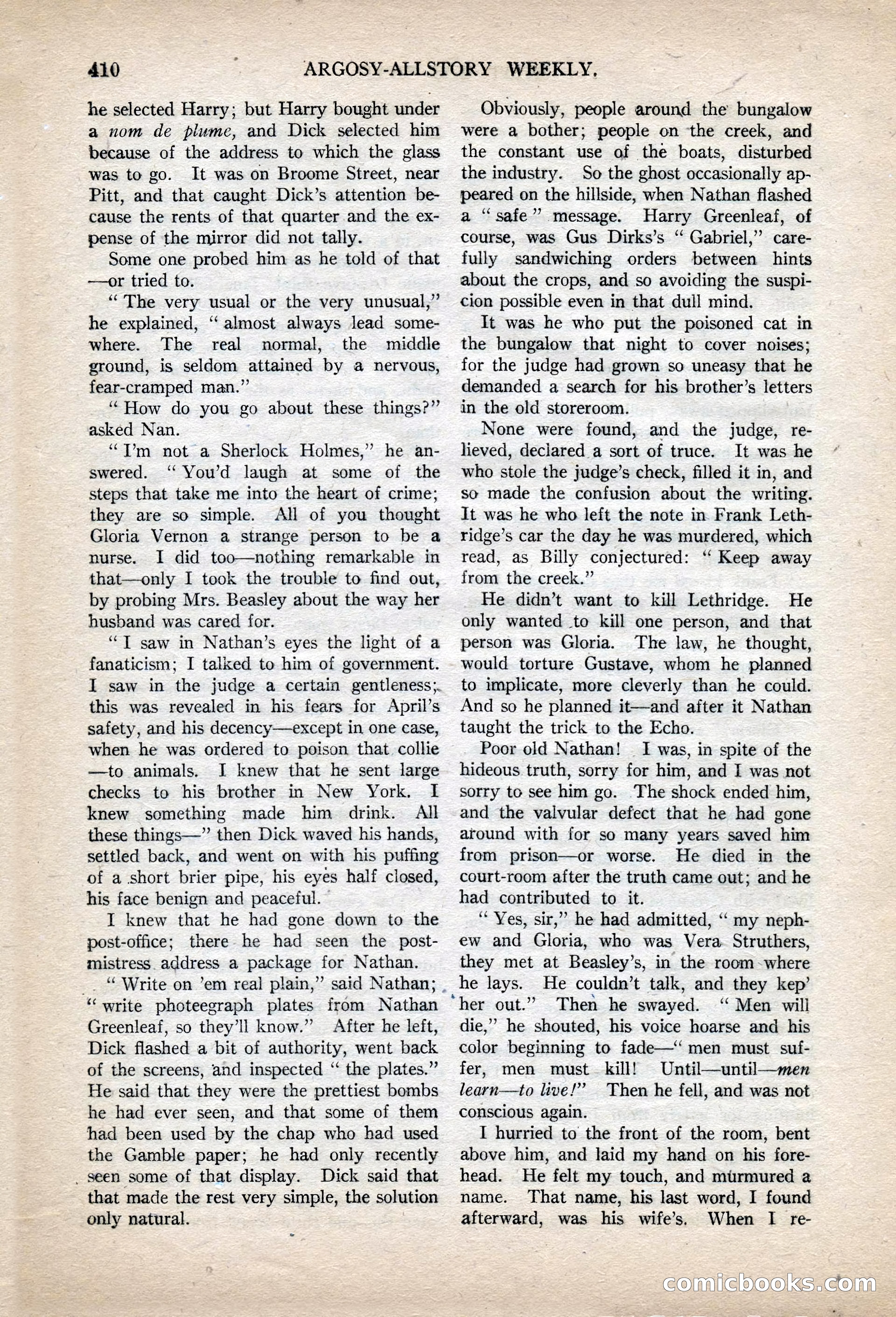
A restored page from Pulp Fiction, 1920. Page through the whole issue in the reader above.
📄 Transcribed text from this page (OCR, searchable)
Machine-transcribed from the original scan — historical spelling and the odd misread are preserved.
410 he selected Harry; but Harry bought under a nom de plume, and Dick selected him because of the address to which the glass was to go. It was on Broome Street, near Pitt, and that caught Dick’s attention be- cause the rents of that quarter and the ex- pense of the mirror did not tally. Some one probed him as he told of that —or tried to. ‘‘The very usual or the very unusual,” he explained, “‘ almost always lead some- where. The real normal, the middle ground, is seldom attained by a nervous, fear-cramped man.”’ ‘“How do you go about these things?” asked Nan. “T’m not a Sherlock Holmes,” he an- swered. ‘‘ You’d laugh at some of the steps that take me into the heart of crime; they are so simple. All of you thought Gloria Vernon a strange person to be a nurse. I did too—nothing remarkable in that—only I took the trouble to find out, by probing Mrs. Beasley about the way her husband was cared for. ‘““T saw in Nathan’s eyes the light of a fanaticism; I talked to him of government. I saw in the judge a certain gentleness;. this was revealed in his fears for April’s safety, and his decency—except in one case, when. he was ordered to poison that collie —to animals. J knew that he sent large checks to his brother in New York. I knew something made him drink. All these things—” then Dick waved his hands, settled back, and went on with his puffing of a short brier pipe, his eyes half closed, his face benign and peaceful. I knew that he had gone down to the post-office; there he had seen the post- mistress. address a package for Nathan. _ “Write on ’em real plain,” said Nathan; . “write photeegraph plates from Nathan Greenleaf, so they’ll know.” After he left, Dick flashed a bit of authority, went back of the screens, and inspected “ the plates.” He said that they were the prettiest bombs he had ever seen, and that some of them had been used by the chap who had used the Gamble paper; he had only recently _ seen some of that display. Dick said that that made the rest very simple, the solution only natural. “her out.” ARGOSY-ALLSTORY WEEKLY. Obviously, people around the bungalow were a bother; people on the creek, and the constant use of the boats, disturbed the industry. So the ghost occasionally ap- peared on the hillside, when Nathan flashed a “safe” message. Harry Greenleaf, of course, was Gus Dirks’s “ Gabriel,” care- fully sandwiching orders between hints about the crops, and so avoiding the suspi- cion possible even in that dull mind. It was he who put the poisoned cat in the bungalow that night to cover noises; for the judge had grown so uneasy that he demanded a search for his brother’s letters in the old storeroom. None were found, and the judge, re- lieved, declared a sort of truce. It was he who stole the judge’s check, filled it in, and so made the confusion about the writing. It was he who left the note in Frank Leth- ridge’s car the day he was murdered, which read, as Billy conjectured: “‘ Keep away from the creek.” He didn’t want to kill Lethridge. He only wanted to kill one person, and that person was Gloria. The law, he thought, would torture Gustave, whom he planned to implicate, more cleverly than he could. And so he planned it—and after it Nathan taught the trick to the Echo. Poor old Nathan! _ 1 was, in spite of the hideous truth, sorry for him, and I was not sorry to see him go. The shock ended him, and the valvular defect that he had gone around with for so many years saved him from prison—or worse. He died in the court-room after the truth came out; and he had contributed to it. “Yes, sir,” he had admitted, “‘ my neph- ew and Gloria, who was Vera. Struthers, they met at Beasley’s, in the room ~where he lays. He couldn’t talk, and they kep’ Then he swayed. ‘“ Men will die,” he shouted, his voice hoarse and his color beginning to fade—‘‘ men must suf- fer, men must_ kill! Until—until—men learn—to live!” Then he fell, and was not conscious again. I hurried to the front of the room, bent above him, and laid my hand on his fore- head. He felt my touch, and murmured a name. That name, his last word, I found afterward, was his wife’s. When I re- Eomichbooks (ele)