
Pulp Fiction, 1920 · page 128 of 164
Argosy All-Story Weekly, November 13, 1920 — page 128: what you’re looking at
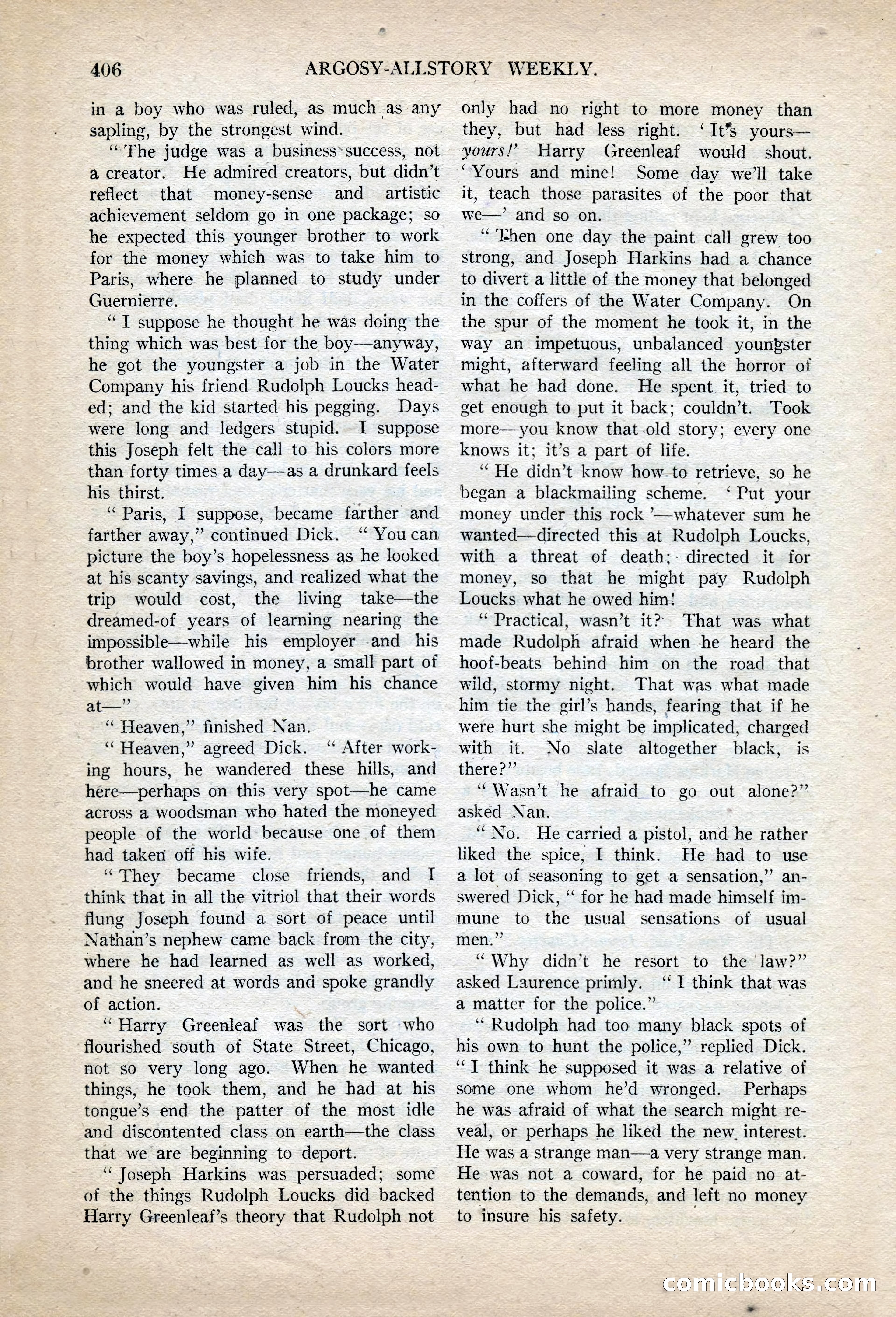
A restored page from Pulp Fiction, 1920. Page through the whole issue in the reader above.
📄 Transcribed text from this page (OCR, searchable)
Machine-transcribed from the original scan — historical spelling and the odd misread are preserved.
le) 406 in a boy who was ruled, as much as any sapling, by the strongest wind. ‘““The judge was a business*success, not a creator. He admired creators, but didn’t reflect that money-sense and artistic achievement seldom go in one package; so he expected this younger brother to work for the money which was to take him to Paris, where he planned to study under Guernierre. ‘““T suppose he thought he was doing the thing which was best for the boy—anyway, he got the youngster a job in the Water Company his friend Rudolph Loucks head- ed; and the kid started his pegging. Days were long and ledgers stupid. I suppose this Joseph felt the call to his colors more than forty times a day—as a drunkard feels his thirst. “Paris, I suppose, became farther and farther away,” continued Dick. “ You can picture the boy’s hopelessness as he looked at his scanty savings, and realized what the trip would cost, the living take—the dreamed-of years of learning nearing the impossible—while his employer -and his brother wallowed in money, a small part of which would have given him his chance ie era ‘““ Heaven,” finished Nan. ‘“ Heaven,” agreed Dick. ‘ After work- ing hours, he wandered these hills, and here—perhaps on this very spot—he came across a woodsman who hated the moneyed people of the world because one of them had taken off his wife. “They became close friends, and I think that in all the vitriol that their words flung Joseph found a sort of peace until Nathan’s nephew came back from the city, where he had learned as well as worked, and he sneered at words and spoke grandly of action. “Harry Greenleaf was the sort who flourished south of State Street, Chicago, not so very long ago. When he wanted things, he took them, and he had at his tongue’s end the patter of the most idle and discontented class on earth—the class that we are beginning to deport. ‘Joseph Harkins was persuaded; some of the things Rudolph Loucks did backed Harry Greenleaf’s theory that Rudolph not *Vours and mine! ARGOSY-ALLSTORY WEEKLY. only had no right to more money than 7 they, but had less right. yours!’ Harry ‘It’s yours— Greenleaf would — shout. Some day we’ll take it, teach those parasites of the poor that we—’ and so on. ‘“Tehen one day the paint call grew too strong, and Joseph Harkins had a chance to divert a little of the money that belonged in the coffers of the Water Company. On the spur of the moment he took it, in the way an impetuous, unbalanced younpster might, afterward feeling all the horror of what he had done. He spent it, tried to get enough to put it back; couldn’t. Took more—you know that-.old story; every one knows it; it’s a part of life. “He didn’t know how-to retrieve. so he began a blackmailing scheme. ‘ Put your money under this rock "—whatever sum he wanted—directed this at Rudolph Loucks, with a threat of death;- directed it for money, so that he might pay Rudolph Loucks what he owed him! ‘Practical, wasn’t it? That was what made Rudolph afraid when he heard the hoof-beats behind him on the road that wild, stormy night. That was what made him tie the girl’s hands, fearing that if he were hurt she might be implicated, charged with it. No slate altogether black, is there?” ‘“Wasn’t he afraid to go out alone?” asked Nan. ‘No. He carried a pistol, and he rather liked the spice, I think. He had to use a lot of seasoning to get a sensation,” an- swered Dick, ‘‘ for he had made himself im- mune to the usual sensations of usual men.” “Why didn’t he resort to the law?” asked Laurence primly. “I think that was a matter for the police.” “Rudolph had too many black spots of his own to hunt the police,” replied Dick. ‘“] think he supposed it was a relative of some one whom he’d wronged. Perhaps he was afraid of what the search might re- veal, or perhaps he liked the new. interest. He was a strange man—a very strange man. He was not a coward, for he paid no at- tention to the demands, and left no money to insure his safety. com Ghbooks >