
Pulp Fiction, 1920 · page 126 of 164
Argosy All-Story Weekly, November 13, 1920 — page 126: what you’re looking at
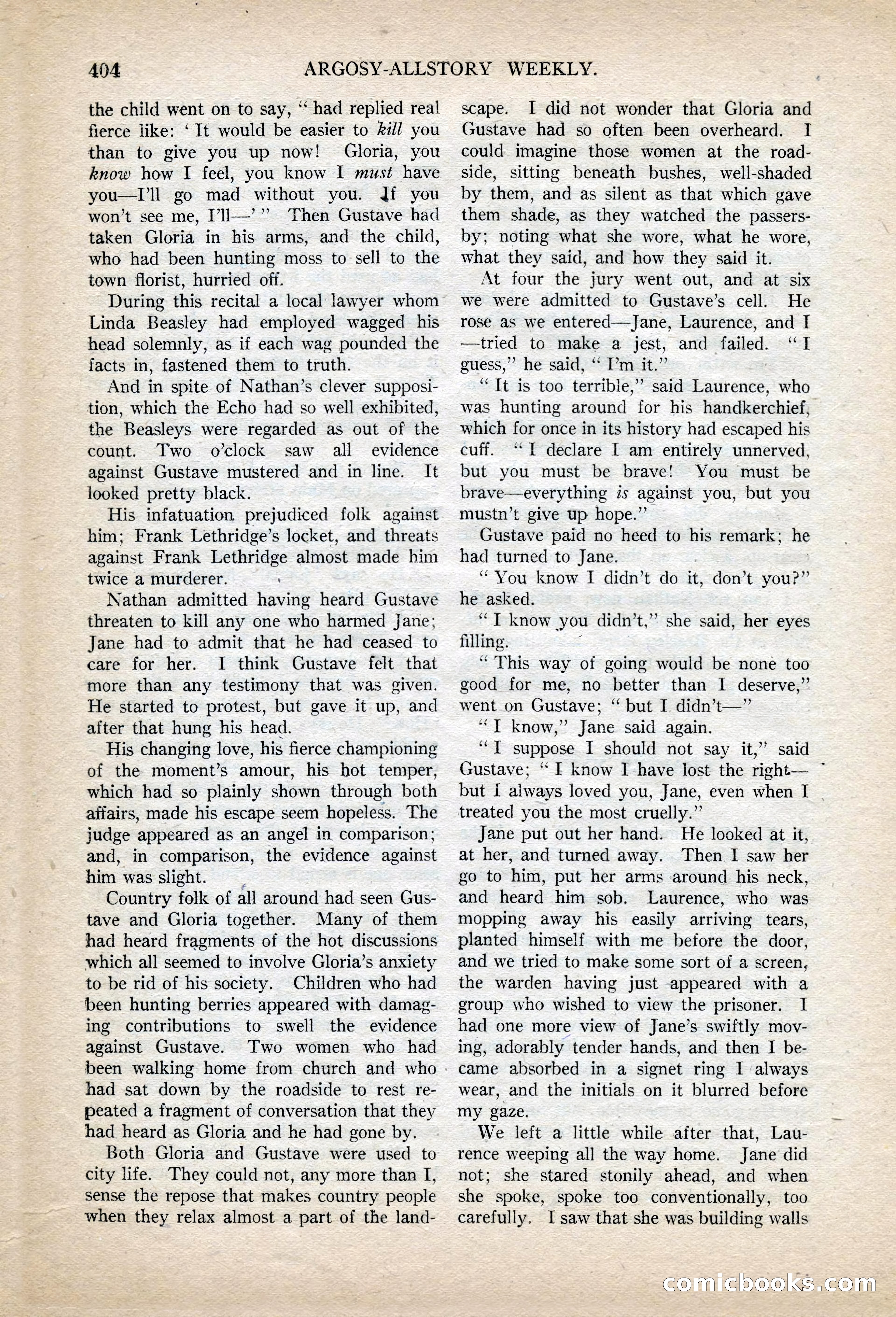
A restored page from Pulp Fiction, 1920. Page through the whole issue in the reader above.
📄 Transcribed text from this page (OCR, searchable)
Machine-transcribed from the original scan — historical spelling and the odd misread are preserved.
AOA the child went on to say, “ had replied real fierce like: ‘It would be easier to Rill you than to give you up now! Gloria, you know how I feel, you know I must have you—I’ll go mad without you. Ji you won’t see me, I’ll—’”’ Then Gustave had taken Gloria in his arms, and the child, who had been hunting moss to sell to the town florist, hurried off. During this recital a local lawyer whom Linda Beasley had employed wagged his head solemnly, as if each wag pounded the facts in, fastened them to truth. And in spite of Nathan’s clever supposi- tion, which the Echo had so well exhibited, the Beasleys were regarded as out of the count. Two o’clock saw all evidence against Gustave mustered and in line. It looked pretty black. His infatuation prejudiced folk against him; Frank Lethridge’s locket, and threats against Frank Lethridge almost made him twice a murderer. Nathan admitted having heard Gustave threaten to kill any one who harmed Jane; Jane had to admit that he had ceased to care for her. I think Gustave felt that more than any testimony that was given. He started to protest, but gave it up, and after that hung his head. His changing love, his fierce championing of the moment’s amour, his hot temper, which had so plainly shown through both affairs, made his escape seem hopeless. The judge appeared as an angel in comparison; and, in comparison, the evidence against him was slight. Country folk of all around had seen Gus- tave and Gloria together. Many of them had heard fragments of the hot discussions which all seemed to involve Gloria’s anxiety to be rid of his society. Children who had been hunting berries appeared with damag- ing contributions to swell the evidence against Gustave. Two women who had been walking home from church and who had sat down by the roadside to rest re- peated a fragment of conversation that they had heard as Gloria and he had gone by. Both Gloria and Gustave were used to city life. They could not, any more than I, sense the repose that makes country people when they relax almost a part of the land- ARGOSY-ALLSTORY WEEKLY. scape. I did not wonder that Gloria and Gustave had so often been overheard. I could imagine those women at the road- side, sitting beneath bushes, well-shaded by them, and as silent as that which gave them shade, as they watched the passers- by; noting what she wore, what he wore, what they said, and how they said it. At four the jury went out, and at six we were admitted to Gustave’s cell. He rose as we entered—Jane, Laurence, and I —tried to make a jest, and failed. “TI guess,” he said, ‘‘ I’m it.” ‘It is too terrible,’ said Laurence, who was hunting around for his handkerchief, which for once in its history had escaped his cuff. ‘“‘ I declare 1 am entirely unnerved, but you must be brave! You must be brave—everything is against you, but you mustn’t give up hope.” Gustave paid no heed to his remark; he had turned to Jane. “You know I didn’t do it, don’t you?” he asked. “T know you didn’t,” she said, her eyes filling. “ This way of going would be none too good for me, no better than I deserve,” went on Gustave; “ but I didn’t—” ‘““T know,” Jane said again. ‘“T suppose I should not say it,” said Gustave; “I know I have lost the right— ~ but I always loved you, Jane, even when I treated you the most cruelly.” Jane put out her hand. He looked at it, at her, and turned away. Then I saw her go to him, put her arms around his neck, and heard him sob. Laurence, who was mopping away his easily arriving tears, planted himself with me before the door, and we tried to make some sort of a screen, the warden having just appeared with a group who wished to view the prisoner. I had one more view of Jane’s swiftly mov- ing, adorably tender hands, and then I be- came absorbed in a signet ring I always wear, and the initials on it blurred before my gaze. We left a little while after that, Lau- rence weeping all the way home. Jane did not; she stared stonily ahead, and when she spoke, spoke too conventionally, too carefully. I saw that she was building walls S (E[AMCeLoxexe) (E@) im