
Pulp Fiction, 1920 · page 123 of 164
Argosy All-Story Weekly, November 13, 1920 — page 123: what you’re looking at
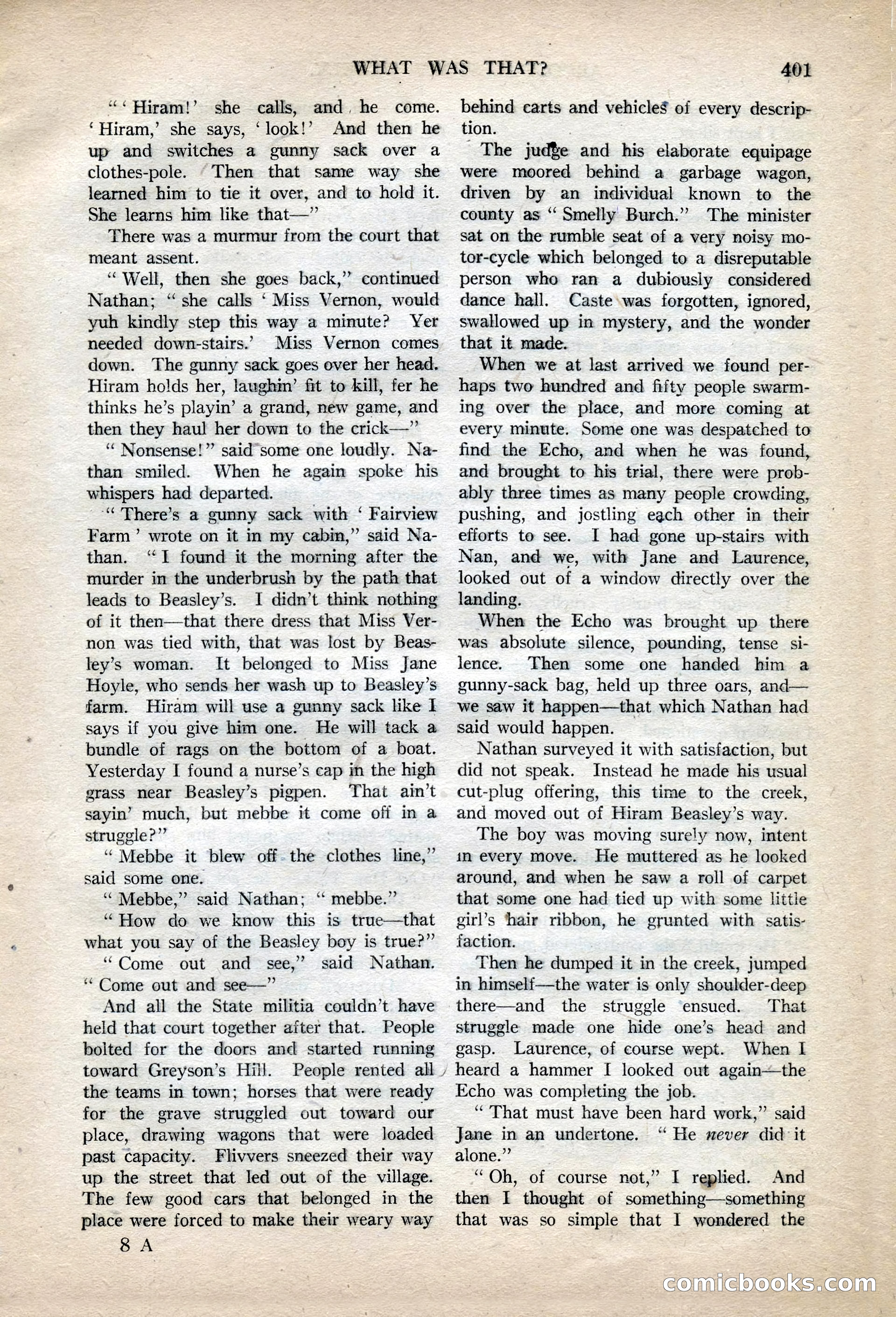
A restored page from Pulp Fiction, 1920. Page through the whole issue in the reader above.
📄 Transcribed text from this page (OCR, searchable)
Machine-transcribed from the original scan — historical spelling and the odd misread are preserved.
WHAT WAS THAT? “* Hiram!’ she calls, and, he come. ‘Hiram,’ she says, ‘look!’ And then he up and switches a gunny sack over 4 clothes-pole. ‘Then that same way she learned him to tie it over, and to hold it. She learns him like that—”’ There was a murmur from the court that meant assent. ‘Well, then she goes back,” continued Nathan; “she calls ‘ Miss Vernon, would yuh kindly step this way a minute? Yer needed down-stairs.’ Miss Vernon comes down. The gunny sack goes over her head. Hiram holds her, laughim’ fit to kill, fer he thinks he’s playin’ a grand, new game, and then they haul her down to the crick—” ‘““ Nonsense!”’ said some one loudly. Na- than smiled. When he again spoke his whispers had departed. “ There’s a gunny sack with ‘ Fairview Farm’ wrote on it in my cabm,” said Na- than. “I found it the morning after the murder in the underbrush by the path that leads to Beasley’s. I didn’t think nothing of it then—that there dress that Miss Ver- non was tied with, that was lost by Beas- ley’s woman. It belonged to Miss Jane Hoyle, who sends her wash up to Beasley’s farm. Hiram will use a gunny sack lke I says if you give him one. He will tack a bundle of rags on the bottom of a boat. Yesterday I found a nurse’s cap in the high grass near Beasley’s pigpen. That ain’t sayin’ much, but mebbe it come off in a struggle?”’ ‘“Mebbe it blew off. the clothes line,”’ said some one. ‘““Mebbe,” said Nathan; ‘“ mebbe.” “How do we know this is true—that what you say of the Beasley boy is true?” “Come out and see,” said Nathan. “Come out and see—”’ And all the State militia couldn’t have held that court together after that. People bolted for the doors and started running toward Greyson’s Hill. People rented all the teams in town; horses that were ready for the grave struggled out toward our place, drawing wagons that were loaded past capacity. Flivvers sneezed their way up the street that led out of the village. The few good cars that belonged in the place were forced to make their weary way 8A / 401 behind carts and vehicles of every descrip- tion. : The jud%e and his elaborate equipage were moored behind a garbage wagon, driven by an individual known to the county as “ Smelly Burch.” The minister sat on the rumble seat of a very noisy mo- tor-cycle which belonged to a disreputable person who ran a dubiously considered dance hall. Caste was forgotten, ignored, swallowed up in mystery, and the wonder that it. made. When we at last arrived we found per- haps two hundred and fiity people swarm- Ing over the place, and more coming at every minute. Some one was despatched to find the Echo, amd when he was found, and brought to his trial, there were prob- ably three times as many people crowding, pushing, and jostling each other in their efforts te see. I had gone up-stairs with Nan, and we, with Jane and Laurence, looked out of a window directly over the landing. When the Echo was brought up there was absolute silence, pounding, tense si- lence. Then some one handed him a gunny-sack bag, held up three oars, and— we saw it happen—that which Nathan had said would happen. Nathan surveyed it with satisfaction, but did not speak. Instead he made his usual cut-plug offering, this time to the creek, and moved out of Hiram Beasley’s way. The boy was moving surely now, intent in every move. He muttered as he looked around, and when he saw a roll of carpet that some one had tied up with some little girl’s ‘hair ribbon, he grunted with satis- faction. Then he dumped it in the creek, jumped in himself—the water is only shoulder-deep there—and the struggle ensued. That struggle made one hide one’s head and gasp. Laurence, of course wept. When lI heard a hammer I looked out again- Echo was completing the job. “That must have been hard work,” said Jane in an undertone. “ He uever did it alone.” “Oh, of course not,” I replied. And then I thought of something—something that was so simple that 1 wondered the Comichboo the <S (eo)