
Pulp Fiction, 1920 · page 106 of 164
Argosy All-Story Weekly, November 13, 1920 — page 106: what you’re looking at
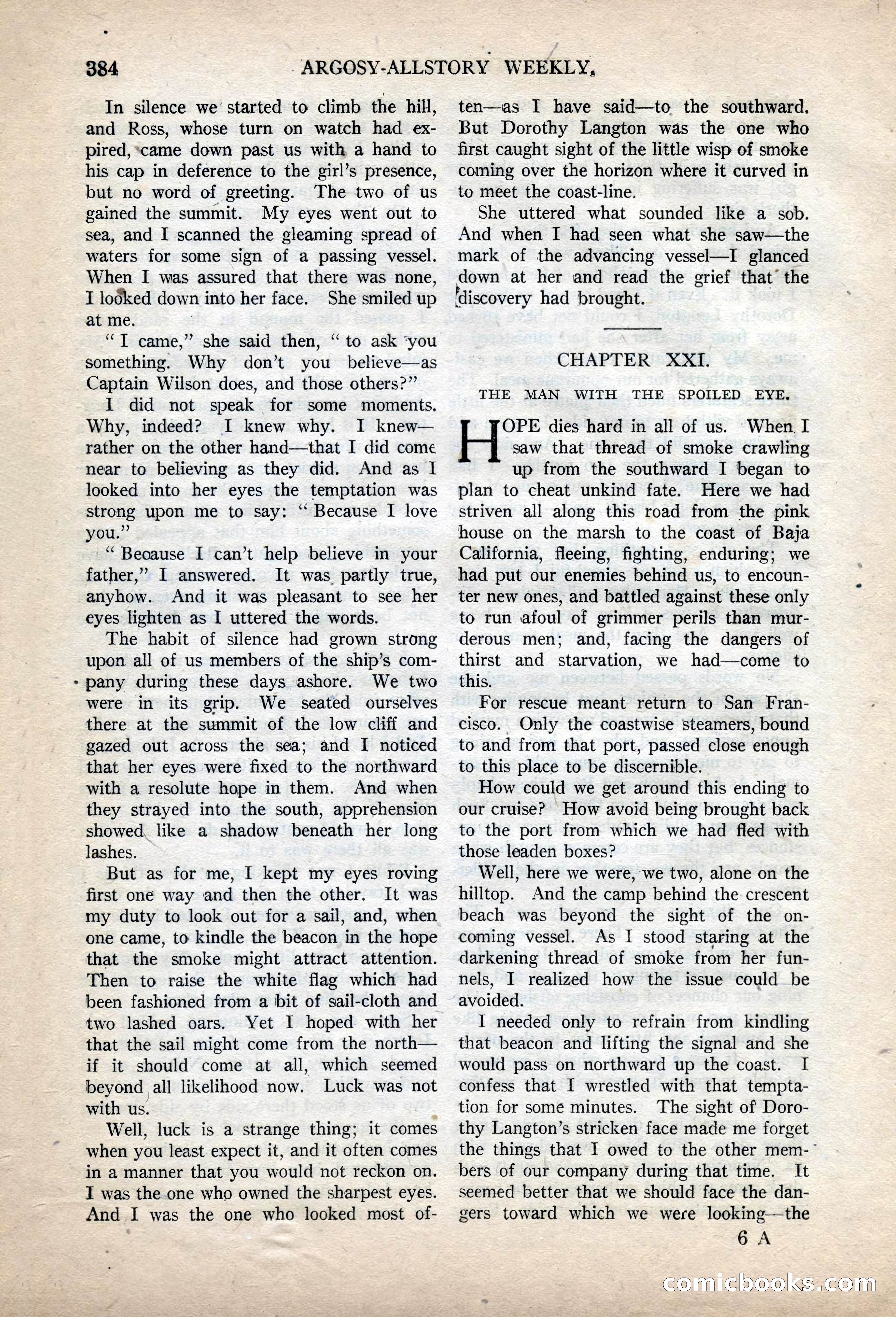
A restored page from Pulp Fiction, 1920. Page through the whole issue in the reader above.
📄 Transcribed text from this page (OCR, searchable)
Machine-transcribed from the original scan — historical spelling and the odd misread are preserved.
first one way and then the other. 384 In silence we’ started to climb the hill, and Ross, whose turn on watch had ex- pired, ‘came down past us with a hand to his cap in deference to the girl’s presence, but no word of greeting. The two of us gained the summit. My eyes went out to sea, and I scanned the gleaming spread of waters for some sign of a passing vessel, When I was assured that there was none, I lodked down into her face. She smiled up at me. ‘““T came,” she said then, ‘“‘ to ask *you something. Why don’t you believe—as Captain Wilson does, and those others?”’ I did not speak for some moments. Why, indeed? I knew why. I knew— rather on the other hand—that I did come near to believing as they did. And as I looked into her eyes the temptation was strong upon me to say: “ Because I love you.” ‘“ Because I can’t help believe in your father,” I answered. It was partly true, anyhow. And it was pleasant to see her eyes lighten as I uttered the words. The habit of silence had grown strong upon all of us members of the ship’s com- pany during these days ashore. We two were in its grip. We seated ourselves there at the summit of the low cliff and gazed out across the sea; and I noticed that her eyes were fixed to the northward with a resolute hope in them. And when they strayed into the south, apprehension showed, like a shadow beneath her long lashes. But as for me, I kept my eyes roving It was my duty to look out for a sail, and, when one came, to kindle the beacon in the hope that the smoke might attract attention. Then to raise the white flag which had been fashioned from a bit of sail-cloth and two lashed oars. Yet I hoped with her that the sail might come from the north— if it should come at all, which seemed beyond all likelihood now. Luck was not with us. Well, luck is a strange thing; it comes when you least expect it, and it often comes in a manner that you would not reckon on. I was the one who owned the sharpest eyes. And I was the one who looked most of- ARGOSY-ALLSTORY WEEKLY, ten—as I have said—to the southward. But Dorothy Langton was the one who first caught sight of the little wisp of smoke coming over the horizon where it curved in to meet the coast-line. She uttered what sounded like a sob. And when I had seen what she saw—the mark of the advancing vessel—I glanced down at her and read the grief that the ‘discovery had brought. CHAPTER XXI. THE MAN WITH THE SPOILED EYE. OPE dies hard in all of us. When I saw that thread of smoke crawling up from the southward I began to plan to cheat unkind fate. Here we had striven all along this road from the pink house on the marsh to the coast of Baja California, fleeing, fighting, enduring; we had put our enemies behind us, to encoun- ter new ones, and battled against these only to run afoul of grimmer perils than mur- derous men; and, facing the dangers of thirst and starvation, we had—come to this. For rescue meant return to San Fran- cisco. Only the coastwise steamers, bound to and from that port, passed close enough to this place to be discernible. How could we get around this ending to our cruise? How avoid being brought back to the port from which we had fled with those leaden boxes? Well, here we were, we two, alone on the hilltop. And the camp behind the crescent beach was beyond the sight of the on- coming vessel. As I stood staring at the darkening thread of smoke from her fun- nels, I realized how the issue could be avoided. I needed only to refrain from kindling that beacon and lifting the signal and she would pass on northward up the coast. I confess that I wrestled with that tempta- tion for some minutes. The sight of Doro- thy Langton’s stricken face made me forget the things that I owed to the other mem-~ bers of our company during that time. It seemed better that we should face the dan- gers toward which we were looking—the 6A annie Lexeye) cS (EO)