
Pulp Fiction, 1920 · page 50 of 158
Argosy, Vol. 123, No. 2 — page 50: what you’re looking at
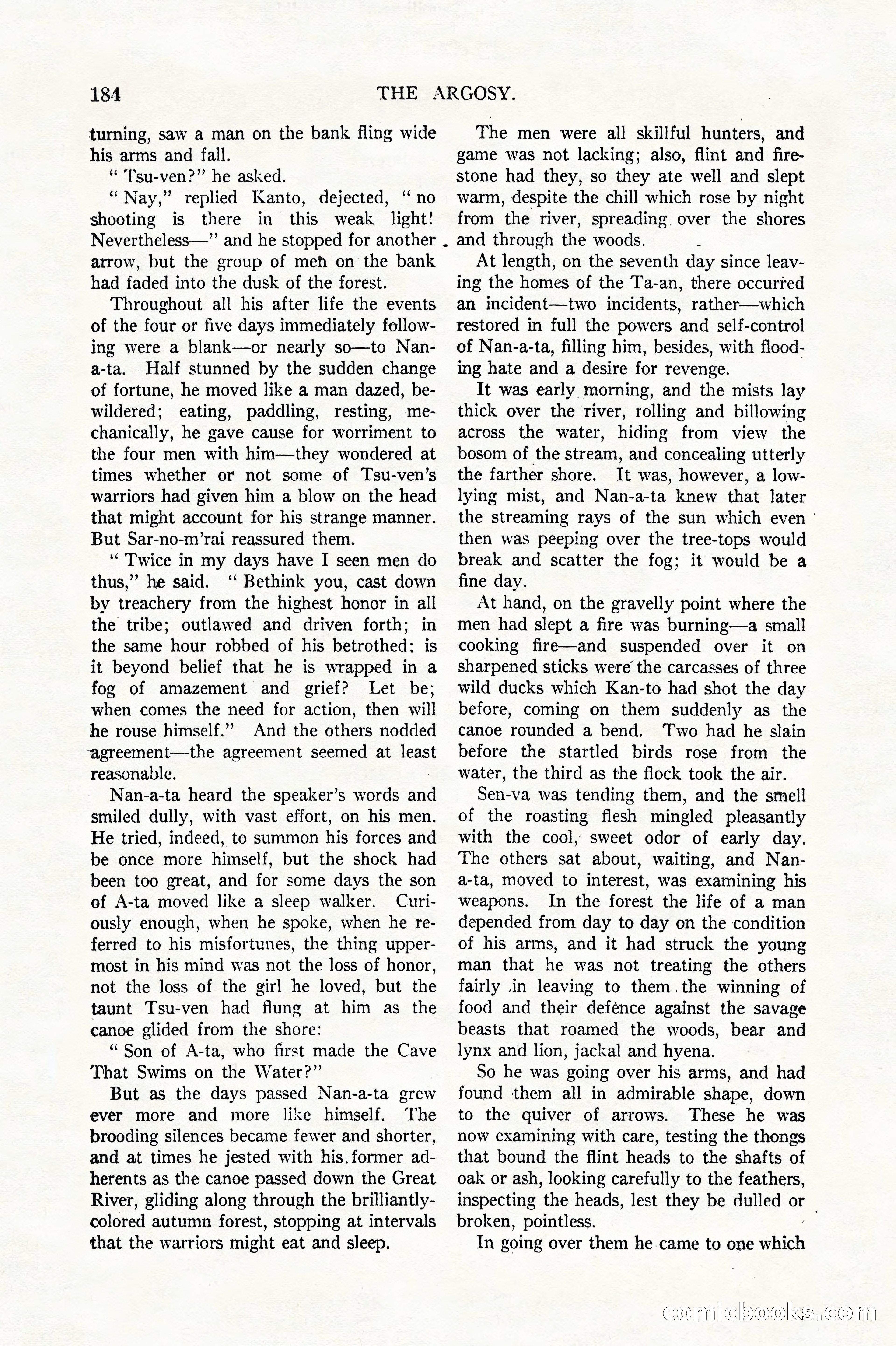
A restored page from Pulp Fiction, 1920. Page through the whole issue in the reader above.
📄 Transcribed text from this page (OCR, searchable)
Machine-transcribed from the original scan — historical spelling and the odd misread are preserved.
184 THE turning, saw a man on the bank fling wide his arms and fall. ) “ Tsu-ven?” he asked. “Nay,” replied Kanto, dejected, “no shooting is there in this weak light! Nevertheless—” and he stopped for another arrow, but the group of meh on the bank had faded into the dusk of the forest. Throughout all his after life the events of the four or five days immediately follow- ing were a blank—or nearly so—to Nan- a-ta. - Half stunned by the sudden change of fortune, he moved like a man dazed, be- wildered; eating, paddling, resting, me- chanically, he gave cause for worriment to the four men with him—they wondered at times whether or not some of Tsu-ven’s warriors had given him a blow on the head that might account for his strange manner. But Sar-no-m/’rai reassured them. ‘‘ Twice in my days have I seen men do thus,” he said. ‘“ Bethink you, cast down by treachery from the highest honor in all the tribe; outlawed and driven forth; in the same hour robbed of his betrothed; is it beyond belief that he is wrapped in a fog of amazement and grief? Let be; when comes the need for action, then will he rouse himself.” And the others nodded “agreement—-the agreement seemed at least reasonable. Nan-a-ta heard the speaker’s words aa smiled dully, with vast effort, on his men. He tried, indeed, to summon Te forces and be once more himself, but the shock had been too great, and for some days the son of A-ta moved like a sleep walker. Curi- ously enough, when he spoke, when he re- ferred to his misfortunes, the thing upper- most in his mind was not the loss of honor, not the loss of the girl he loved, but the taunt Tsu-ven had flung at him as the canoe glided from the shore: ‘Son of A-ta, who first made the Cave That Swims on the Water?” But as the days passed Nan-a-ta grew ever more and more like himself. The brooding silences became fewer and shorter, and at times he jested with his.former ad- herents as the canoe passed down the Great River, gliding along through the brilliantly- colored autumn forest, stopping at intervals that the warriors might eat and sleep. ARGOSY. The men were all skillful hunters, and game was not lacking; also, flint and fire- stone had they, so they ate well and slept warm, despite the chill which rose by night from the river, spreading over the shores and through the woods. At length, on the seventh day since leav- ing the homes of the Ta-an, there occurred an incident—two incidents, rather—which restored in full the powers and self-control of Nan-a-ta, filling him, besides, with flood- ing hate and a desire for revenge. It was early morning, and the mists lay thick over the river, rolling and billowing across the water, hiding from view the bosom of the stream, and concealing utterly the farther shore. It was, however, a low- lying mist, and Nan-a-ta knew that later the streaming rays of the sun which even ° then was peeping over the tree-tops would break and scatter the fog; it would be a fine day. At hand, on the gravelly point where the men had slept a fire was burning—a small cooking fire—and suspended over it on sharpened sticks were’ the carcasses of three wild ducks which Kan-to had shot the day before, coming on them suddenly as the canoe rounded a bend. Two had he slain before the startled birds rose from the water, the third as the flock took the air. Sen-va was tending them, and the smell of the roasting flesh mingled pleasantly with the cool, sweet odor of early day. The others sat about, waiting, and Nan- a-ta, moved to interest, was examining his weapons. In the forest the life of a man depended from day to day on the condition of his arms, and it had struck the young man that he was not treating the others fairly in leaving to them. the winning of food and their defénce against the savage beasts that roamed the woods, bear and lynx and lion, jackal and hyena. So he was going over his arms, and had found them all in admirable shape, down to the quiver of arrows. These he was now examining with care, testing the thongs that bound the flint heads to the shafts of oak or ash, looking carefully to the feathers, inspecting the heads, lest they be dulled or — broken, pointless. In going over them he.came to one which MICLO© S C@