
Pulp Fiction, 1920 · page 29 of 158
Argosy, Vol. 123, No. 2 — page 29: what you’re looking at
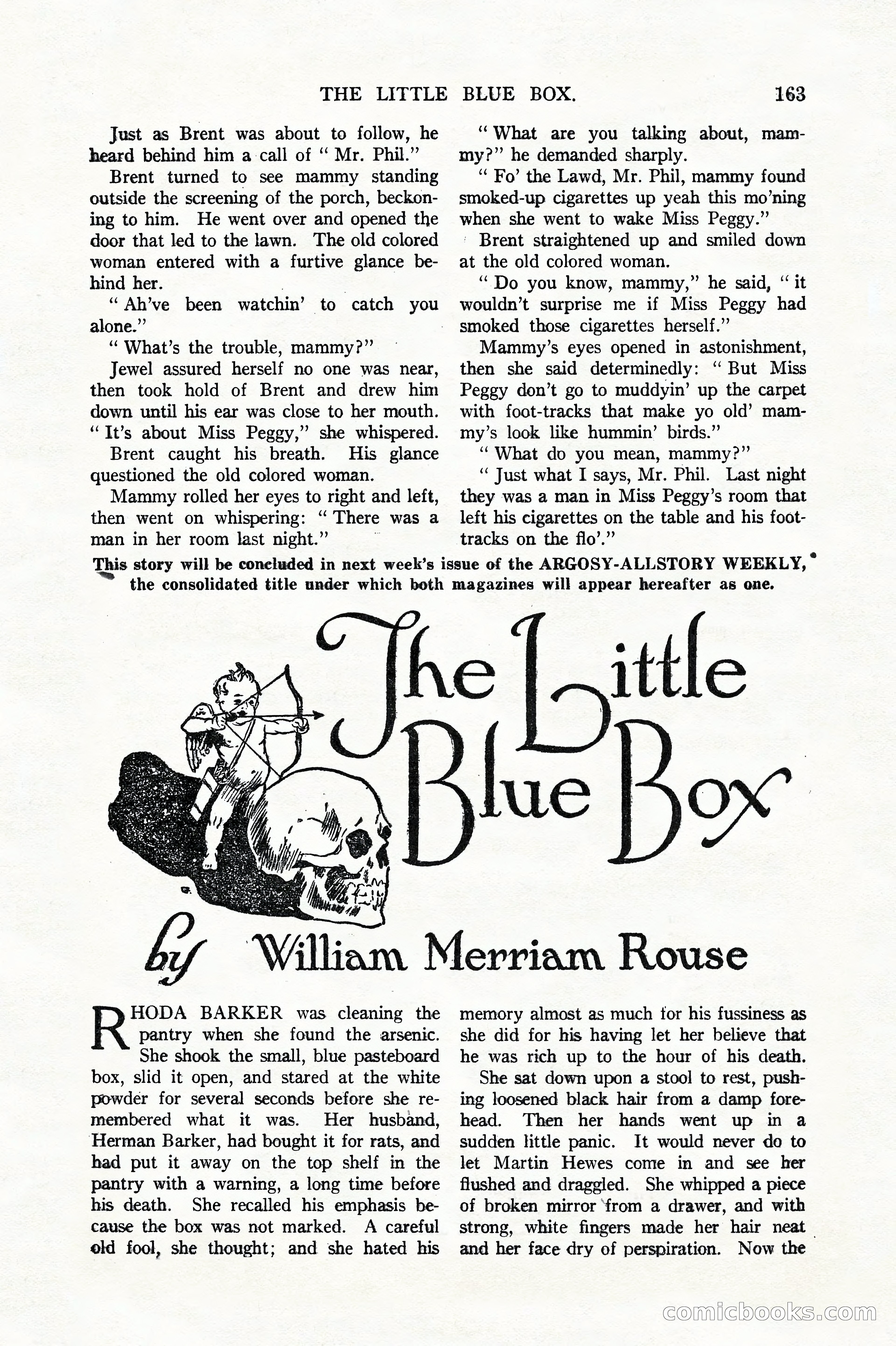
A restored page from Pulp Fiction, 1920. Page through the whole issue in the reader above.
📄 Transcribed text from this page (OCR, searchable)
Machine-transcribed from the original scan — historical spelling and the odd misread are preserved.
THE LITTLE BLUE BOX. Just as Brent was about to follow, he heard behind him a-call of ‘ Mr. Phil.” Brent turned to see mammy standing outside the screening of the porch, beckon- ing to him. He went over and opened the door that led to the lawn. The old colored woman entered with a furtive glance be- hind her. alone.” ‘“‘What’s the trouble, mammy?”’ Jewel assured herself no one was near, then took hold of Brent and drew him down until his ear was close to her mouth. “It’s about Miss Peggy,” she whispered. Brent caught his breath. His glance questioned the old colored woman. Mammy rolled her eyes to right and left, then went on whispering: “ There was a man in her room last night.” : This story will be concluded in next week’s issue of the ARGOSY-ALLSTORY WEEKLY, ~ the consolidated title under which both magazines will appear hereafter as one. “ Ah’ve been watchin’ to catch you 163 ‘““What are you talking about, mam- my?” he demanded sharply. ‘“ Fo’ the Lawd, Mr. Phil, mammy found smoked-up cigarettes up yeah this mo’ning when she went to wake Miss Peggy.” ' Brent straightened up and smiled down at the old colored woman. “Do you know, mammy,” he said, “ it wouldn’t surprise me if Miss Peggy had smoked those cigarettes herself.” Mammy’s eyes opened in astonishment, then she said determinedly: “ But Miss Peggy don’t go to muddyin’ up the carpet with foot-tracks that make yo old’ mam- my’s look like hummin’ birds.” “What do you mean, mammy?” “Just what I says, Mr. Phil. Last night they was a man in Miss Peggy’s room that left his cigarettes on the table and his foot- tracks on the flo’.” by -HODA BARKER was cleaning the pantry when she found the arsenic. She shook the small, blue pasteboard box, slid it open, and stared at the white powder for several seconds before she re- membered what it was. Her husband, ‘Herman Barker, had bought it for rats, and had put it away on the top shelf in the pantry with a warning, a long time before his death. She recalled his emphasis be- cause the box was not marked. A careful old fool, she thought; and she hated his William Merriam Rouse memory almost as much for his fussiness as she did for his having let her believe that he was rich up to the hour of his death. She sat down upon a stool to rest, push- ing loosened black hair from a damp fore- head. Then her hands went up in a sudden little panic. It would never do to let Martin Hewes come in and see her flushed and draggled. She whipped a piece of broken mirror ‘from a drawer, and with strong, white fingers made her hair neat and her face dry of perspiration. Now the COMIGDOO S C@