
Pulp Fiction, 1920 · page 147 of 158
Argosy, Vol. 123, No. 2 — page 147: what you’re looking at
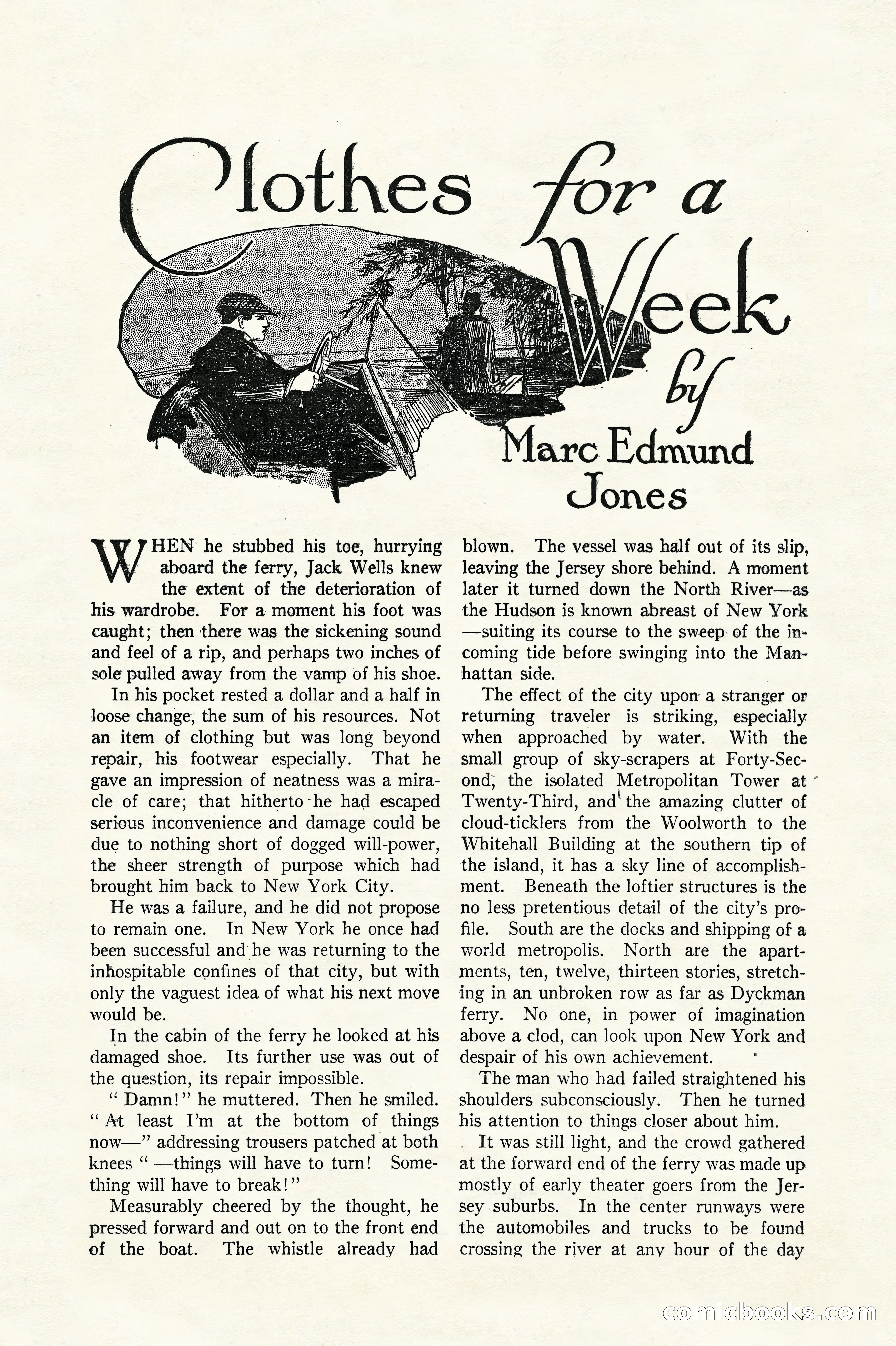
A restored page from Pulp Fiction, 1920. Page through the whole issue in the reader above.
📄 Transcribed text from this page (OCR, searchable)
Machine-transcribed from the original scan — historical spelling and the odd misread are preserved.
HEN he stubbed his toe, hurrying aboard the ferry, Jack Wells knew the extent of the deterioration of his wardrobe. For a moment his foot was caught; then there was the sickening sound and feel of a rip, and perhaps two inches of sole pulled away from the vamp of his shoe. In his pocket rested a dollar and a half in loose change, the sum of his resources. Not an item of clothing but was long beyond repair, his footwear especially. That he gave an impression of neatness was a mira- cle of care; that hitherto-he had escaped serious inconvenience and damage could be due to nothing short of dogged will-power, the sheer strength of purpose which had brought him back to New York City. He was a failure, and he did not propose to remain one. In New York he once had been successful and he was returning to the inhospitable confines of that city, but with only the vaguest idea of what his next move would be. In the cabin of the ferry he looked at his damaged shoe. Its further use was out of the question, its repair impossible. ‘“ Damn!” he muttered. Then he smiled. “At least I’m at the bottom of things now—” addressing trousers patched at both knees ‘‘ —things will have to turn! Some- thing will have to break!” Measurably cheered by the thought, he pressed forward and out on to the front end of the boat. The whistle already had darc Edmund Jones blown. The vessel was half out of its slip, leaving the Jersey shore behind. A moment later it turned down the North River—as the Hudson is known abreast of New York —suiting its course to the sweep of the in- coming tide before swinging into the Man- hattan side. | The effect of the city upon a stranger or returning traveler is striking, especially when approached by water. With the small group of sky-serapers at Forty-Sec- ond; the isolated Metropolitan Tower at Twenty-Third, and’ the amazing clutter of cloud-ticklers from the Woolworth to the Whitehall Building at the southern tip of the island, it has a sky line of accomplish- ment. Beneath the loftier structures is the no less pretentious detail of the city’s pro- file. South are the docks and shipping of a world metropolis. North are the apart- ments, ten, twelve, thirteen stories, stretch- ing in an unbroken row as far as Dyckman ferry. No one, in power of imagination above a clod, can look upon New York and despair of his own achievement. : The man who had failed straightened his shoulders subconsciously. Then he turned his attention to things closer about him. It was still light, and the crowd gathered at the forward end of the ferry was made up mostly of early theater goers from the Jer- sey suburbs. In the center runways were the automobiles and trucks to be found crossing the river at any hour of the day MICLO© % SS ©