
Pulp Fiction, 1920 · page 109 of 158
Argosy, Vol. 123, No. 2 — page 109: what you’re looking at
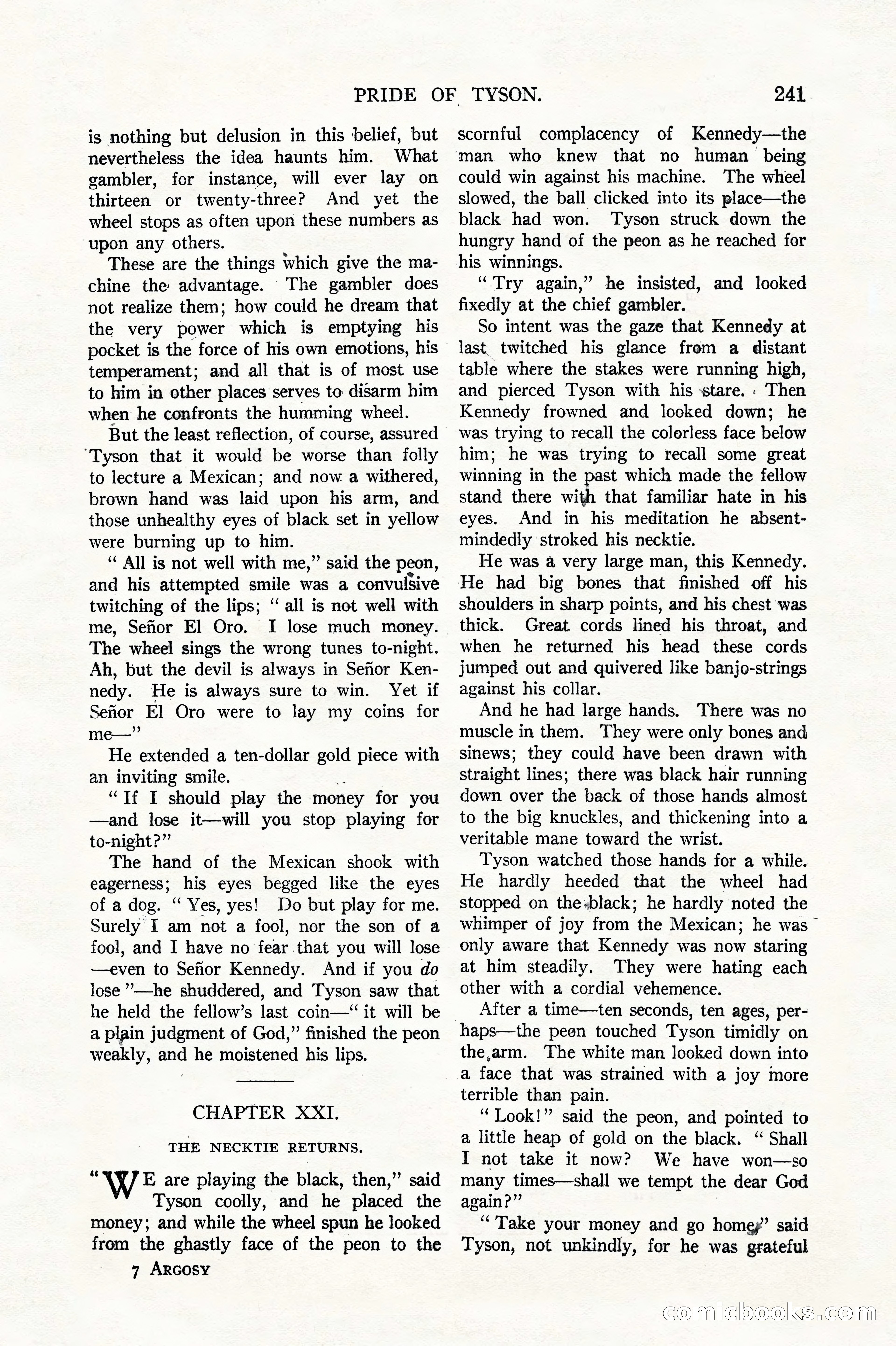
A restored page from Pulp Fiction, 1920. Page through the whole issue in the reader above.
📄 Transcribed text from this page (OCR, searchable)
Machine-transcribed from the original scan — historical spelling and the odd misread are preserved.
PRIDE OF TYSON. is nothing but delusion in this belief, but nevertheless the idea haunts him. What gambler, for instance, will ever lay on thirteen or twenty-three? And yet the wheel stops as often upon these numbers as upon any others. These are the things which give the ma- chine the advantage. The paniiler does not realize them; how could he dream that the very power which is emptying his pocket is the force of his own emotions, his © temperament, and all that is of most use to him in other places serves to disarm him when he confronts the humming wheel. But the least reflection, of course, assured ‘Tyson that it would be worse than folly to lecture a Mexican; and now a withered, brown hand was laid upon his arm, and those unhealthy eyes of black set in yellow were burning up to him. ‘ All is not well with me,” said the peon, and his attempted smile was a convulsive twitching of the lips; ‘all is not well with me, Sefor El Oro. The wheel sings the wrong tunes to-night. Ah, but the devil is always in Senor Ken- nedy. He is always sure to win. Yet if Sefior El Oro were to lay my coins for me—’”’ He extended a ten-dollar gold piece with an inviting smile. “Tf I should play the money for you —and lose it—will you stop playing for to-night?” The hand of the Mexican shook with eagerness; his eyes begged like the eyes of a dog. “ Yes, yes! Do but play for me. Surely I am not a fool, nor the son of a fool, and I have no fear that you will lose —even to Sefior Kennedy. And if you do lose ”—he shuddered, and Tyson saw that he held the fellow’s last coin—‘ it will be a plain judgment of God,” finished the peon weakly, and he moistened his lips. CHAPTER XXI., THE NECKTIE RETURNS. “WE are playing the black, then,” said Tyson coolly, and he placed the money; and while the wheel spun he looked from the ghastly face of the peon to the 7 ARGOSY I lose much money. . scornful complacency of Kennedy—the ‘man who knew that no human being could win against his machine. The wheel slowed, the ball clicked into its place—the black had won. Tyson struck down the hungry hand of the peon as he reached for his winnings. “Try again,” he insisted, and looked fixedly at the chief gambler. So intent was the gaze that Kennedy at last. twitched his glance from a distant table where the stakes were running high, and pierced Tyson with his stare. : Then Kennedy frowned and looked down; he was trying to recall the colorless face below him; he was trying to recall some great winning in the past which made the fellow stand there with that familiar hate in his eyes. And in his meditation he absent- mindedly stroked his necktie. He was a very large man, this Kennedy. He had big bones that finished off his shoulders in sharp points, and his chest was thick. Great cords lined his throat, and when he returned his. head these cords jumped out and quivered like banjo-strings against his collar. And he had large hands. There was no muscle in them. They were only bones and sinews; they could have been drawn with straight lines; there was black hair running down over the back of those hands almost to the big knuckles, and thickening into a veritable mane toward the wrist. Tyson watched those hands for a while. He hardly heeded that the wheel had stopped on the-black; he hardly noted the whimper of joy from the Mexican; he was only aware that Kennedy was now staring at him steadily. They were hating each other with a cordial vehemence. After a time—ten seconds, ten ages, per- haps—the peen touched Tyson timidly on the,arm. The white man looked down into _.a face that was strained with a joy more terrible than pain. “Look!” said the peon, and pointed to a little heap of gold on the black. ‘ Shall I not take it now? We have won—so many times—shall we tempt the dear God again?” ‘Take your money and go homey’ said Tyson, not unkindly, for he was grateful Co DOO) mn SS 241. C@