
Pulp Fiction, 1920 · page 80 of 156
Argosy, Vol. 123, No. 1 — page 80: what you’re looking at
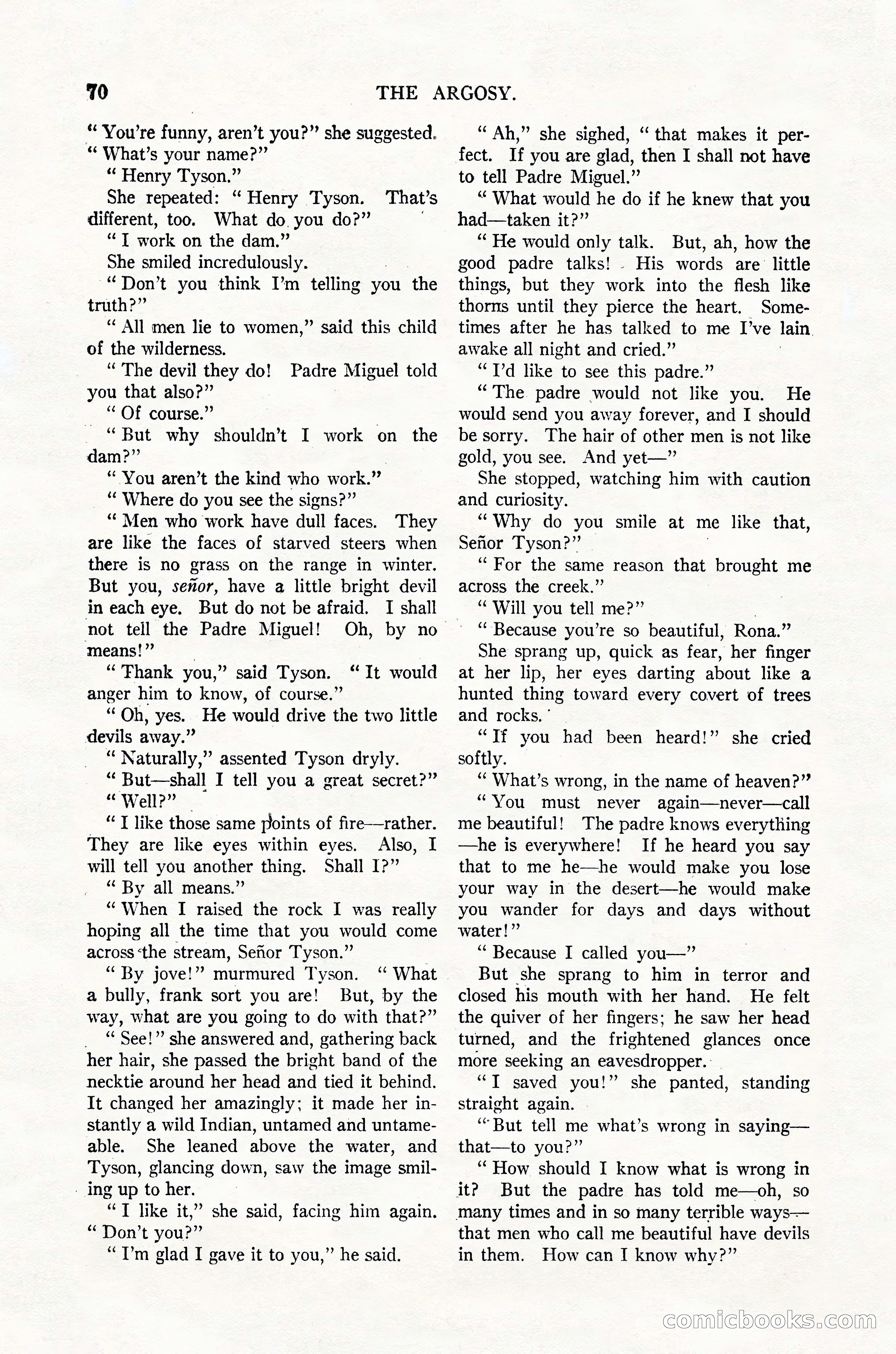
A restored page from Pulp Fiction, 1920. Page through the whole issue in the reader above.
📄 Transcribed text from this page (OCR, searchable)
Machine-transcribed from the original scan — historical spelling and the odd misread are preserved.
10 “ You're funny, aren’t you?” she suggested. “* What’s your name?” “Henry Tyson.” She repeated: “ Henry Tyson. different, too. What do, you do?” “TI work on the dam.” She smiled incredulously. “Don’t you think I’m telling you ‘the truth?” “ All men lie to women,” said this child of the wilderness. ‘The devil they do! you that also?” ‘‘ Of course.” 3 “But why shouldn’t I work on the dam?” 3 ‘You aren’t the kind who work.” _ “ Where do you see the signs?” *“* Men who work have dull faces. They are like the faces of starved steers when there is no grass on the range in winter. But you, senor, have a little bright devil in each eye. But do not be afraid. I shall That’s Padre Miguel told not tell the Padre Miguel! Oh, by no — means!” | “"Fhank you,” said Tyson. ‘“ It would anger him to know, of course.” “Oh, yes. He would drive the two little devils away.” “ Naturally,” assented Tyson dryly. “ But—shall I tell you a great secret?” “Well?” — “T like those same points of fire—rather. They are like eyes within eyes. Also, I will tell you another thing. Shall I?” “‘ By all means.” “When I raised the rock I was really hoping all the time that you would come across ‘the stream, Senor Tyson.” ‘““ By jove!” murmured Tyson. a bully, frank sort you are! But, by the way, what are you going to do with that?” _ “See!” she answered and, gathering back her hair, she passed the bright band of the necktie around her head and tied it behind. It changed her amazingly; it made her in- stantly a wild Indian, untamed and untame- able. She leaned above the water, and Tyson, glancing down, saw the image smil- - ing up to her. “T like it,” she said, facing him again. “ Don’t you?” “Tm glad I gave it to you,” he said. fect. ““ What - it? many times and in so many terrible ways— THE ARGOSY. ‘““ Ah,” she sighed, “ that makes it per- If you are glad, then I shall not have to tell Padre Miguel.” “What would he do if he knew that you had—taken it?” “He would only talk. But, ah, how the good padre talks! . His words are little things, but they work into the flesh like thorns until they pierce the heart. Some- times after he has talked to me I’ve Jain awake all night and cried.” “Td like to see this padre.” “The padre would not like you. He would send you away forever, and I should be sorry. The hair of other men is not like gold, you see. And yet—” She stopped, watching him with caution and curiosity. “Why do you smile at me like that, Sefior Tyson?” - “For the same reason that brought me across the creek.” “Will you tell me?” “Because you’re so beautiful, Rona.” She sprang up, quick as fear, her finger at her lip, her eyes darting about like a hunted thing toward every covert of trees and rocks. ’ “Tf you had been heard!” she cried softly. ‘“‘ What’s wrong, in the name of heaven?” “You must never again—never—call me beautiful! The padre knows everything —he is everywhere! If he heard you say that to me he—he would make you lose your way in the desert—he would make you wander for days and days without water!” ‘* Because I called you—” But she sprang to him in terror and closed his mouth with her hand. He felt the quiver of her fingers; he saw her head turned, and the frightened glances once more seeking an eavesdropper. ' ““T saved you!” she panted, standing straight again. “But tell me what’s wrong in saying— that—to you?” ‘How should I know what is wrong in But the padre has told me—oh, so that men who call me beautiful have devils in them. How can I know why?” cComiclbool C©