
Pulp Fiction, 1920 · page 66 of 156
Argosy, Vol. 123, No. 1 — page 66: what you’re looking at
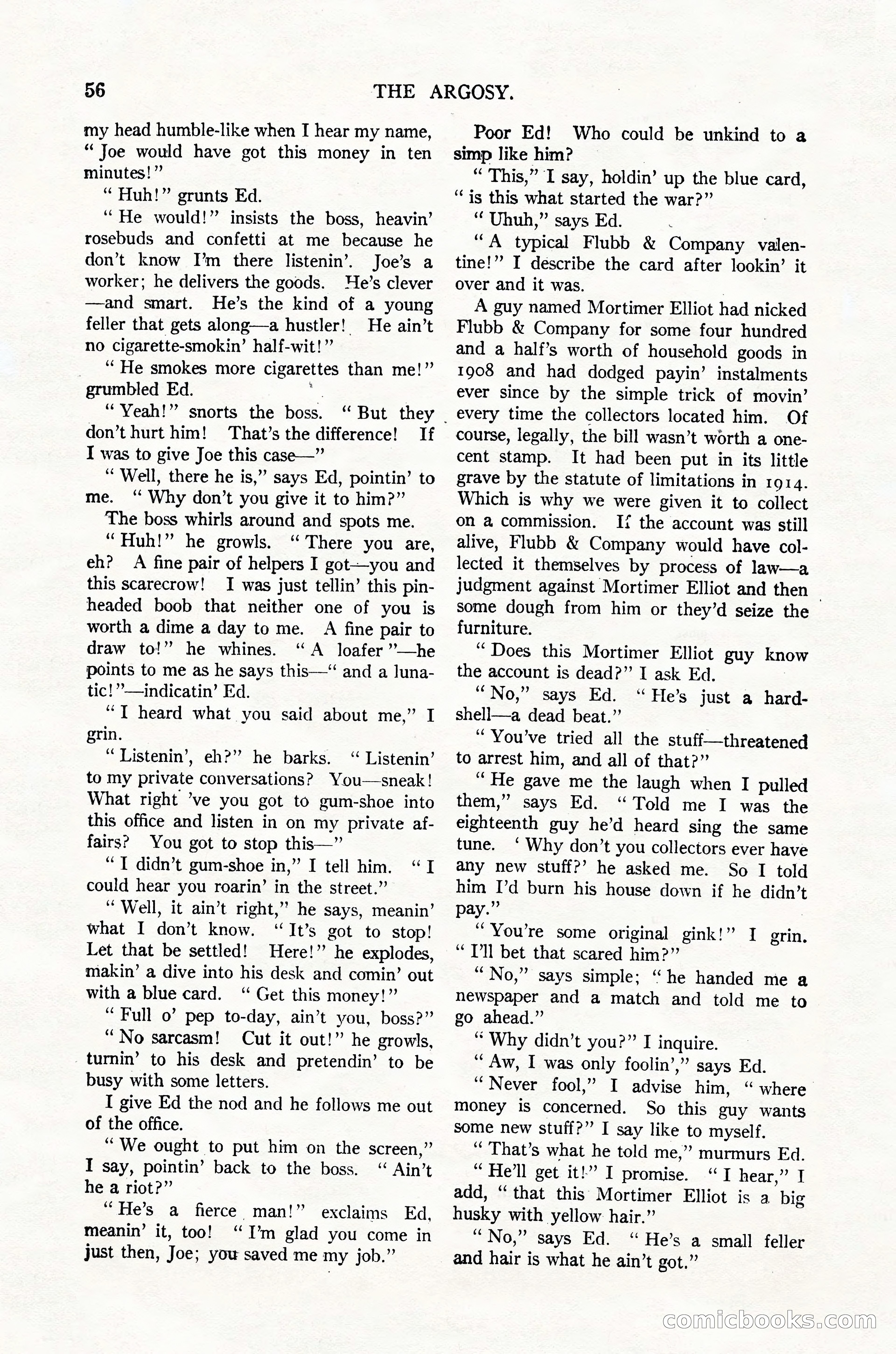
A restored page from Pulp Fiction, 1920. Page through the whole issue in the reader above.
📄 Transcribed text from this page (OCR, searchable)
Machine-transcribed from the original scan — historical spelling and the odd misread are preserved.
56 my head humble-like when I hear my name, “Joe would have got this money in ten minutes!” “ Huh!” grunts Ed. ‘“He would!” insists the boss, heavin’ rosebuds and confetti at me because he don’t know I’m there listenin’. Joe’s a worker; he delivers the goods. He’s clever —and smart. He’s the kind of a young feller that gets along—a hustler! He ain’t no cigarette-smokin’ half-wit!” ‘“He smokes more cigarettes than me!” grumbled Ed. “Yeah!” snorts the boss. “But they don’t hurt him! That’s the difference! If I was to give Joe this case—” ‘ Well, there he is,” says Ed, pointin’ to me. ‘ Why don’t you give it to him?” The boss whirls around and spots me. “Huh!” he growls. ‘“ There you are, eh? A fine pair of helpers I got—you and this scarecrow! I was just tellin’ this pin- headed boob that neither one of you is worth a dime a day to me. A fine pair to draw to!” he whines. “A loafer ”’—he points to me as he says this—“ and a luna- tic!”’—indicatin’ Ed. “I heard what you said about me,” I grin. ‘Listenin’, eh?” he barks. “ Listenin’ to my private conversations? You—sneak! What right ’ve you got to gum-shoe into this office and listen in on my private af- fairs? You got to stop this—” “I didn’t gum-shoe in,” I tell him. could hear you roarin’ in the street.” “Well, it ain’t right,’’ he says, meanin’ what I don’t know. “It’s got to stop! Let that be settled! Here!” he explodes, makin’ a dive into his desk and comin’ out with a blue card. “ Get this money!” “Full o’ pep to-day, ain’t you, boss?” “No sarcasm! Cut it out!” he growls, turnin’ to his desk and pretendin’ to be busy with some letters. I give Ed the nod and he follows me out of the office. “We ought to put him on the screen,” I say, pointin’ back to the boss. “ Ain't he a riot?” “He’s a fierce man!” exclaims Ed, meanin’ it, too! “Dm glad you come in Just then, la you saved me my Job.” eT THE ARGOSY. Poor Ed! simp like him? “ This,” I say, holdin’ up the blue card, ‘is this what started the war?” ‘“Uhuh,” says Ed. : “A Epic Flubb & Company valen- tine!”” I describe the card after lookin’ it over and it was. | A guy named Mortimer Elliot had nicked Flubb & Company for some four hundred and a half’s worth of household goods in 1908 and had dodged payin’ instalments ever since by the simple trick of movin’ Who could be unkind to a _ every time the collectors located him. Of course, legally, the bill wasn’t worth a one- cent stamp. It had been put in its little grave by the statute of limitations in 1914. Which is why we were given it to collect on a commission. If the account was still alive, Flubb & Company would have col- lected it themselves by process of law—a judgment against Mortimer Elliot and then some dough from him or they’d seize the furniture. “ Does this Mortimer Elliot guy know the account is dead?” I ask Ed. “No,” says Ed. “ He’s just a hard- shell—a dead beat.”’ 3 “You've tried all the stuff—threatened to arrest him, and all of that?” ‘“ He gave me the laugh when I pulled them,” says Ed. “Told me I was the eighteenth guy he’d heard sing the same tune. ‘Why don’t you collectors ever have any new stuff?’ he asked me. So I told him I’d burn his house down if he didn’t pay. 93 “You're some original gink!” I grin. “Pll bet that scared him?” “No,” says simple; “he handed me a hewspaper and a match and told me to go ahead.” * Why didn’t you?” I inquire. * Aw, I was only foolin’,” says ec, “Never fool,” I advise him, money is concerned. So this guy wants some new stuff?” I say like to myself. ‘ That’s what he told me,” murmurs Ed. He'll get it!” I promise. “I hear,” I add, ‘“‘ that this Mortimer Elliot is a big husky with yellow: hair.” “No,” says Ed. “ He’s a small feller and hair is what he ain’t got.” comiclboool ‘““ where C@