
Pulp Fiction, 1920 · page 63 of 156
Argosy, Vol. 123, No. 1 — page 63: what you’re looking at
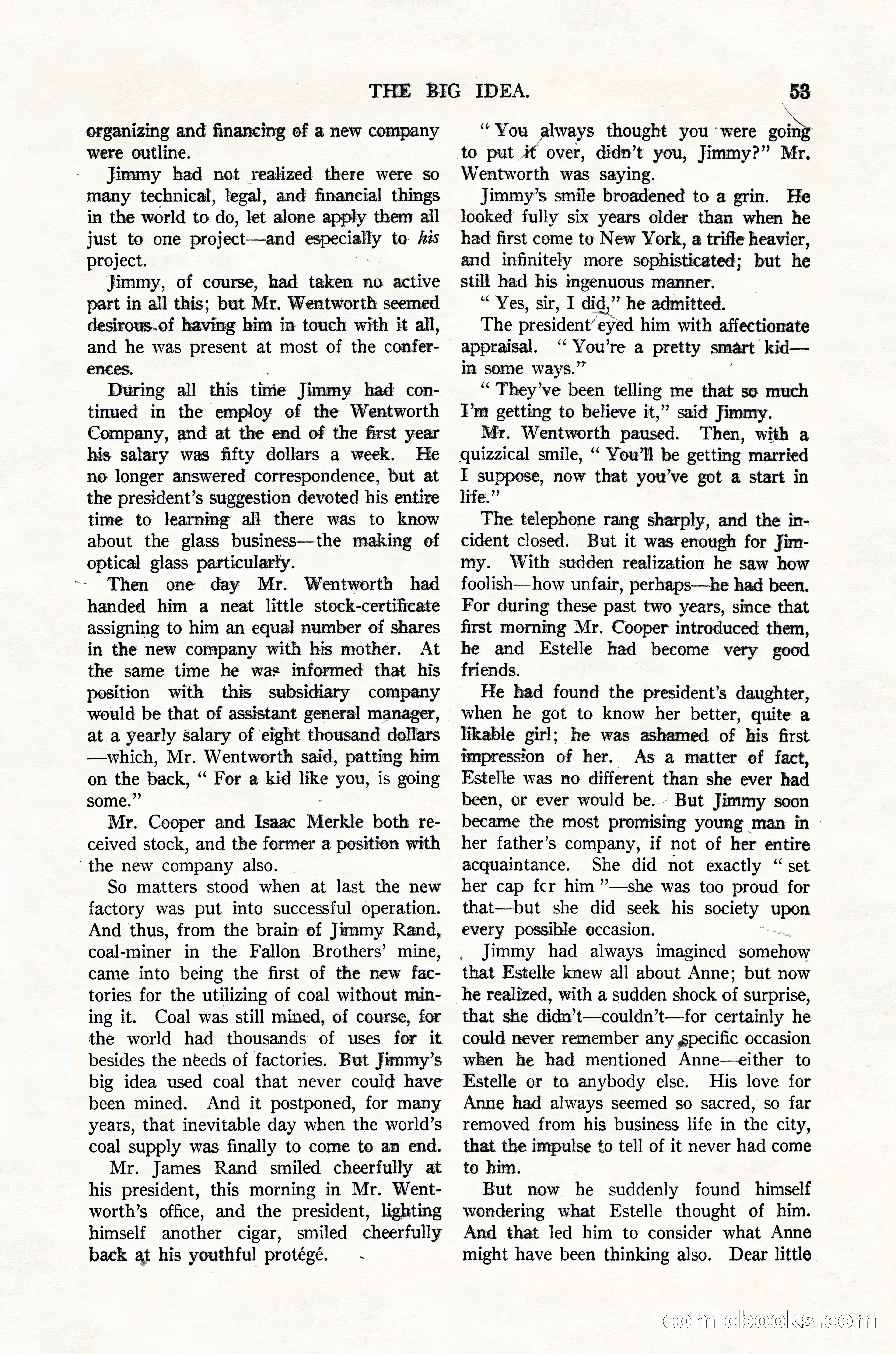
A restored page from Pulp Fiction, 1920. Page through the whole issue in the reader above.
📄 Transcribed text from this page (OCR, searchable)
Machine-transcribed from the original scan — historical spelling and the odd misread are preserved.
THE BIG IDEA. organizing and financing of a new company were outline. Jimmy had not realized there were so many technical, legal, and financial things in the world to do, let alone apply them all just to one project—and Specially to his project. Jimmy, of course, had taken no active part in all this; but Mr. Wentworth seemed desirous.of having him in touch with it all, and he was present at most of the confer- ences, During all this time Jimmy had con- tinued in the employ of the Wentworth Company, and at the end of the first year his. salary was fifty dollars a week. He no longer answered correspondence, but at the president’s suggestion devoted his entire time to learning all there was to know about the glass business—the making of optical glass particularly. ~ Then one day Mr. Wentworth had handed him a neat little stock-certificate assigning to him an equal number of shares in the new company with his mother. At the same time he was informed that his position with this subsidiary company would be that of assistant general manager, » at a yearly Salary of eight thousand dollars —which, Mr. Wentworth said, patting him on me back, “‘ For a kid like you, is going some.’ Mr. Cooper and Isaac Merkle both re- ceived stock, and the former a position with ‘the new company also. So matters stood when at last the new factory was put into successful operation. And thus, from the brain ef Jimmy Rand, coal-miner in the Fallon Brothers’ mine, came into being the first of the new fac- tories for the utilizing of coal without min- ing it. Coal was still mined, of course, for the world had thousands of uses for it besides the needs of factories. But Jimmy’s big idea used coal that never could have been mined. And it postponed, for many years, that inevitable day when the world’s coal supply was finally to come te an end. Mr. James Rand smiled cheerfully at his president, this morning in Mr. Went- worth’s office, and the president, lighting himself another cigar, smiled cheerfully back at his youthful protégé. Estelle or to anybody else. 53 “You always thought you ‘were cee to put if over, didn’t you, Jimmy?” Mr. Wentworth was saying. Jimmy’s smile broadened to a grin. He looked fully six years older than when he had first come to New York, a trifle heavier, and infinitely more sophisticated; but he still had his ingenuous manner. “Yes, sir, I did,” he admitted. The president’ eyed him with affectionate appraisal. a aoe re a pretty smart kid— in some ways.” “ They’ve been telling me that so much I’m getting to believe it, ” said Jimmy. Mr. Wentworth paused. Then, with a quizzical smile, “ You'll be getting married I suppose, now that you’ve got a start in life.” The telephone rang sharply, and the in- cident closed. But it was enough for Jim- my. With sudden realization he saw how foolish—how unfair, perhaps—he had been. For during these past two years, since that first morning Mr. Cooper introduced them, he and Estelle had become very good friends. He had found the president’s daughter, when he got to know her better, quite a likable girl; he was ashamed of his first mmpression of her. As a matter of fact, Estelle was no different than she ever had been, or ever would be... But Jimmy soon became the most promising young man in | her father’s company, if not of her entire acquaintance. She did not exactly “ set her cap fcr him ’’—she was too proud for that—but she did seek his society sipen every possible occasion. Jimmy had always imagined sonehee that Estelle knew all about Anne; but now he realized, with a sudden shock of surprise, that she didn’t—couldn’t—for certainly he could never remember any gpecific occasion when he had mentioned Anne—either to His love for Anne had always seemed so sacred, so far removed from his business life in the city, that the impulse to tell of it never had come to him. But now he suddenly found himself wondering what Estelle thought of him. And that led him to consider what Anne might have been thinking also. Dear little COMICLO© S C@